
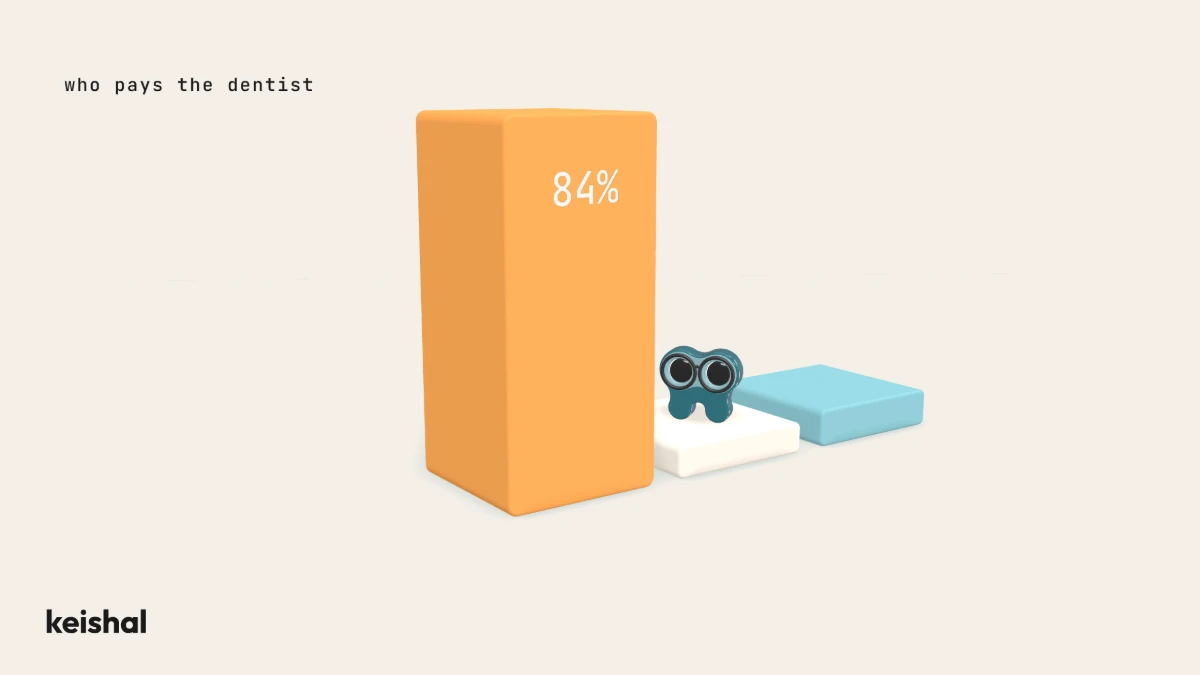
The Portugal dental market is private and fee-for-service. In 2024, 84% of the €1,240.6 million spent at dental practices came straight from patients (OECD). The public layers still pay per act: the cheque-dentista voucher pays €45 per episode and 91% are redeemed in private offices; ADSE and insurers pay from tables or networks. The public sector employs about 150 of 13,498 dentists. From 1 January 2027, PNPSO 2030 nearly doubles cheque eligibility.
The Portugal dental market is a private, fee-for-service market with a thin public layer on top. In 2024, €1,240.6 million was spent at dental practices in Portugal, and €1,042.5 million of it came straight from patients: 1,042.5 ÷ 1,240.6 = 84%. Even the state's own dental voucher, the cheque-dentista, is spent mostly in private clinics.
This is the map we would want if we were looking at Portugal from outside, as an investor, a vendor or a partner. It covers who pays a Portuguese dentist, how the clinic is paid in each channel, what changes on 1 January 2027, and what that means for the software and operations layer.
Keishal serves dental clinics in Spain and is researching Portugal. Every figure below comes from a primary source, named in the text and listed at the end. Where the arithmetic is ours, it is shown.
Who pays a Portuguese dentist
The OECD's health accounts split spending at dental practices by who paid. For 2024:
| Who paid (2024) | € million | Share |
|---|---|---|
| Patients, out of pocket | 1,042.5 | 84.0% |
| Voluntary health insurance | 90.9 | 7.3% |
| Government schemes | 107.3 | 8.6% |
| Total at dental practices | 1,240.6 | 100% |
The shares are ours: each line divided by the total. They add to 99.9% because of rounding.
Dental practices were 4.2% of Portugal's current health spending in 2024, by Eurostat's figures: 1,240.65 ÷ 29,568.97 = 4.2%. The OECD and European Observatory's 2025 country profile puts the reason plainly: most dental services are excluded from the national health service's benefits package.
Patients say the same thing. In the Ordem dos Médicos Dentistas' 2025 oral-health barometer (n=1,200), 71.8% pay the dentist directly at the visit, 15.8% through insurance or a health plan, and 6.6% through a public servants' health subsystem. 94.0% did not use the national health service (SNS) at their last visit.
The private sector is the market
The supply side matches the money. Portugal had 13,498 dentists with an active registration at the end of 2024, according to the Ordem. The public sector employs about 150, most of them as contracted service providers. A salaried dentist career inside the SNS was only created in August 2026. That is roughly 13,498 ÷ 150 ≈ 90 registered dentists for every public-sector one.
The SNS had 250 oral-health rooms in primary care at the end of 2025, and 98 of the 278 mainland municipalities had none. It saw 52,154 dental patients in primary care that year, according to the health regulator, the Entidade Reguladora da Saúde (ERS).
The private side is many small operators. The ERS registry counted 6,531 private oral-health establishments run by 4,949 operators in May 2024, so about 6,531 ÷ 4,949 ≈ 1.3 sites per operator. The two largest operators held 9% of the market in Greater Lisbon and 7% in the Porto metropolitan area, by the ERS's own measure, and concentration was low in every region. The largest group we found, OralMED, lists 64 clinics on its own site: about 1% of private sites (64 ÷ 6,531).
Geography matters too. 1,161 operators sit in the Porto metropolitan area and 1,040 in Greater Lisbon: 2,201 of 4,949, or about 44% of all operators in two metros.
How the clinic is paid, channel by channel
Every channel pays the clinic per act or per episode. None of them pays a fixed amount per patient or a salary. Four channels matter.
The private patient
The default. The patient pays the clinic for each treatment. Tickets are small and plans are where the value is: in the 2025 barometer, the average last treatment cost €136, but 64.4% of patients paid €50 or less. Cleanings and check-ups were 60.1% of last treatments. The money is in what the check-up leads to.
The cheque-dentista (the SNS voucher)
The public payer issues vouchers to eligible groups, and the patient redeems them with a dentist who has signed up. The clinic receives a fixed €45 per cheque used (€20 or €50 for oral-cancer diagnosis and biopsy), paid monthly within 30 days of validation, under Portaria 430/2023. Signing up is an open online contract, with no tender and no quota, and the patient chooses the dentist.
One cheque covers a whole episode of care. The Ordem's 2025 cheque report counts about 3.3 acts per cheque on average since 2008, so 45 ÷ 3.3 ≈ €13.6 per act. About 20% of the population was entitled to cheques in 2025, by WHO/Europe's estimate.
The ERS counted 767,746 cheques issued in 2025 and 492,112 used. That leaves 767,746 − 492,112 = 275,634 unused, about 36%. Of the cheques used, 91% were redeemed in private offices. At the standard value, the used cheques are worth about 492,112 × €45 ≈ €22.1 million: roughly 1.8% of the €1,240.6 million spent at dental practices. The cheque is a way into a clinic, not a revenue line. We have not established what else sits in the €107.3 million government line.
ADSE (the public servants' subsystem)
ADSE covered 1,352,461 beneficiaries at the end of 2025. The clinic bills ADSE per act from a fixed price table and collects a co-payment from the patient. In the table in force from 1 October 2026, a consultation pays €15.75 from ADSE plus €5.25 from the patient, €21 in total, up to four a year. Scaling pays the same, up to two a year. Acts outside the table can be billed privately, with a quote the patient accepts.
Private insurers
Insurers pay through networks at negotiated prices per act. In some products the insurer pays the clinic and the patient pays a co-payment (Médis Dental's conditions describe this). In others, the patient gets access to the network and pays the whole negotiated price (Multicare's "Acesso à Rede"). Either way, insurance rarely covers the full bill: 85.2% of insured respondents in the barometer said it didn't fully cover their last treatment.
Spain works the same way at the root: clinics paid per treatment, with coming back left to the patient. We mapped its software side in the dental software market in Spain.
Who decides when the patient comes back
The patient does. We found no recall obligation on private dentists in the cheque rules, the ADSE rules or the insurer conditions we read. Return timing is shaped only by cheque expiry and by annual caps in the ADSE and insurer tables.
The barometer shows what that produces. 26.0% of Portuguese people go to the dentist only in emergencies, and 26.2% never book a check-up. 68.1% went in the last 12 months, so 100 − 68.1 ≈ 32% didn't.
Loyalty is high, though. 71.6% have never changed dentist, or would only out of necessity, and 84.4% always see the same one. So the lapsed patient is usually still in one clinic's database. That is what makes recall and reactivation work, and also why they so often go undone: the list exists, and nobody has the hours to work it. We wrote about why dental recall fails, even with recall software.
What PNPSO 2030 changes on 1 January 2027
Portugal's new national oral-health programme, PNPSO 2030, takes full effect on 1 January 2027. The Government's note of 20 March 2026 and the ERS's May 2026 study describe four changes:
- Eligibility for cheques rises from about 850,000 to about 1.6 million people: 1.6 ÷ 0.85 ≈ 1.9 times.
- A new prosthesis voucher, the cheque-prótese.
- Cheques move into the SNS 24 app.
- Private providers join a national oral-health network (Rede Nacional de Saúde Oral) as convention providers.
What we could not establish is as important. We could not read the payment terms for convention providers in the new network: the implementing regulation's text did not open for us. Nor have we seen the cheque-prótese's values and criteria. Those terms decide whether 2027 adds a contract layer to a market that today pays per act.
For an investor, the safe reading is this. More cheques mean more families walking into private clinics at about €13.6 per act. Whether they stay is the open question: in the Ordem's cheque survey, only 20.3% of cheque users stayed with that dentist (n=321). We don't project cheque volumes from eligibility: people entitled and cheques used are different numbers.
The software layer: local, certified, fragmented
No regulator, professional body or analyst publishes market shares for Portuguese dental practice software. The best-known system is NewSoft DS, from Imaginasoft. The vendor says on its own site that it is used in more than 2,000 clinics in Portugal. Against 6,531 private sites, that would be about 2,000 ÷ 6,531 ≈ 31%: a vendor's claim, not a measured share. The rest is a long tail of small Portuguese vendors, some installed on the clinic's own server and some in the cloud.
One reason the layer is local is invoicing. Under Decreto-Lei 28/2019, a business that invoices with software uses a program certified in advance by the tax authority. Certified programs carry a Portuguese signature chain and a SAF-T (PT) export, and every invoice carries an ATCUD code and a QR code. Our reading: that raises the cost of entry for a foreign practice system, and a Spanish vendor's tax work doesn't carry over. Of the practice systems Keishal connects to in Spain, only one had announced Portuguese certification when we checked in October 2026.
The communication tools sit inside that layer. Portuguese vendors, the largest included, sell SMS reminder packs and WhatsApp add-ons, by their own descriptions. What we did not find in Portugal is anyone operating the follow-up for the clinic: deciding who to contact, holding the conversation and writing the result back. That is an absence in our research, not a verified fact.
The front desk: phone-first, in a WhatsApp country
Portuguese patients phone. In the 2025 barometer, 65.3% book by phone and 23.5% book the next visit at the end of the appointment. Only 1.8% book online, through social networks, WhatsApp or a website.
Yet WhatsApp is everywhere. 79% of online adults used it in the week before the Reuters Institute's 2026 survey, the most-used network in the country. Clinics publish WhatsApp numbers for bookings, mostly answered by staff in office hours.
The gap shows in no-shows. Only 48.6% of patients always warn the clinic when they cancel or will be late, 17.7 points fewer than in 2024. What a missed appointment costs, and what a reminder recovers, is in dental appointment reminders: what a no-show costs.
So the reach for outbound messages (reminders, confirmations, reactivation) is already there. Inbound contact is still the telephone.
What this means for a system that operates the admin side
This is our reading, as a company that operates patient communication for clinics in Spain.
- The core economics travel. The money is the patient's own and paid per act, so a dormant patient is lost revenue, as in Spain. The tickets are smaller, so the arithmetic belongs on the treatment a check-up leads to, not on the check-up fee.
- Third-party patients pay less per act. ADSE and insurer patients still bring revenue, at table or network prices. An ADSE consultation totals €21. Modelling them at private prices overstates the value.
- The cheque is an acquisition channel. At €45 per episode it pays little, but it brings families in, and from 2027 it reaches about 1.9 times as many people.
- The practice system is an integration programme. The leader publishes no API that we found. Working on top of it means a connector on the clinic's server or a partnership, and the vendor sells overlapping reminder features.
- Regulation needs local advice first. Health advertising rules, direct-marketing consent and secrecy obligations have Portuguese specifics. What a reactivation message must contain in Portugal is a question for Portuguese counsel, and we are treating it as one before anything goes out.
Software a clinic has to operate meets the same shortage of hours in Porto as anywhere else. Paying for completed work instead of seats is the argument in service-as-a-software in dental practices.
Keishal today serves dental clinics in Spain. We are researching Portugal, and we don't connect to any Portuguese practice system yet.
What this map doesn't tell you
It gives no total market size beyond the OECD's spending at dental practices. Wider estimates exist, but we couldn't verify them, so we don't use them.
It gives no practice-software shares, because nobody publishes them, and no count of insured people. It doesn't cover the Azores and Madeira, which run their own schemes, and it can't yet say how convention providers will be paid from 2027.
If you are an investor or a partner looking at southern European dentistry, we're happy to walk you through what we see. You can reach us at keishal.com.
Sources: OECD Health Statistics, System of Health Accounts, Portugal, dental practices by financing scheme (2024); Eurostat, health care expenditure by provider (updated October 2026); OECD and European Observatory, State of Health in the EU, Country Health Profile 2025: Portugal; Ordem dos Médicos Dentistas, Barómetro da Saúde Oral 2025, Os Números da Ordem 2025 and Relatório sobre o Cheque-Dentista 2025; Portaria 430/2023; ERS, Acesso a Cuidados de Saúde Oral no SNS (May 2026) and Concorrência nos mercados de saúde oral (May 2024); WHO/Europe, financial protection in Portugal (2025); Government of Portugal, notes of 20 March and 11 August 2026; ADSE, activity report 2025 and price table in force 1 October 2026; Médis Dental and Multicare product conditions; Reuters Institute Digital News Report 2026, Portugal; Decreto-Lei 28/2019, Portarias 363/2010 and 195/2020; vendor sites as cited. Last updated November 2026.
WhatsApp for dental clinics: everyone is on it, almost nobody books through it
WhatsApp for dental clinics in southern Europe has reach but little use. In Portugal, 79% of online adults used WhatsApp in the past week (Reuters Institute, 2026), yet 65.3% of patients book by phone and only 1.8% book online through social networks, WhatsApp or a website (OMD Barómetro 2025). The bottleneck is who operates the line: usually one person, in office hours, about 32% of the week.
Dental practice management software integration: read for context, write back the outcome
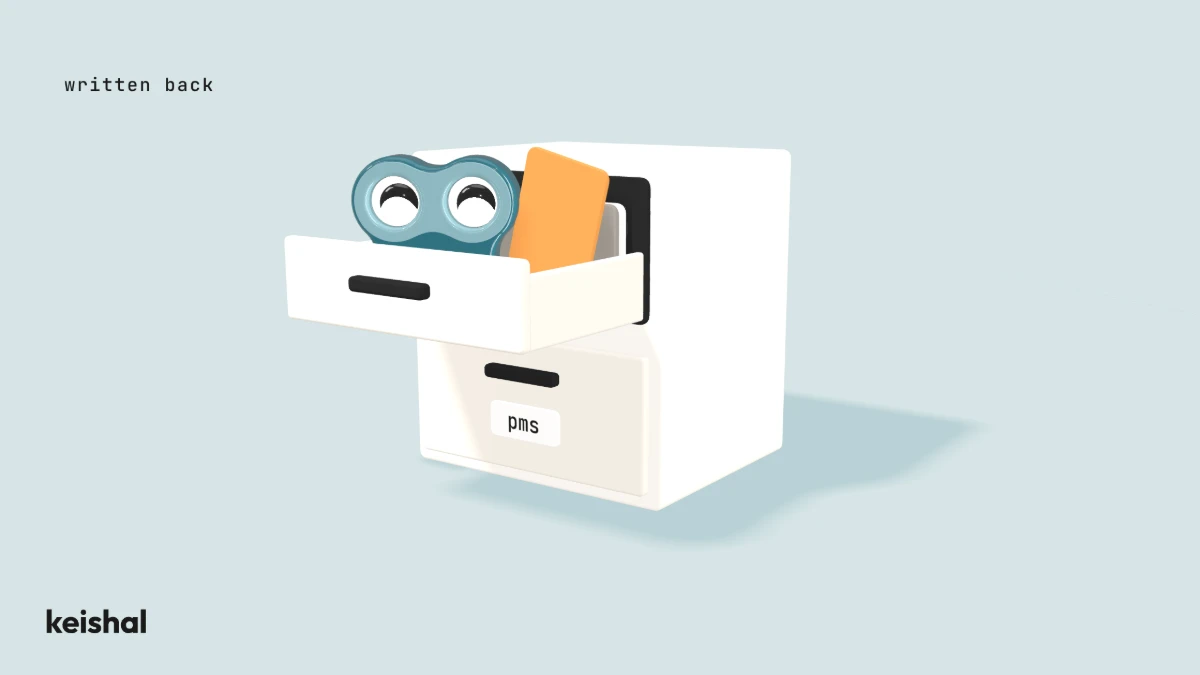
Dental practice management software integration, for a system that talks to patients, means two directions: read the practice system for context (agenda, contact details, last visit, do-not-contact flags) and write the outcome back (appointments, statuses, documents). Without write-back, every outcome is re-keyed by hand: 150 changes a month at 2 minutes is 5 hours in an illustrative clinic. In a fragmented PMS market like Spain's, the answer is a modular connector layer, not one deep integration.