
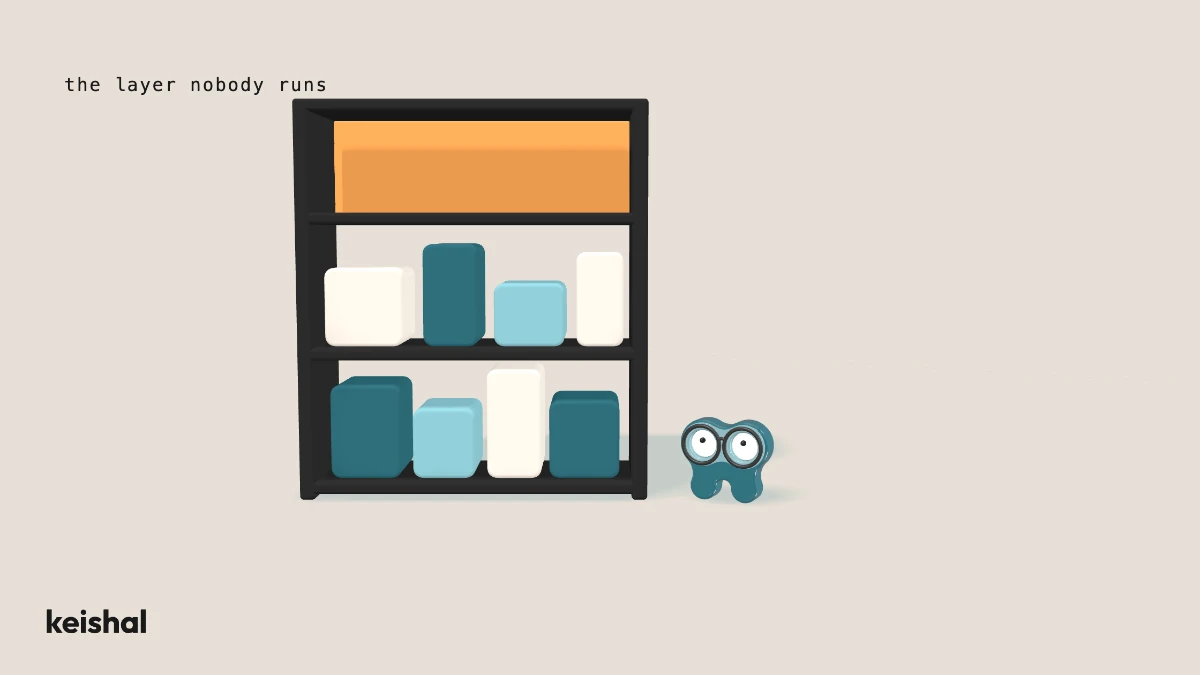
Spain's dental software market is built on private clinics that bill per treatment, where coming back is the patient's decision. The stack has three layers: the practice management system (agenda, clinical record, billing), clinical tools such as imaging, and patient communication. The PMS layer is fragmented across desktop and cloud systems. The communication layer is where work goes undone: it is sold as software someone at the clinic must operate, and nobody has the hours.
If you are looking at the Spain dental software market from outside, as an investor, a vendor or a partner, the useful map isn't a list of products. It is three layers of software sitting on one economic fact: a Spanish dental clinic is paid for the treatments it delivers. A patient who stops coming back is revenue the clinic stops making.
We build Keishal in Barcelona for dental clinics in Spain, and we connect to the practice systems those clinics already run. This is the map we work from. Every Spanish fact below names its source. Where we haven't found a source we trust, we say so instead of filling the gap.
How dentistry is paid in Spain, and why it shapes the software
According to the Libro Blanco de la Salud Oral en España (Consejo General de Dentistas, 2020), 51% of the population had visited a dentist in the previous 12 months. Eurostat's data puts Spain at 0.7 dental visits per inhabitant per year (2017 figures, the latest we have seen cited). Put the first number the other way round: for every 100 people, 100 − 51 = 49 went a full year without seeing a dentist.
That is a population figure, not a clinic's database. But it tells you what the default is in Spain. Patients drift, and coming back is a decision each one makes alone.
On the money side, the clinics we work with and talk to in Spain are private practices. They bill per treatment and quote larger work as a budget the patient accepts or not. We are not quoting a national share of private dental spending here, because we haven't verified one we would stand behind.
Those two facts together explain what a Spanish clinic needs from its software:
- Run the chair. An agenda by professional and by surgery, because chair time is the clinic's inventory.
- Document the mouth. A clinical record with an odontogram, because treatment is planned tooth by tooth.
- Bill per act and track budgets. Accepted, pending and abandoned treatment plans are the clinic's pipeline.
- Bring patients back. Because nobody else will. This is the one most stacks leave to the front desk.
The three layers of Spain's dental software market
When a Spanish clinic owner says "my software", they usually mean one system. In practice the stack has three layers, and they are bought in different ways.
Layer 1: the practice management system
The practice management system (PMS) is the operational core: agenda, clinical history, budgets, billing, documents and basic appointment reminders. It is the structural decision. Clinics choose it once and live with it for years, because changing it means moving clinical histories, budgets and images, and retraining the whole team.
The PMS layer splits by deployment model. Desktop systems with a local licence sit next to cloud systems that run in the browser. The split runs even inside one vendor: Gesden is sold both as Gesden G5 (desktop) and as Gesden One (cloud). Another system, Clinic Cloud, comes from Doctoralia, a patient booking platform, so the PMS and the booking marketplace sit in one ecosystem.
The clearest picture of how many systems are in use is our own integration list. These are the practice systems Keishal connects to today in Spain: Gesden G5, Gesden One, Nubimed, Mulhacén Soft, Cegid Ekon, Softgam, Odontonet, Vevi Clinic, Dentalink, Clinic Cloud by Doctoralia, Flowww, Cliniwin and Klinikare.
That is thirteen systems, for one country. It isn't a census of the market, and it says nothing about who is biggest. It is simply the set of systems clinics have needed us to work with, and it is long.
Layer 2: clinical tools
Imaging and radiology sit here. They connect to the PMS but are chosen on clinical criteria, by the dentist, not by whoever runs the front desk. This is also where most of the AI in dentistry has gone so far: reading radiographs, detecting caries, planning treatment. It is a different market from the other two layers, and it isn't ours.
Layer 3: patient communication
This is everything that happens between visits. Reminders and confirmations, booking and rescheduling, questions about hours or treatments, review requests, consent forms, and bringing dormant patients back.
Part of this layer lives inside the PMS, usually as basic reminders. The rest is bought as separate tools: bulk SMS, messaging tools, generic chatbots and, more recently, AI patient-communication software. In Spain much of the conversation with patients has moved to WhatsApp, which is where the clinics we work with get their replies.
Why the PMS layer is fragmented
We have not found a source for PMS market shares in Spain that we would trust, so we don't give any. Invented shares are the most common error in writing about this market. What we can describe is why the layer stays fragmented, from what we see in the clinics we work with.
The purchase happens clinic by clinic. The clinics we focus on have two to eight chairs and teams of 3 to 15 people, dentists and hygienists included. They are independent or small groups of up to five locations. Each owner chooses alone, often years ago, for reasons that made sense at the time.
Switching is expensive, so old choices persist. Migrating a PMS means moving years of clinical records, budgets and images, and retraining a team that is already busy. A desktop system installed long ago keeps running next to cloud newcomers, because the cost of change rarely beats the cost of staying.
Specialisation keeps niches alive. Orthodontics and implant work need deep clinical modules. A general family practice wants something simple that the team learns in days. Both kinds of system survive because both kinds of clinic exist.
For anyone building on top of this layer, fragmentation has one direct consequence. You can't reach Spanish clinics through one or two integrations. Every connector is its own piece of work.
The layer nobody operates
Most of the patient-communication layer is sold as software, and software has to be operated. Someone at the clinic has to decide who to contact, write the messages, send them, read every reply, answer the questions in those replies and book the patients who say yes.
In a Spanish clinic, that someone is the front desk. The same person is already answering the phone, replying on WhatsApp, checking patients in and handling billing, all at once. The outbound work is the part that gets dropped, not because anyone is careless, but because it never has a deadline today.
The arithmetic shows why. Take an illustrative clinic with 3,000 patients who haven't been seen in 12 months or more. Assume five minutes per patient to send a personal message and handle the reply. That is our working assumption, and some replies take much longer.
- 3,000 patients × 5 minutes = 15,000 minutes
- 15,000 minutes ÷ 60 = 250 hours
- 250 hours ÷ 40 hours a week = about 6 weeks of full-time work
Nobody at a clinic has six spare weeks. So the reactivation campaign happens once a year, or halfway, or not at all. The value at stake is the clinic's own figure: its dormant patients multiplied by its average treatment value. That is a ceiling, not a forecast. Some of those patients have moved, some have changed dentist, and some no longer need treatment.
In sales conversations in Spain we repeatedly hear about communication tools that were contracted and then left idle, because nobody had the hours to run them. That isn't a failing of the clinic or of the tool. It is what happens when a product's value depends on time the buyer doesn't have.
Software the clinic operates vs a system someone operates for it
In investor language this is service-as-a-software: selling the outcome and operating the tool ourselves, instead of selling a tool and asking the clinic to run it. To a dentist we say something simpler. Keishal is a digital coworker, an autonomous system that runs the non-clinical side of the practice.
Concretely, this is how it works in a Spanish clinic:
- Keishal runs on top of the clinic's existing PMS and its WhatsApp number. Nothing is migrated.
- It reads the PMS to find dormant patients and applies suppression rules first: opt-outs, patients flagged as deceased or moved abroad, and anyone the clinic marks as do-not-contact.
- It starts a personalised WhatsApp conversation and answers the patient's questions.
- When the patient wants to book, they get a calendar link and pick the slot themselves.
- The confirmed appointment is written back to the PMS.
The same system handles the daily load (reminders, confirmations, 24/7 questions, refilling cancelled slots, reviews, consents) and reports what it produced to the owner. Patients are told they are talking to an AI assistant, in line with the EU AI Act's transparency requirements. The clinic stays the data controller, Keishal acts as data processor under a written agreement, and data is stored in the EU.
Two things follow for the market map. First, this layer sits across the PMS layer rather than competing with it, so every PMS on the list above is a system to connect to, not a rival. Second, the obvious risk is a PMS vendor adding its own AI communication features. What it would still have to solve is the operating part: deciding, conversing and following up every day, for every clinic. That is a different business from selling software.
What this map doesn't tell you
It doesn't give market size, market shares or vendor counts. We haven't found sources for them that we would put our name to.
It is about Spain only. Keishal serves dental clinics in Spain. We are researching Portugal, where the OECD and European Observatory's 2025 country health profile notes that most dental services are excluded from the national health service's benefits package. We don't serve clinics there yet.
It isn't a buying guide. A clinic choosing a practice system is asking a different question, about size, specialisation, cloud or desktop, and data portability. We answer that one in Spanish, for Spanish clinics.
If you are an investor or a partner looking at this layer of the market, we're happy to walk you through what we see in Spanish clinics. You can reach us at keishal.com.
Sources: Consejo General de Dentistas de España, Libro Blanco de la Salud Oral en España (2020); Eurostat, dental consultations per inhabitant (2017 data); OECD and European Observatory on Health Systems and Policies, State of Health in the EU, Country Health Profile 2025: Portugal. Keishal's integration list as of November 2026.
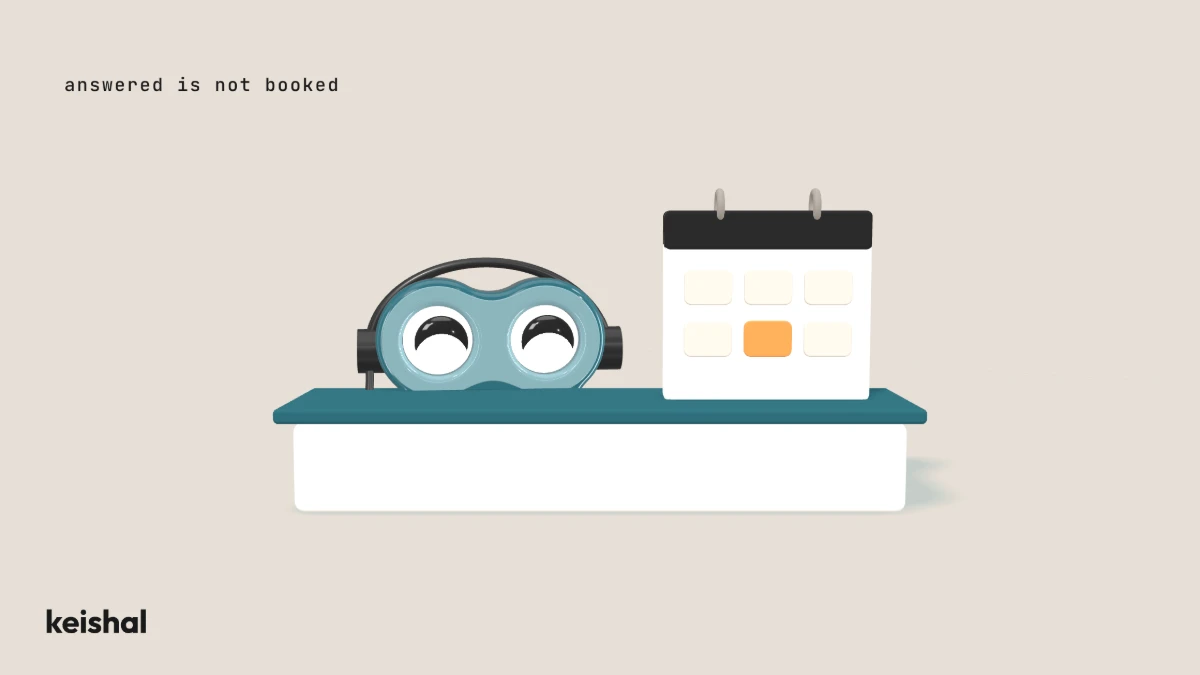
What a dental AI receptionist actually does: the work, the hand-offs and who operates it
A dental AI receptionist handles a practice's routine patient communication: questions, booking, reminders, cancelled slots, lapsed patients and reviews. It runs those tasks end to end only if it writes outcomes back to the practice system; clinical questions, complaints and requests for a person go to the team. For one illustrative clinic the routine load is 17.5 hours a month. What decides whether it works is who operates it after installation.
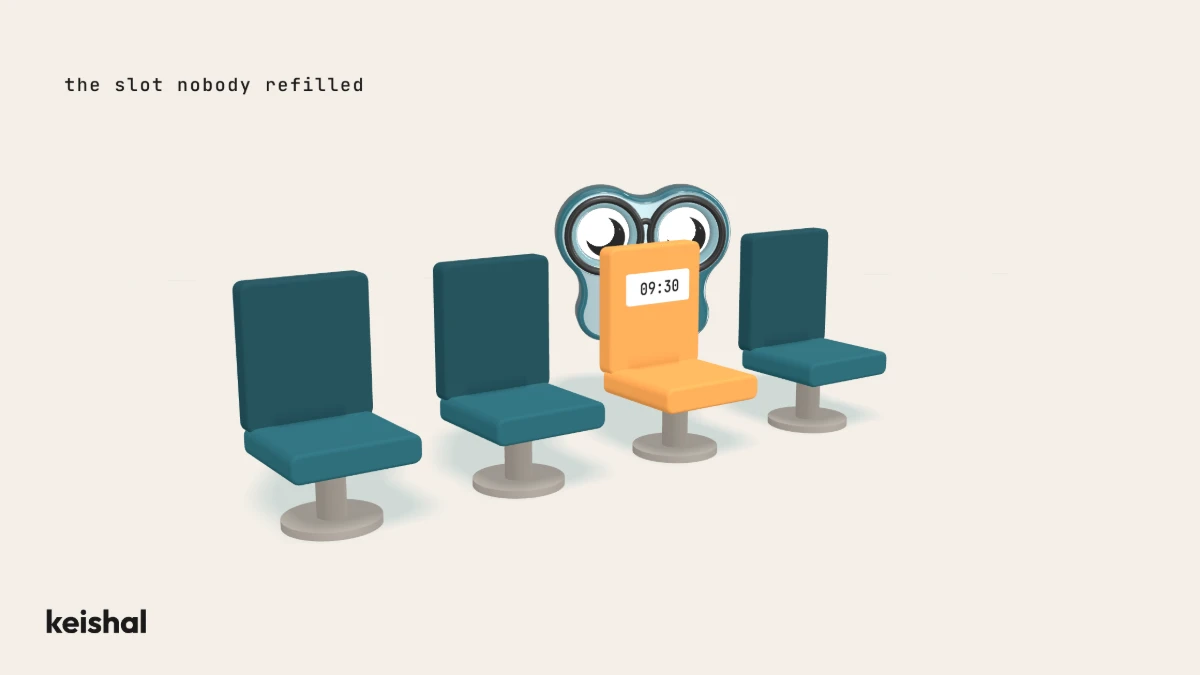
Dental appointment reminders: what a no-show costs and what the reminder actually recovers
A dental appointment reminder tells the patient the slot exists. It recovers nothing on its own: a no-show costs the slot's value minus what gets refilled, and only a confirmation the patient can answer in one tap, plus a refill within hours, moves that number. In an illustrative 2-surgery diary, 15 no-shows and 11 late cancellations a month cost about €2,700, two thirds of it in the column nobody can refill.