
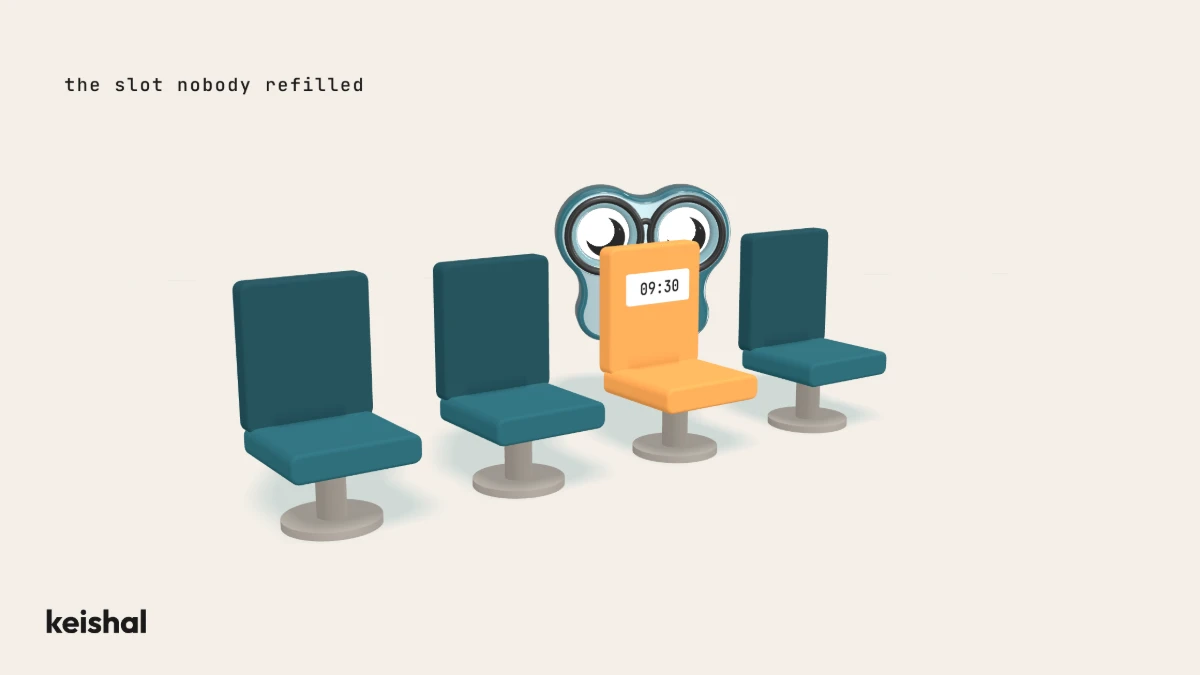
A dental appointment reminder tells the patient the slot exists. It recovers nothing on its own: a no-show costs the slot's value minus what gets refilled, and only a confirmation the patient can answer in one tap, plus a refill within hours, moves that number. In an illustrative 2-surgery diary, 15 no-shows and 11 late cancellations a month cost about €2,700, two thirds of it in the column nobody can refill.
Dental appointment reminders are rarely the weak point of a clinic's schedule. The message goes out. What it recovers is another matter: a missed appointment costs the value of the slot minus whatever the clinic manages to refill, and a reminder on its own refills nothing. The lever is the reply path and the refill behind the reminder, and that is where most clinics lose the money.
I run operations at Keishal. We operate patient communication for dental clinics in Spain, on top of the practice systems they already use, including reminders, confirmations and filling cancelled slots. This article is about the economics of the empty chair, written as formulas you can run on your own diary. Where a country figure appears, it carries its country and its source.
A missed appointment and a late cancellation are two different losses
Most clinics report one "no-show rate". It hides two events that behave differently.
- A no-show: the patient doesn't come and doesn't tell anyone. The clinic finds out when the slot has already started. Nothing can be refilled.
- A late cancellation: the patient warns, but late, say inside 24 hours. The slot is lost unless someone fills it before it starts.
The distinction matters because the two respond to different fixes. A reminder can turn a no-show into a cancellation, by prompting the patient who can't come to say so. Only a refill turns a cancellation back into a used slot. Measure them separately for a month, from the practice management system (PMS) or a tally at the desk, and you know which half of the problem you have.
There is a third column worth counting: cancellations with more than 48 hours' notice. They are the healthy kind. A clinic that moves patients from the first column into this one has done most of the work.
What a no-show costs: the arithmetic on your own diary
A national average won't tell you what an empty chair costs in your clinic. Your own diary will. Here is the formula, then an example with numbers chosen to be easy to follow. They are illustrative, not a benchmark. Replace each one with yours.
monthly loss = (no-shows × value per slot) + (late cancellations × value per slot × (1 − share refilled))
The diary. Take a practice with 2 surgeries, 9 appointments per surgery per day and 21 working days. That is 2 × 9 × 21 = 378 appointments a month.
The two rates. Suppose 4% of appointments are no-shows and 3% are late cancellations. That is 378 × 0.04 ≈ 15 no-shows and 378 × 0.03 ≈ 11 late cancellations a month.
The value per slot. Use what a chair produces in the time of one appointment: monthly production per surgery divided by the slots it offers. Say it comes to €120. That is a placeholder for the arithmetic, not a figure to quote.
The refill. Suppose the desk manages to fill 3 in 10 late cancellations, which is generous when it happens by phone between patients.
Now run it:
- No-shows: 15 × €120 = €1,800, because none of them can be refilled.
- Late cancellations: 11 × €120 × (1 − 0.3) = 11 × €84 = €924.
- Total: €1,800 + €924 = €2,724 a month, or €2,724 × 12 = €32,688 a year.
Two limits keep that honest. It is a ceiling: some lost minutes get used for an emergency, a long previous appointment or paperwork. And it undercounts in the other direction, because a missed check-up is also the treatment it would have found, which never enters the diary at all.
What the formula shows is where the money sits. In this example, two thirds of the loss is in the no-show column, the one where refilling is impossible. The first job is to move patients out of it.
Reminder, confirmation and refill are three separate mechanisms
The word "reminder" is used for three different things. Only one of them is a reminder.
The reminder tells the patient the appointment exists. It solves forgetting. It doesn't solve the patient who remembers perfectly well and can't come, or doesn't want to.
The confirmation asks the patient to answer: coming, can't come, need another time. It is what moves a would-be no-show into the cancellation column, and it gives the clinic a list of unconfirmed appointments to chase. A confirmation only works if answering takes seconds and the answer goes somewhere someone will act on it.
The refill turns a freed slot into a booked one: offering it to patients on a waiting list, or to patients with a later appointment who would rather come sooner. It is time-critical. A slot freed at 19:00 for 09:30 the next morning is worth something only if the offer goes out that evening.
A clinic can have excellent reminders and still lose most of the value, because the second and third pieces are missing.
Why a one-way SMS documents the no-show instead of preventing it
Many reminder systems send from a sender that can't receive replies, or route replies into a screen nobody watches. The message reads "Reply to cancel" or "Call us if you can't attend". Follow the patient who can't come:
- The reminder arrives at 18:30 the evening before.
- The patient can't reply to it, so they would have to phone.
- The clinic closed at 18:00. The next chance is 09:00, and their appointment is at 09:30.
- Many don't call. The slot goes empty, and the system's log shows a reminder "delivered".
The reminder did its job. The no-show happened anyway, now with a record that the patient was warned. That is useful for a cancellation policy and useless for the diary.
Portugal gives a sense of how much depends on patients taking that step themselves. In the Ordem dos Médicos Dentistas' Barómetro da Saúde Oral 2025 (n = 1,200, aged 15 and over), only 48.6% said they always warn the clinic when they will miss an appointment or be late, 17.7 percentage points fewer than in 2024. That is Portugal's figure, from one survey. It is not a European rate. But it describes the problem well: if fewer than half of patients reliably warn, a system that waits for them to make the effort will miss a lot.
What running the confirmation loop takes
The loop has five steps, and each needs an owner:
- Send the reminder with context the patient recognises: the clinic's name, the day and time, the dentist, any preparation needed.
- Ask for an answer that takes one tap: confirm, change or cancel.
- Handle the answer when it arrives, including at 21:00. A "can I come later?" needs a reply, not a note for tomorrow.
- Refill any freed slot straight away, from the waiting list or from patients booked later who would come earlier.
- Write the outcome back to the PMS, so the diary, the confirmation list and the no-show history are true.
The timing. It is a trade-off between two goals: close enough to the appointment that the patient remembers, and far enough ahead that a freed slot can be refilled. A reminder sent two hours before preserves memory and leaves no time to refill. There is no universal right hour. Pick one per appointment type and measure the refill rate it allows.
The workload, by hand. In the example above, 11 late cancellations plus, say, 5 no-shows the confirmation turns into cancellations, give 16 freed slots a month. If refilling each means offering it to 4 patients, at 2 minutes a call, that is 16 × 4 × 2 = 128 minutes, about two hours a month.
Two hours sounds small. The problem is when they fall. They fall at 18:30, at 08:45 and in the middle of a full waiting room.
That is when the slot can still be saved, and when nobody at the desk is free. Volume isn't the constraint. Timing is.
It is the same pattern that explains why dental recall fails, even with recall software: the software sends, and the value sits in work that has no hours assigned to it.
What the loop recovers. Take the same example and change two things. Suppose the confirmation turns 5 of the 15 no-shows into cancellations with a day's notice, and that being able to answer quickly lifts the refill share from 3 in 10 to 6 in 10. Then:
- The 16 freed slots × €120 × 0.6 = €1,152 refilled, instead of 11 × €120 × 0.3 = €396.
- The no-show loss falls to 10 × €120 = €1,200, from €1,800.
- The monthly loss becomes €1,200 + 16 × €120 × 0.4 = €1,200 + €768 = €1,968, against €2,724 before.
Those inputs are assumptions, there to show the mechanism. Some patients will no-show whatever you send. What moves the result is not the reminder's wording but whether the answer has somewhere to go and someone to act on it.
Questions to ask about any dental appointment reminder software
Whether you are choosing a system for a clinic or assessing a company in this space, these questions separate sending from recovering:
- Can the patient reply to the reminder itself, and who reads the reply, at what hours?
- Does a "can't come" free the slot automatically, or does someone have to process it?
- What happens to a freed slot in the next ten minutes? Who is offered it, and how is the booking confirmed?
- Are no-shows and late cancellations reported separately?
- Is every outcome written back to the PMS? Which systems does it connect to today?
- When the conversation is run by AI, are patients told?
The last one is a product question as much as a legal one. Article 50 of the EU AI Act sets transparency obligations for AI systems that talk to people, and it has applied since 2 August 2026. Patients who know who they are talking to, and see the clinic looking after their data, trust the messages more.
Where Keishal fits
Keishal is an autonomous system that runs this loop for dental clinics. It reads the next day's appointments from the PMS and sends a WhatsApp reminder with the appointment's context. The patient confirms, reschedules or cancels in one tap, and the answer is written back to the clinic's diary. When a slot frees up, Keishal offers it to patients on the waiting list or with later appointments, books the first who accepts and tells the others it has gone. Patients are told they are talking to an AI assistant.
We serve clinics in Spain, on the practice systems on our integration list. We are researching Portugal, and we don't serve clinics there yet.
For how patient communication fits into a national software stack, see the dental software market in Spain. If you want to see the loop running on a real diary, you can book a demo.
Sources: Ordem dos Médicos Dentistas, Barómetro da Saúde Oral 2025 (10th edition, November 2025, n = 1,200); Regulation (EU) 2024/1689 (AI Act), Article 50. Diary, rate and value figures are illustrative arithmetic, not Keishal results or sector averages.

What a dental AI receptionist actually does: the work, the hand-offs and who operates it
A dental AI receptionist handles a practice's routine patient communication: questions, booking, reminders, cancelled slots, lapsed patients and reviews. It runs those tasks end to end only if it writes outcomes back to the practice system; clinical questions, complaints and requests for a person go to the team. For one illustrative clinic the routine load is 17.5 hours a month. What decides whether it works is who operates it after installation.
Why dental recall fails, even with recall software
Dental recall software produces the list of overdue patients and sends a reminder. Recall fails in the work after that: replies nobody answers, no second attempt, bookings never written back, lists never cleaned. With 167 patients due a month and four minutes each, that is over 11 hours of work a month nobody has. Operated recall means suppression, a conversation, a confirmed booking, write-back and an owner.