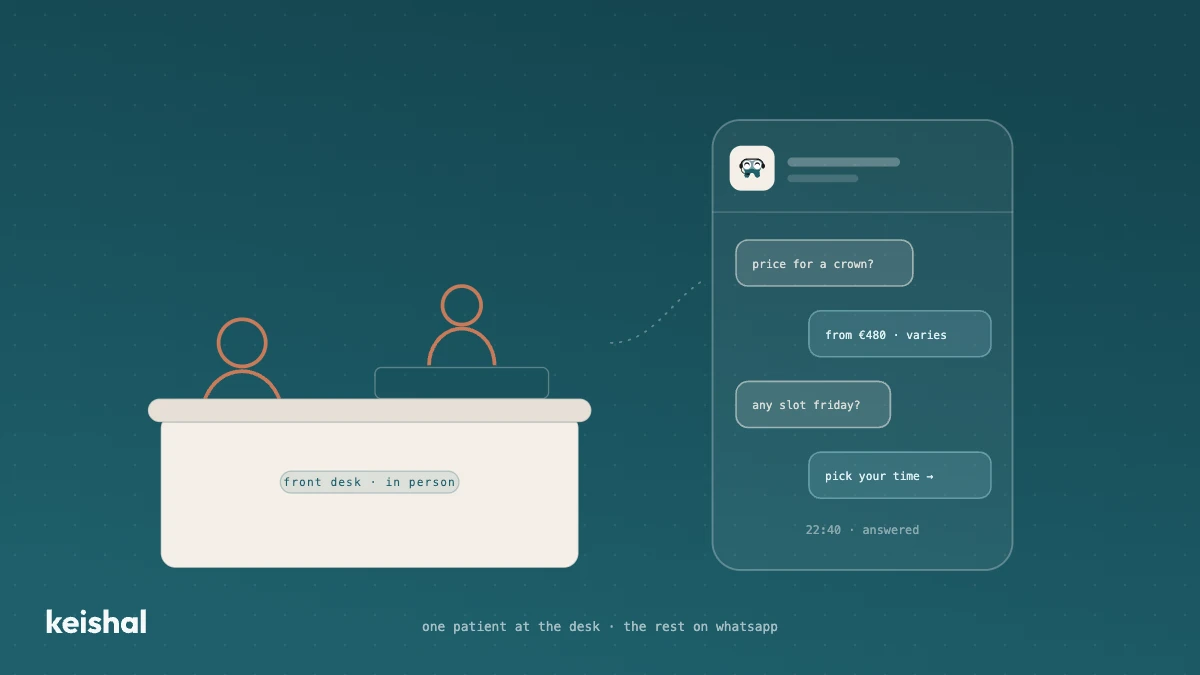
A virtual receptionist should not replace your receptionist: it should absorb the repetitive load that does not fit in their day. A front desk open 50 hours a week leaves 118 of the week's 168 hours unanswered: 70% of the time. An autonomous system covers reminders that get a response, 24/7 booking (WhatsApp chat plus a calendar link), out-of-hours questions with escalation, recall and reactivation. It does not answer the phone: it removes volume from it. The front desk, clinical conversations and complaints stay human.
People usually search for a «virtual receptionist» for their dental clinic at the same moment: the phone rings while a patient stands at the front desk, WhatsApp messages pile up and, once the clinic closes, enquiries keep arriving that nobody will answer until the next morning. A front desk that opens 50 hours a week leaves 118 of the week's 168 hours with nobody on the other side. That is 70% of the time.
Most of what you will find under that search promises to replace your receptionist. This article argues the opposite: your receptionist stays. What has to go is not the person but the repetitive part of the job. A well-designed virtual receptionist takes on that part and gives your team back the time for the work that genuinely needs human hands.
Step by step: what a virtual receptionist actually is, what it can take on, what it does not do (it does not answer the phone, and that is worth saying plainly), what should stay human and which questions to ask before hiring anything.
What is a virtual receptionist for a dental clinic
Three very different things live under the same name.
An outsourced phone answering service. People in a call centre answering for you with a script. They solve the missed call, but they do not know your schedule or your patient history: they take a message and your team still does the work afterwards.
A chatbot or virtual assistant. Software that answers frequent questions on your website or WhatsApp. It answers, but it does not operate: it does not book into your real schedule, confirm appointments or update patient records. We analyse that category in depth in what chatbots solve and where they fall short.
An autonomous system connected to your clinic. It reads your schedule and your practice management software, talks with patients over WhatsApp and executes outcomes: appointments booked, confirmations recorded, records updated. It is not a virtual employee, and not one more software your team has to learn: it is AI applied to the administrative side of the clinic, operated by the provider. If you're wondering what an AI agent is and why it can work with the data in your practice management software, it's this piece: the one that goes from answering to executing.
The distinction matters because the conversation is no longer theoretical: in 2026 even dental software vendors present patient-communication modules at trade shows like Expodental. The useful question is not whether something sounds modern, but who does the work: your team with one more tool, or a system that works on its own?
The hours nobody covers: run the numbers
Before evaluating solutions, size the problem with your own numbers.
Opening hours: if your front desk opens 9:30 to 19:30, Monday to Friday, that is 50 hours a week. The week has 168. That leaves 118 hours, 70% of the time, in which a patient who writes or calls finds nobody there.
Load within opening hours: if your team makes 40 confirmation calls a day at 3 minutes each, that is 2 hours a day spent on reminders alone. Over a 22-working-day month, 44 hours: more than a full week of work repeating the same call.
Neither number is ours: they are yours. Count your calls on any given day and your opening hours and you will have the real size of the gap. And one honest warning: covering those hours does not mean every late-night message is a patient won. It means you stop losing the ones who write today and do not wait.
What a virtual receptionist can take on (if it is an autonomous system)
Reminders and confirmations that get a response
Not the SMS nobody answers: a WhatsApp message where the patient confirms, reschedules or cancels on the spot, and the schedule is updated without anyone transcribing anything. It is the first line of defence against no-shows, and the 2 daily hours of confirmation calls disappear from the front desk.
24/7 appointment booking
It works in two steps, and that is worth knowing when evaluating any provider: the patient sorts out their questions over WhatsApp (opening hours, treatments, insurance) and, when they want an appointment, receives a calendar link where they pick the slot themselves. The confirmed appointment is written into your schedule. The 9:40 pm patient books that same night instead of calling another clinic in the morning.
Out-of-hours questions, with escalation
It answers from information the clinic approves (indicative prices, insurance, instructions). And when something arrives that it should not answer alone, a clinical doubt, a complaint, an unusual case, it hands the conversation to your team with its full context. How that balance works is covered in 24/7 patient support without expanding your front desk.
Recall and reactivation
The part no phone service or chatbot does: the proactive work. Reminding each patient when their check-up is due and restarting the conversation with those who have not visited in over a year, personally and at a volume that fits in nobody's working day: 1,000 dormant patients at 5 minutes per contact is around 83 hours, two full weeks of one person's time. What to automate and what not walks through the full inventory task by task.
What a virtual receptionist does not do: answer the phone
Let us be clear about the limit, because almost nobody is: Keishal does not answer voice calls. If that is exactly what you are looking for, a phone answering service will fit you better.
What an autonomous system does with the phone is something else: it takes volume away from it. Every task that migrates to asynchronous WhatsApp is a call that stops happening: the confirmation that no longer needs making, the insurance question that arrives already answered, the patient who booked at midnight and does not call «to ask for an appointment». The phone stops being the channel for everything and goes back to being the channel for what is urgent.
Fewer inbound and outbound calls with the same team: that is the real improvement, and it does not require any machine to pretend to be a person on the phone.
What should stay human
An honest virtual receptionist also draws its own boundary. This should not be delegated:
- The patient at the front desk. Whoever walks through the door deserves someone who looks at them, greets them by name and sorts out what they need. That is exactly what 2 daily hours of calls make impossible to do well.
- Clinical conversations. Questions about a diagnosis, pain, a complex treatment plan: your team answers those. The system detects them and escalates them with context; it does not improvise.
- Complaints. An upset patient needs a person with real authority to decide, not a correct answer.
- The relationship. Knowing that a patient prefers early appointments or that someone is going through a rough patch cannot be automated. It is protected by giving time back to the person who knows it.
Seen this way, the question changes: it is not «can I replace my receptionist?» but «how many hours of their week are spent doing machine work?».
A tool you learn, or an operation you delegate?
The decisive question remains, the one that separates two products advertised the same way: who operates it every day?
A good part of communication software requires your team to configure it, learn it and feed it: templates, campaigns, segments. In sales conversations we hear versions of the same sentence again and again; one clinic put it like this: «I would rather call patient by patient myself than have to learn yet another new tool» (translated from a sales conversation held in Spanish). The barrier is not the price of the tool, it is the attention it demands.
An autonomous system flips the split: the provider operates it and your team sees the results (the appointment in the schedule, the record up to date, the activity summary). If, while evaluating a «virtual receptionist», the demo ends with a training session for your front desk, you are not delegating work: you are adding one more task.
Does it work with your practice management software?
The usual practical question, and the short answer is that it must work on top of what you already use. Keishal integrates with the software most common in Spain (Gesden, Nubimed, Dentalink, Clinic Cloud and others) and writes the outcomes into your schedule and patient records. No migration, no PMS change: the reception layer is added on top.
Five questions before hiring a virtual receptionist
- Does it answer, or does it operate? Ask to see the appointment appearing in the real schedule, not a pretty conversation.
- Who operates it every day? If the answer includes «your team manages the campaigns», count the hours that asks of you.
- How does the patient book? Be wary of an AI that «notes down» the time in the chat; the reliable method is a calendar link where the patient picks their own slot.
- What happens with what it cannot solve? The right answer is escalation to your team with the full conversation, not «we will keep it in mind».
- How does it handle patient data? Communicating with patients means handling sensitive data on any channel. A serious provider explains its framework without being asked twice; the specifics belong with your data protection advisors.
If a provider answers all five well, you have a system. If it hesitates, you have one more tool waiting for someone to use it.
Want to see it with your own schedule and database? Book a demo and we will show you with your numbers, not ours.

Ready to try Keishal in your dental clinic?
Book a demo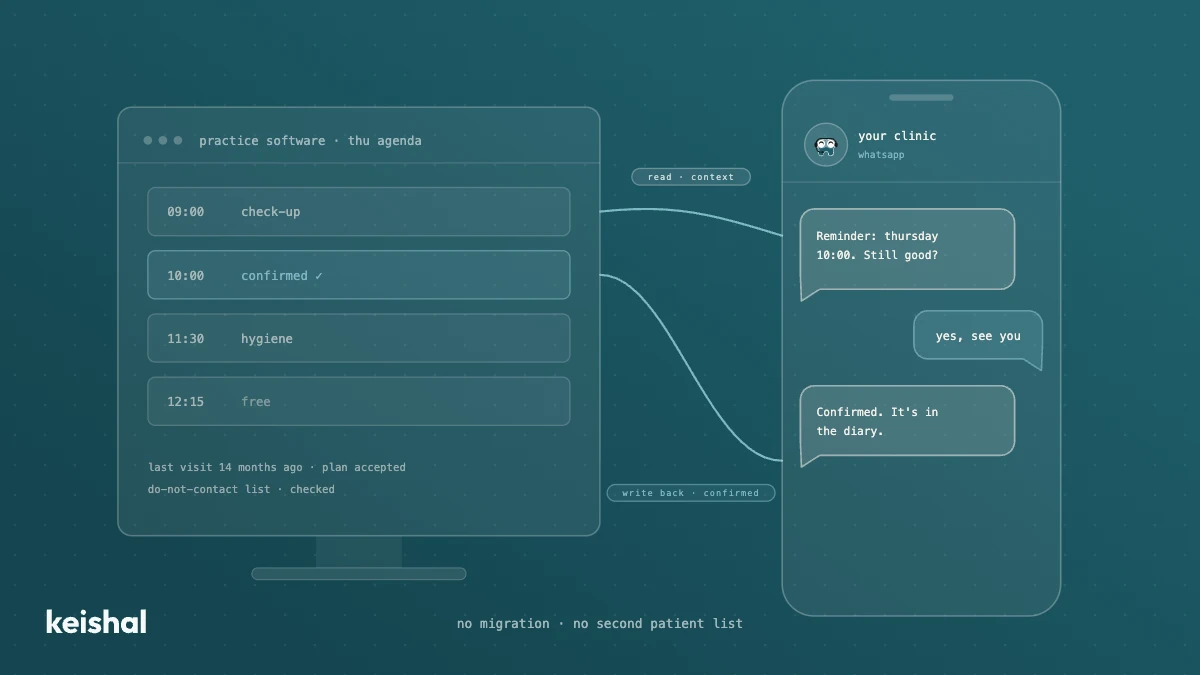
Integrating AI with your dental practice software: what a real connection means
A real integration with your dental clinic's software does two jobs: it reads your patients' data for context and writes appointments, confirmations and status changes back into your program. A monthly CSV, a calendar connector or a read-only tool leaves the rest to your team: with 330 reminders a month, marking each confirmation at 30 seconds adds up to almost 3 hours. Ask for the list of supported programs and versions in writing, and check that there's no migration and no duplicate patient base.
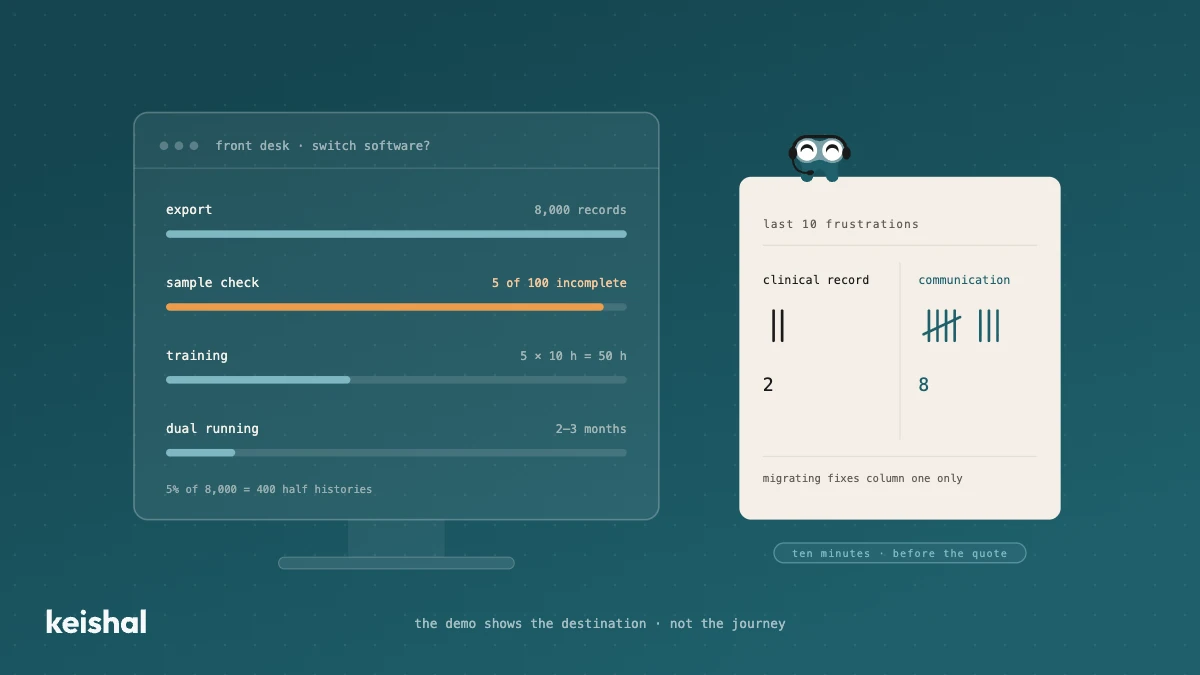
Switching dental software: what migrating really involves and when you don't need to
Switching dental software isn't installing a program: it's exporting and verifying thousands of records, training the team (5 people × 10 hours = 50 hours) and running two systems side by side for two or three months. It's worth it when the software has no support, holds your data hostage or the clinic has outgrown it. But if what's pushing you is unmanaged reminders, recall that never happens and out-of-hours messages, that communication layer can be added on top of your current PMS, without migrating anything.