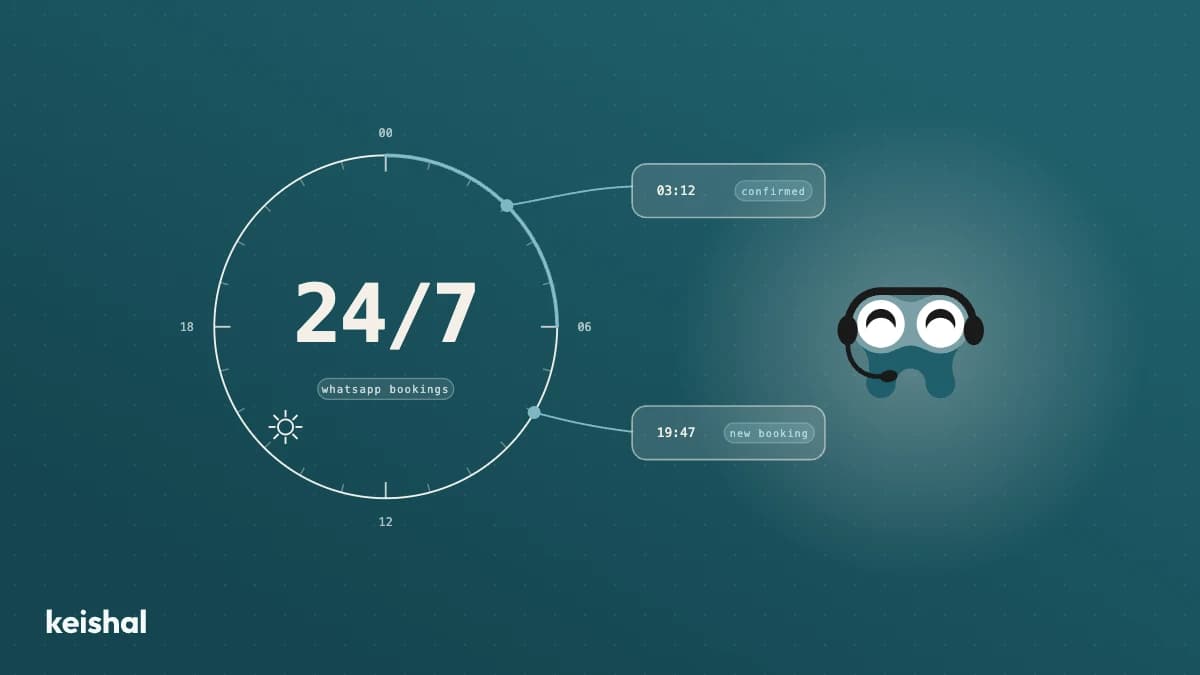
Many first visits are lost outside clinic hours: someone decides to book at ten at night, can't, and by the next day has already called another clinic. 24/7 online booking closes that door. At Keishal it works in two stages: the patient asks questions and resolves doubts over WhatsApp at any hour, and when they want to book, they get a link to a calendar where they pick their own slot. The confirmed appointment lands in your agenda, without anyone on your team having to be available at that hour.
What happens at 9pm on an ordinary Tuesday
A new patient searches for a dentist on Google, on a Tuesday evening. They find your clinic, open the site, want to book. It's 9pm. Your front desk closed at 8pm. The patient has two options: set a reminder to call tomorrow, or open the next browser tab and call a clinic that lets them book right now.
Most pick the second option. Not out of impatience: because right then they had ten free minutes to think about their teeth, and tomorrow they won't.
This doesn't only happen at 9pm. It happens on Saturdays, over lunch, any moment someone has a phone in hand and the clinic has the phone off the hook. Each of those moments is a first visit that's lost before anyone on your team even knows it existed.
In 2026, searching for a clinic and wanting to book straight from a phone, outside business hours, is increasingly the norm: patients no longer wait to call during office hours, they expect to settle it the moment they're thinking about it.
It's not a booking widget, it's a WhatsApp conversation
When people talk about "24/7 online booking", the mental image is usually a Calendly-style calendar: the patient picks a slot from a grid and that's it. It works, but it's rigid. If the slot on offer doesn't fit what the patient needs, or if they have a question before booking, the widget doesn't answer. It falls back on someone calling them.
Keishal's 24/7 booking works differently because it isn't a separate widget: it's the same WhatsApp conversation we already use for confirmations and reminders. The patient messages the clinic's WhatsApp number, at any hour, and has a normal conversation: "I need a check-up", "Do you have anything this week?", "I need to move Thursday's appointment". The system understands the request, checks real availability in your PMS at that moment, applies your clinic's rules, and confirms or reschedules the appointment. Everything gets written into the same software your team already uses, with no parallel spreadsheet for anyone to reconcile on Monday.
An autonomous system differs from plain booking software exactly on this point: it doesn't just open a slot in a grid, it carries the whole conversation, questions, changes of mind and rescheduling included, the way your front desk would if it were awake at 9pm.
How it actually works
The mechanism has four steps, and all four happen without anyone on your team stepping in:
- The patient messages. On WhatsApp, any time. They can book directly or ask a question first ("how much is a cleaning?", "do you take my insurance?") that the system answers before moving toward the booking.
- The system checks your PMS in real time. It doesn't work off an approximate schedule or slots fixed in advance: it reads live availability from Gesden, Nubimed, Dentalink, Clinic Cloud, or whatever software you use, at the exact moment the patient asks.
- It applies your clinic's rules. A first visit doesn't take as long as a check-up. A filling isn't done by just any dentist on the team. The system respects treatment duration and which professional can handle it, exactly as your front desk would.
- It confirms and writes the appointment to the PMS. The patient gets confirmation instantly. Your team, arriving in the morning, sees a new appointment on the same calendar as always, in the same format as always.
None of these steps require anyone at your clinic to be online. A patient books on a Saturday at noon, and the appointment already exists in your PMS by Monday morning.
What the real conversation sounds like
The difference between an autonomous system and a form shows up in the tone of the reply, not just in availability.
Generic: "Thanks for your message. You can book an appointment on our website: [link]."
Real conversation: "Hi! Yes, we have a first-visit slot this Thursday at 5:30pm or Friday at 10am with Dr. Martín. Which works better for you? If you have dental insurance, tell me the provider and I'll confirm we work with them."
The first reply sends the patient right back to the problem they had at 9pm: another screen, another form. The second resolves the booking on the spot, in the same thread the patient was already writing in. It's the same logic that worked well for reactivating dormant patients: the closer the reply sounds to a person with the schedule in front of them, the less friction there is to a confirmed appointment.
It's the line we tend to hear from clinic managers explaining why after-hours booking requests get lost (a composite line, not from one specific clinic): "It's not that we don't want to answer them. It's that by the time we arrive in the morning, the patient has already gone to another clinic, and we never even find out they asked." That line sums up the whole problem: it's not a matter of goodwill, it's a scheduling-availability gap no single person can cover alone.
Think about how many first visits start outside your hours.
Someone with toothache at eleven at night. A parent who finally remembers to book for their child on a Sunday afternoon. Someone who saw your clinic on Google over dinner. They all have something in common: in that moment they're decided, and in that moment your front desk is closed.
If they can't do anything until tomorrow, some of them won't try again with you. They'll have called the clinic that did answer, or the impulse will simply have passed. The decision to book lasts a short while, and if there's nowhere to channel it, it's lost.
24/7 online booking exists to capture exactly that moment.
The problem isn't "not having hours", it's "not having an open door when the patient decides"
Clinics know this, which is why many put a "request an appointment" form on their website. But a form isn't a booking: it's a request someone at reception has to see, assess, and call back the next day. By then, the patient is no longer in the moment of decision.
What captures the first visit isn't collecting a request. It's letting the patient resolve their doubt and choose their time in the same moment they've decided, without waiting for anyone.
How 24/7 booking works at Keishal
It's worth being precise here, because "booking over WhatsApp" can mean very different things. At Keishal the process has two parts:
First: the conversation. The patient messages the clinic over WhatsApp at whatever hour. They ask what they need —whether there's a slot this week, whether you accept their insurance, what a first visit costs, whether you treat what's wrong— and get an answer immediately, in the clinic's voice. This part is conversational: it's talking, not filling in a form.
Second: the booking. When the patient is ready to book, they receive a link to a calendar where they see the available slots and pick the one that suits them. It isn't the AI "guessing" the time in the chat: it's the patient who selects it, the same way they'd book a table or a flight. The confirmed appointment is written directly into the clinic's agenda.
This split matters. The conversation resolves the friction of "I have questions before I commit", which is what stops a lot of people. And the calendar resolves the mistrust of "what if they book me a time I can't make?": you choose the time, there's no possible misunderstanding.
The result is that a patient can go from "I think I need to see a dentist" to "I have an appointment Thursday at 5pm" at eleven at night on a Sunday, without anyone at your clinic being awake.
What the clinic gains (beyond the first visit)
You don't lose the out-of-hours first visits. That's the direct effect. Evenings and weekends are when a lot of people have time to deal with these things, and that's exactly when reception isn't there.
Your team doesn't manage the back-and-forth. Without online booking, every first visit is several calls: the patient's, the one you return, the confirmation. With direct booking, the slot appears already closed in the agenda.
Rescheduling and cancellations also resolve themselves. The same channel that books an appointment moves one. The patient reschedules over WhatsApp and gets the link to pick the new time, without tying up your phone.
You don't change systems. The appointment is written into your current practice management software. It isn't a parallel agenda someone later has to reconcile with the real one.
Online booking isn't the same as a "book now" button
It's worth marking the difference, because many clinics think a widget on the website already solves this.
A standalone calendar widget on the website works for someone who's already decided and just wants a time. But it leaves out everyone who has a question first: do you treat this? do you accept my insurance? is what I have urgent? Those people don't book in a mute widget — they leave. The prior conversation over WhatsApp is what recovers those patients, and the calendar is what closes the appointment once the doubts are resolved.
It's the difference between a door with a hours sign and a door with someone who answers and then walks you to the agenda.
It's the second entry door, not the only one
It's worth being honest about what 24/7 booking does and doesn't do.
It captures patients who've already found you and are decided to take the step outside hours. It doesn't bring new patients on its own: for someone to book, they first have to reach your clinic (through Google, a review, a recommendation). That's why booking works as a pair with review collection: reviews make you findable and choosable, and 24/7 booking turns that visibility into appointments at the moment the patient decides.
Together they close the gap between "they found you" and "they have an appointment", which is where many first visits are lost.
24/7 online booking isn't about technology, it's about being available when the patient decides — which almost never matches your hours. If you want to see how it works with your agenda and your software, book a call. And if you're building your presence to attract new patients, start with Google reviews — they're two sides of the same door.
Ready to try Keishal in your dental clinic?
Book a demo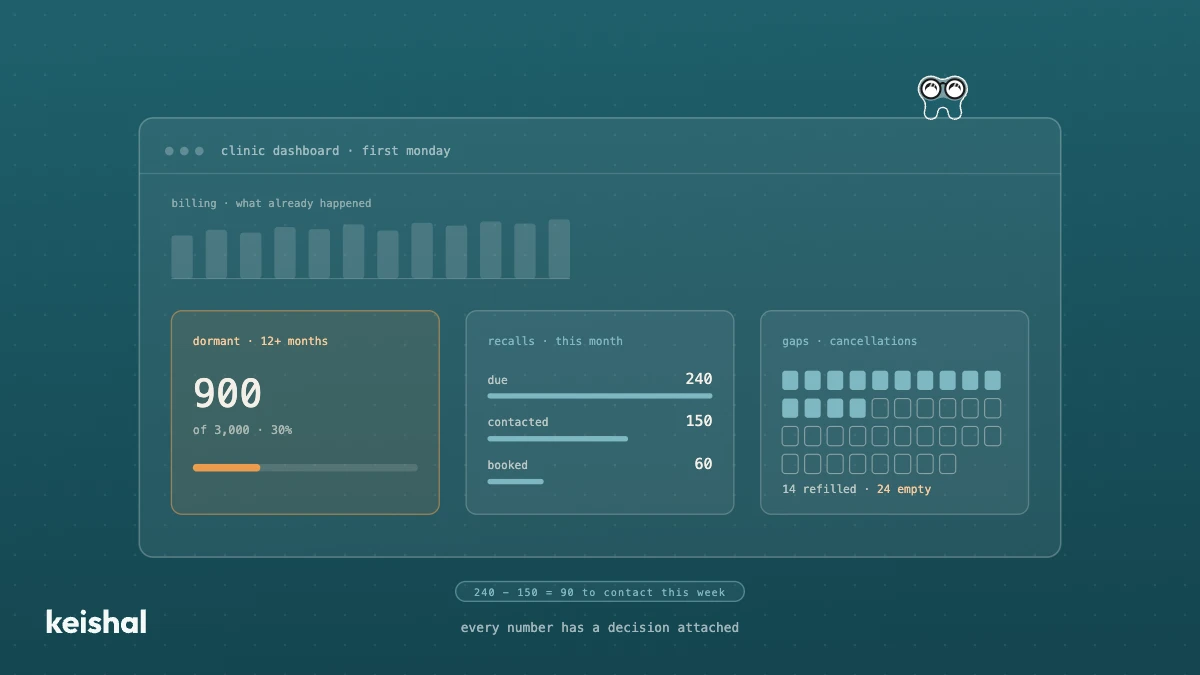
Dental clinic dashboard: what it should actually show you
A dental clinic dashboard is useful if it helps you decide something. The one in your practice management software usually shows billing and the schedule, which is the past. What it usually lacks is the patient base: how many haven't been in for over a year (900 of 3,000 = 30%), which recalls fall due this month, which gaps stayed empty and how much of your base you can actually reach. Six questions, each with its number and its decision.
What is superintelligence and what AI actually does in a dental clinic today
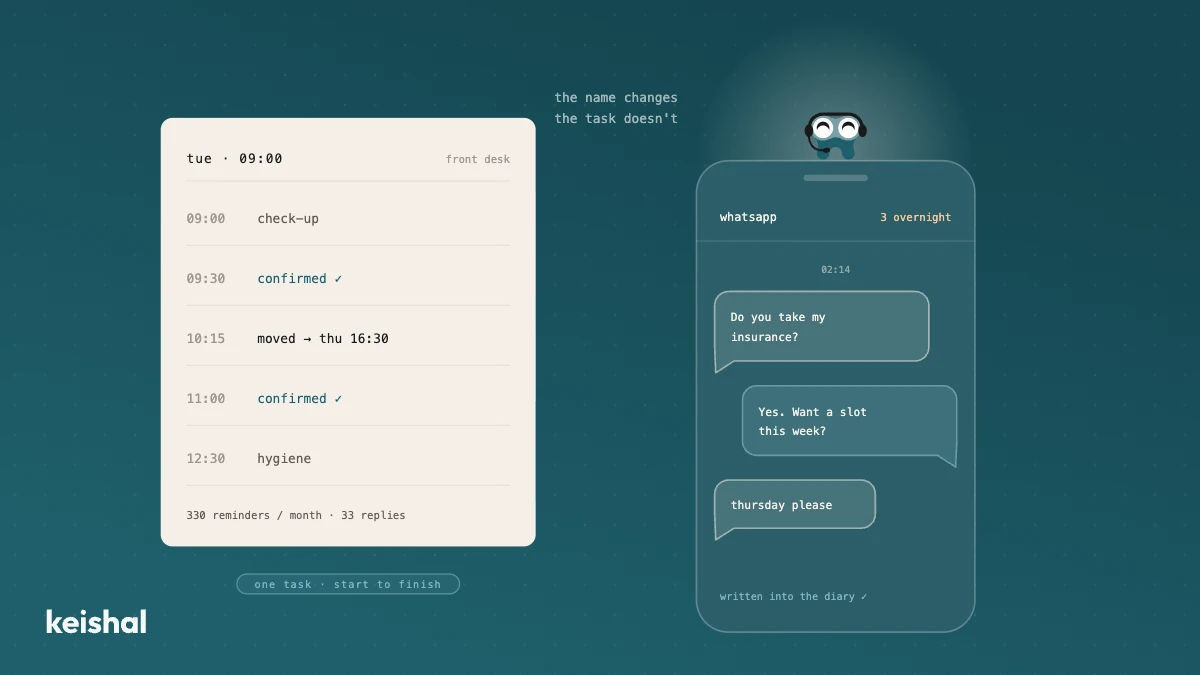
Superintelligence is a hypothetical AI that would outperform people at almost every intellectual task, and it doesn't exist today. The AI dental clinics use is narrow AI: it confirms appointments (15 × 22 = 330 reminders a month), reactivates dormant patients, answers during the 118 hours a week the clinic is closed and flags incomplete records. For a clinic, the name matters less than the specific task the tool gets done in your schedule.