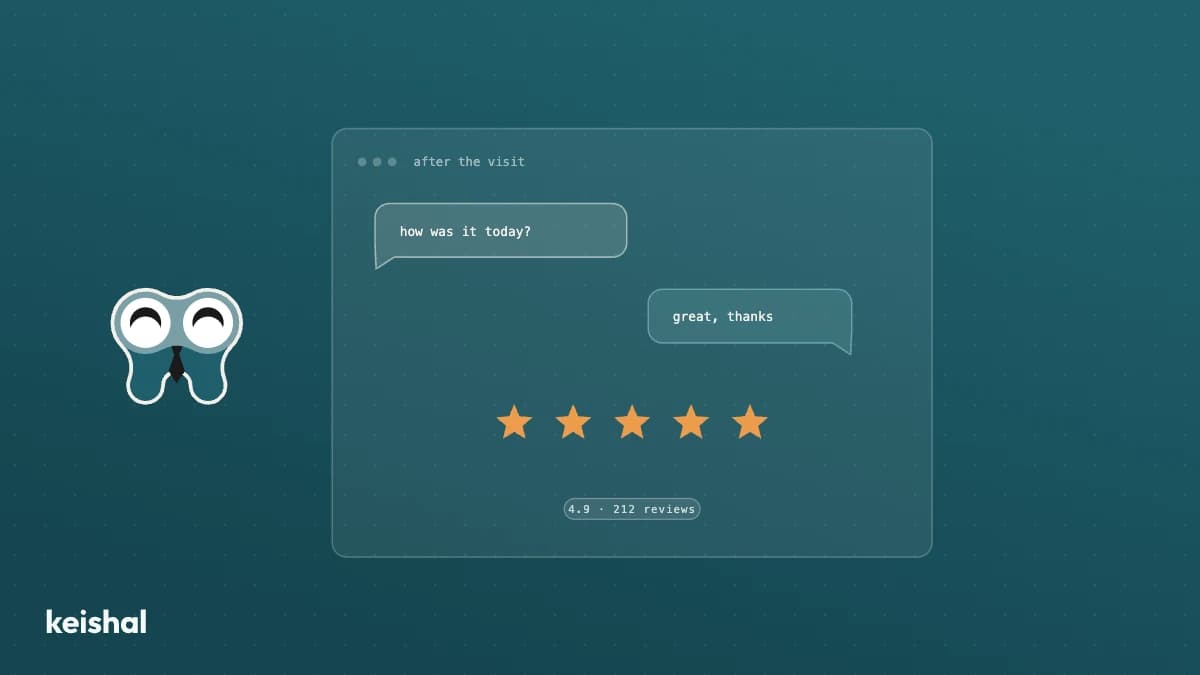
73% of patients check Google reviews before choosing a dentist, but most clinics don't get reviews consistently because it depends on someone remembering to ask in person. The fix: automate the request over WhatsApp a few hours after each visit, when patient satisfaction is at its highest, with no one on the team having to manage it.
Over 70% of patients check Google reviews before choosing a dentist (73.28%, according to the RepuGen 2025 Patient Review Survey). Most clinics know this. Almost none get reviews consistently, because the usual method — asking in person, at the front desk — depends on someone remembering to do it every day. This article explains how to get Google reviews for your dental clinic without relying on anyone's memory: by automating the request over WhatsApp right after the visit, when patient satisfaction is at its highest.
Why Google reviews matter more than clinics think
Before booking, a new patient almost always looks up your clinic on Google first. The first thing they see isn't your website — it's the star rating and the latest reviews. With few reviews, or old ones, that first impression already works against you before the patient has spoken to anyone on your team.
The effect isn't just about trust. Google also uses review volume and frequency as a ranking signal for the local business profile on Maps. According to Whitespark's local ranking factors analysis (2025), reviews older than 180 days retain only 10-20% of their original weight in that algorithm. A clinic with recent, steady reviews tends to rank above one with the same five stars but no activity in two years.
Why most clinics don't get them
It's the line I hear most in sales conversations with clinic managers: "we know we should ask for reviews, but between the schedule, the waiting room and the phone, it slips most of the time".
It isn't about the team's attitude — it's about the hours they have left in the day. Asking for a review well — at the right moment, from the right person, without sounding mechanical — is one more task for a front desk that already covers scheduling, payments, phone questions and patients in the waiting room. When there's no spare time, whatever isn't urgent falls off the list first. Asking for a review is never urgent, so it almost never happens.
The result: clinics that have treated hundreds of satisfied patients over the years and still have fewer than 30 reviews on Google.
The method that doesn't depend on anyone remembering
The alternative isn't asking more often or pushing harder. It's taking the request off the front desk's task list and putting it on a channel that already fires on its own: the WhatsApp thread the clinic already uses to confirm appointments and send reminders (see WhatsApp for dental clinics).
The principle is simple: the message goes out on its own, a few hours after the visit, while the experience is still fresh and any discomfort from treatment has passed. Nobody on the team has to remember to send it or decide who to ask: it goes to whoever had an appointment that day, every time, with no exceptions and nothing forgotten.
It's the same principle we apply to reactivating inactive patients (see how to reactivate inactive patients at your dental clinic): what doesn't fit into one person's schedule fits into a system that does it every day, for every patient, without anyone having to remember.
How to set it up, step by step
-
Define the trigger. The message should go out after a completed visit, not after a booking. Asking for a review before the patient has had the experience doesn't make sense.
-
Wait for the right moment. A few hours after the appointment, not on the way out the door. Give any anesthesia or treatment discomfort time to pass, so the review reflects the full experience.
-
Ask without conditions. The message links directly to your Google profile with a short text: thank the patient and ask for their opinion, with nothing offered in exchange. Google's terms of service explicitly ban incentivizing reviews with discounts or gifts, so asking with no strings attached isn't just simpler — it's the only approach that follows the platform's own rules.
-
Filter after amplifying, not before asking. Ask every patient from a completed visit, not just the ones you assume are happy. Pre-filtering biases the sample, and if Google detects it, the profile can be penalized.
-
Track volume, not just the average rating. A clinic with 4.9 stars and 12 reviews signals less trust than one with 4.7 stars and 200. Volume and consistency matter as much as the score.
An autonomous system that already handles daily patient communication — confirmations, reminders, recall — can add this request as one more task without your team having to touch anything (see how to apply artificial intelligence at my dental clinic).
What to say in the message: two examples
The difference between a message that gets ignored and one that gets a response isn't the offer — it's whether it reads like a template or like someone who knows the patient.
Generic (low response rate): "Thanks for your visit. Rate us on Google: [link]." Nothing wrong with it, but it says nothing about the patient or the clinic. It reads like spam and gets treated like spam.
Specific (higher response rate): "Hi Maria, thanks for coming in today for your cleaning with Dr. Soler. If it went well, it would help a lot if you shared it on Google: [link]. See you at your next check-up." It names the patient, the treatment and the provider. It costs the same to generate automatically once the system already has that appointment data, but the patient reads it as something meant for them, not a bulk send.
How much this can change for your clinic
The math is simple, and you can run it with your own numbers: count how many completed visits your clinic has per month and how many new reviews you get today. If you see 600 visits a month and five new reviews come in, your conversion rate is 0.8%. Automating the request right after the visit usually lifts that rate several times over, because it stops depending on someone asking in person.
Not every patient will leave a review, even asked at the perfect moment. Some don't use Google Maps, others simply don't have the habit. That's normal, and it doesn't change the outcome: moving from almost never asking to always asking multiplies the review count even if the per-patient response rate stays low.
What to do with a negative review
Automating the request also means that, sometimes, a three-star review will come in. That's part of the process, not a system failure: asking everyone, without filtering, is exactly what makes the whole set credible.
Always respond, in a professional tone, without arguing in public. Acknowledge the patient's experience, offer to resolve it through a private channel (a call or WhatsApp), and avoid justifying yourself line by line in the public reply. A negative review handled well, with a considered response from the clinic, often builds more trust than its absence would — it shows there's a real person behind the profile.
In 2026, with most "dentist near me" searches starting directly on Google Maps, the business profile has stopped being a secondary detail and become the first entry point for a new patient.
What to watch to know it's working
You don't need a complex dashboard. Three numbers are enough to tell whether the system is working:
- New reviews per month. Compare it to the average of the three months before automating the request. It's the most honest comparison, because it uses your own clinic as the baseline, not an industry average.
- 90-day average rating. If it dips once you start asking every patient (not just the happy ones), that's a real signal about the in-clinic experience, not a problem with the request system.
- Time from visit to review. If most reviews land within 48 hours, the automatic trigger is working as intended. If it takes weeks, check when the message is actually being sent.
Before you automate: handle patient data with care
Asking for a review means contacting the patient over a channel where you already hold their information. As with any patient communication, it's worth being clear about what data you use and on what basis — that's a general data-protection good-practice question, not specific to WhatsApp or to reviews. A clinic that communicates clearly and takes care of these details builds more trust with patients, not less. If you're unsure about the specific framework for your clinic, the safest path is to resolve it with specialized data-protection advice.
Reviews are just the first step of acquisition
Most content about reactivation and patient communication focuses on the database you already have. Reviews are different: they're the entry point for patients who don't know you yet. A clinic with recent, steady reviews doesn't just signal more trust — it ranks higher on Google Maps when someone searches for a dentist nearby.
The two reinforce each other. The same visit data that triggers the review request is what, months later, flags a patient who's gone too long without returning and triggers recall (see what dental recall is and how to automate it). Acquisition and retention end up running on the same communication infrastructure, applied at two different moments in the patient's journey.
If you want to see how an autonomous system can handle asking for reviews, confirming appointments and reactivating patients without your team managing any of it, you can see a Keishal demo.

Ready to try Keishal in your dental clinic?
Book a demo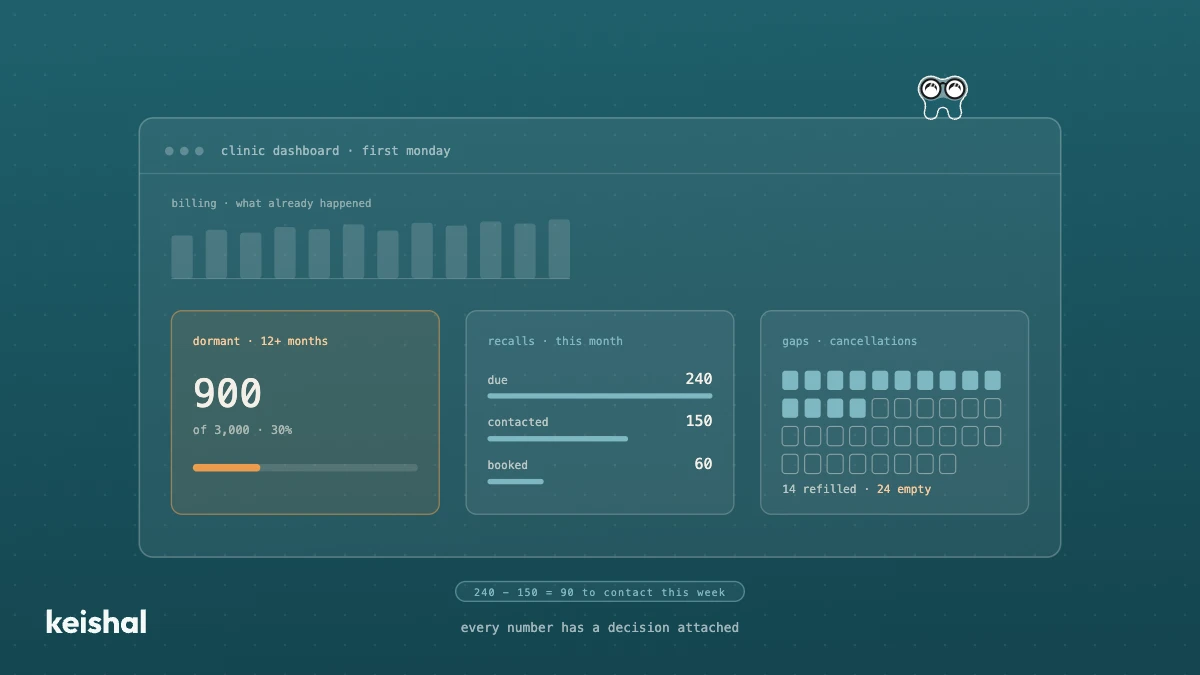
Dental clinic dashboard: what it should actually show you
A dental clinic dashboard is useful if it helps you decide something. The one in your practice management software usually shows billing and the schedule, which is the past. What it usually lacks is the patient base: how many haven't been in for over a year (900 of 3,000 = 30%), which recalls fall due this month, which gaps stayed empty and how much of your base you can actually reach. Six questions, each with its number and its decision.
What is superintelligence and what AI actually does in a dental clinic today
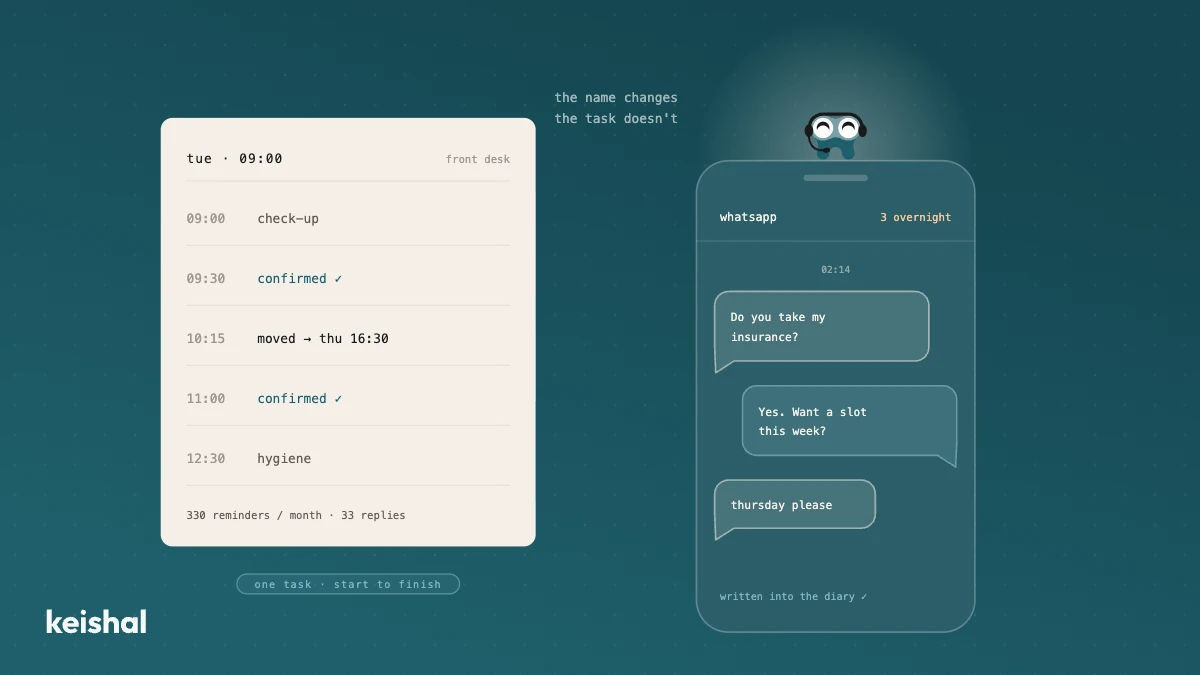
Superintelligence is a hypothetical AI that would outperform people at almost every intellectual task, and it doesn't exist today. The AI dental clinics use is narrow AI: it confirms appointments (15 × 22 = 330 reminders a month), reactivates dormant patients, answers during the 118 hours a week the clinic is closed and flags incomplete records. For a clinic, the name matters less than the specific task the tool gets done in your schedule.