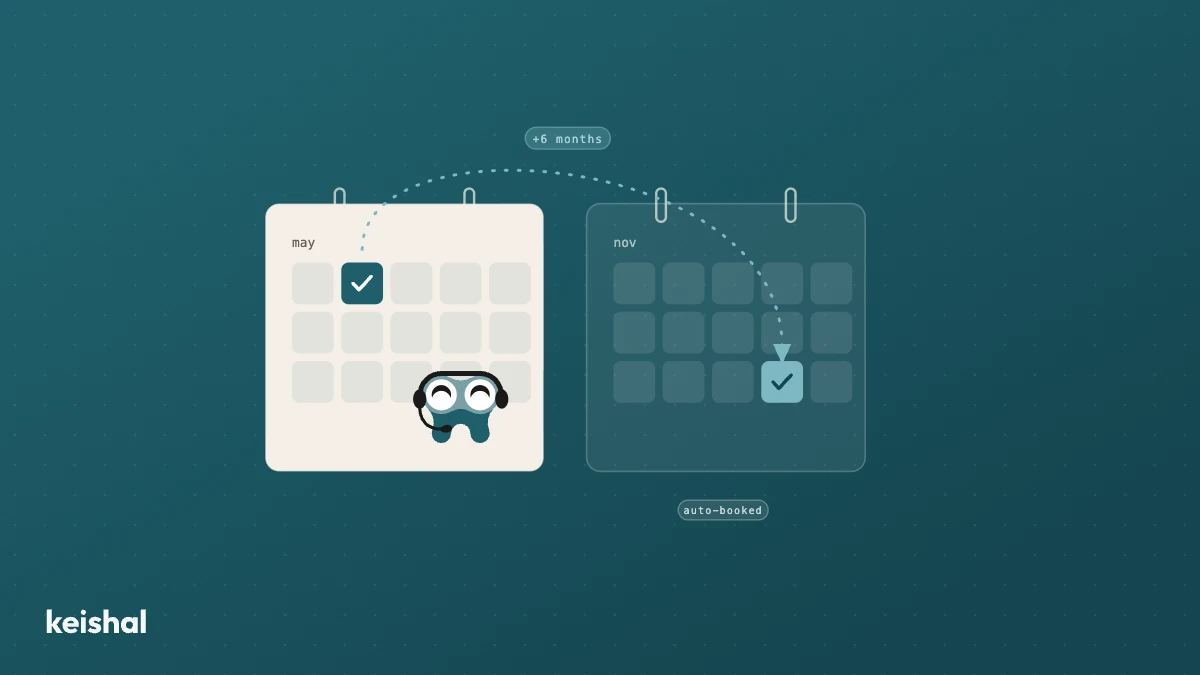
Dental recall is the system through which a clinic periodically contacts its patients so they come back for check-ups, maintenance, or pending treatment. The industry standard is to contact each patient at least once a year; clinics that optimise go to two annual contacts. Most clinics don't run recall consistently — not for lack of intent, but because the team has no time. There are three ways to solve it: manual reminders with templates, recall software, or an autonomous system that operates on the clinic's behalf. Volume is what makes it hard to sustain by hand: a clinic with 3,000 patients generates 250 to 500 recall contacts a month — at 5 minutes per contact, that's 21 to 42 hours of work a month.
Every dental clinic talks about recall. Almost none do it well.
It's the metric that most affects mid-term revenue, and the first thing that drops when the day-to-day gets busy. In this article we explain what recall actually is, why it fails at most clinics, and three ways to automate it.
What is dental recall
Dental recall is the system through which a clinic contacts its patients so they come back: periodic check-ups, maintenance, orthodontics, pending treatments. In practice, it's the engine of continuity for any dental practice.
Where the term comes from
"Recall" simply means to call back. In the dental sector it has been used for decades to describe any proactive action by the clinic to bring patients back. Today the term covers everything: phone calls, messages, automated reminders, reactivation campaigns.
What a complete recall system includes
A well-designed recall system covers at least:
- Periodic check-up reminders — based on patient status
- Maintenance reminders — cleanings, periodontal care, orthodontic adjustments
- Follow-up on pending treatments — incomplete root canals, second phases, open quotes
- Reactivation of inactive patients — those who haven't visited in 12+ months; we have a step-by-step guide to reactivating inactive patients
- Confirmation of upcoming appointments — to reduce no-shows at your dental clinic
Each one has its own logic and cadence. That's why operating recall manually is hard: it isn't one task, it's five parallel tasks that compete with the clinic's daily flow.
Why recall is the most important metric for a dental clinic
A clinic earns revenue in two ways: new patients or returning patients. New ones are expensive to acquire (marketing, referrals, first visit). The ones already in your database are almost-immediate revenue potential.
Recall is what turns that potential into real revenue.
The financial calculation
If a clinic has 3,000 active patients and operates a consistent recall system that reactivates 20% of inactive patients per quarter, we're talking about €30,000 to €50,000 per quarter in additional billing, depending on average treatment value.
If that same clinic doesn't operate recall, that revenue doesn't disappear — it simply doesn't arrive. The patient is still there, but no one brings them back. We cover this calculation in detail in our article on how much your dental clinic loses each month to inactive patients.
Why most clinics fail at recall
Here's the paradox: every dentist knows recall matters. And yet, almost no one does it well.
The reason isn't lack of knowledge. It's operational. Manual recall requires focused team time — calling one by one, leaving messages, following up, noting responses, scheduling new appointments. This competes directly with in-person patient care, daily scheduling, billing, and emergencies.
A receptionist quoted in a case from the dental software (...) puts it well:
"There are patients who have been unhappy because we didn't call them for their check-up, and they came in once it was already too late."
It's not a team failure. It's a structural problem: a dental front desk simply doesn't have enough hours in the day to run recall properly while handling everything else.
What an ideal recall system looks like
Before talking about automation, we need clarity on what a working recall actually looks like. Without that benchmark, automating poorly just amplifies the problem.
Frequency: how often to contact
The industry standard in dental care is to contact each patient at least once a year. Clinics that optimise their recall go to two annual contacts: a full check-up plus an intermediate maintenance visit. Frequency adjusts by case: monthly for orthodontics, quarterly for periodontal care, more frequent follow-up for children and adolescents.
That gives between 1 and 2 contacts per patient per year as a baseline. For a clinic with 3,000 patients, that's between 3,000 and 6,000 contacts a year — roughly 250 to 500 per month.
Channel: why WhatsApp beats email and phone
Ten years ago, recall was done by phone. Five years ago, by email. Today, the channel with the highest response rate in Spain is WhatsApp:
- WhatsApp open rate: >95%
- Email open rate: 20-30%
- Response rate to unscheduled calls: very low, especially during working hours
The average patient in Spain checks WhatsApp multiple times a day. That's where attention actually lives.
Personalisation: what the system needs to know
A recall system that doesn't know who the patient is won't work. The system needs access to at least:
- Last treatment performed
- Date of last visit
- Pending treatments or open quotes
- Relevant clinical notes (allergies, medications)
- Time preferences if recorded
Without this, the message sounds generic and the patient doesn't respond.
Follow-up: the cycle doesn't end at the first message
A single message rarely converts. Effective recall has 2-3 spaced contacts:
- Initial message reminding about the check-up or pending treatment
- If no response, a second message 5-7 days later with a different tone
- If still no response, archive for the next cycle (no further pushing)
This distributed sequence is what makes recall work. Doing it manually for 500 patients a month is practically impossible.
How to automate recall: 3 options
There are three different ways to automate recall at a dental clinic. Each makes sense in a different situation. In 2026, automating patient communication is no longer the exception: even dental software vendors presented patient-communication modules at Expodental 2026. The question is no longer whether to automate recall, but who operates it. If you're comparing specific options, here's our guide on how to choose a recall system for your dental clinic.
Option 1: Manual reminders with templates
The most basic approach: the team prepares message templates (check-up, maintenance, pending treatment) and sends them manually from the clinic's WhatsApp. If you're starting here, we have WhatsApp message templates for your dental clinic ready to adapt.
When it works: small clinics (<1,000 patients) with dedicated administrative time.
When it doesn't: when volume exceeds what one person can handle manually (typically >150 contacts/month).
Option 2: Recall software
Dental PMS like Gesden, Nubimed, Dentalink, or Flowww include basic reminder modules. There are also specialised platforms like Optimydent or Kokuai that add advanced AI automation, patient list generation, and scheduled outreach.
When it works: mid-sized clinics with someone on the team (clinic manager, senior receptionist) who has time to operate the software, configure templates, review responses, and adjust the system.
When it doesn't: when the clinic subscribes to the software but no one has time to operate it. This is a very common pattern. We cover it in detail in our article on software vs. autonomous system.
Option 3: Autonomous system that operates recall for you
An AI platform integrates with your PMS and WhatsApp, and operates the entire recall autonomously: identifying patients to contact, sending messages, managing responses, scheduling appointments in your calendar. The clinic team doesn't touch anything.
Recall is one of the many tasks artificial intelligence can operate autonomously at a dental clinic.
When it works: clinics with overloaded teams, previous failed software implementations, or a clear preference for a platform that runs without requiring attention.
When it doesn't: clinics that want full control over every single message sent to a patient.
What we've learned operating recall in real clinics
In 2026 we worked with a dental clinic that gave us access to their patient database to operate recall for 90 days. Here are the results:
- 750 patients contacted (those who hadn't visited in 12+ months)
- 150 patients recovered (20% conversion to confirmed appointment)
- €16,500 billed in resulting treatments
What matters most isn't the number, but what happened on the clinic team: nothing. They didn't have to call anyone, didn't learn new software, didn't change any habits. Recall was operated without them participating.
If you want to calculate what a properly operated recall would generate for your clinic, you can use our calculator. You enter the size of your database and the average treatment value, and it shows you the number.
If your clinic has a recall system that works, keep what you're doing. If you try but the day-to-day eats it, that's not your team's fault: it's a structural problem with a solution. Book a call and we'll show you how we handle it.
Ready to try Keishal in your dental clinic?
Book a demo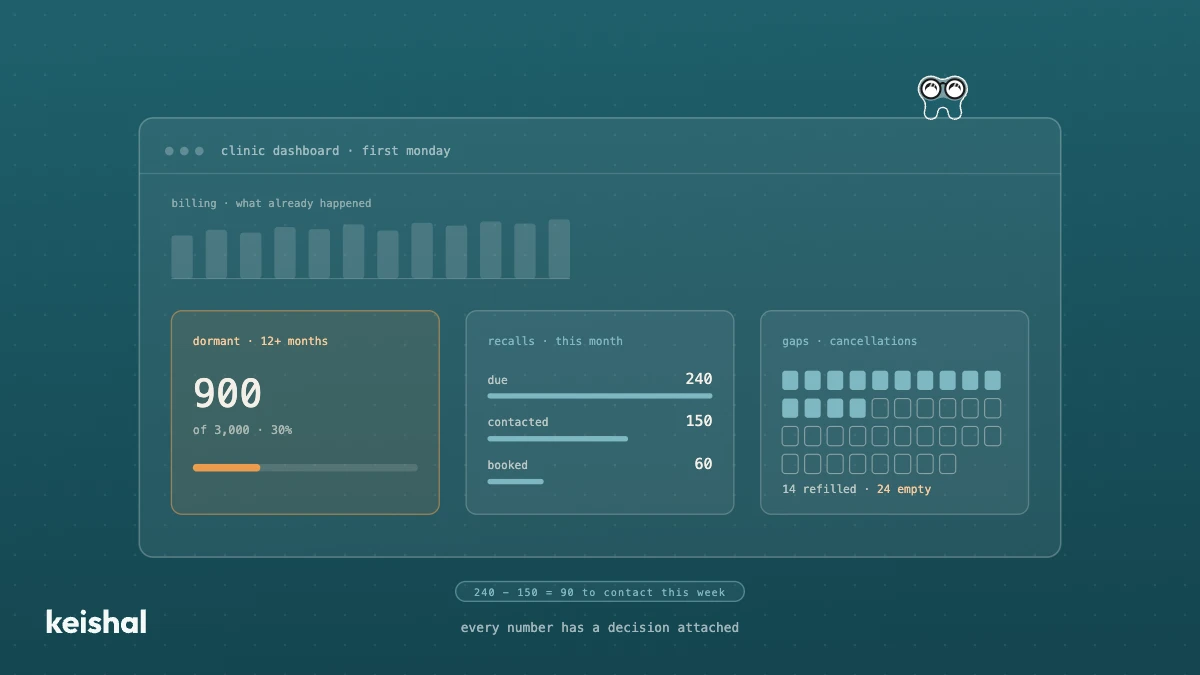
Dental clinic dashboard: what it should actually show you
A dental clinic dashboard is useful if it helps you decide something. The one in your practice management software usually shows billing and the schedule, which is the past. What it usually lacks is the patient base: how many haven't been in for over a year (900 of 3,000 = 30%), which recalls fall due this month, which gaps stayed empty and how much of your base you can actually reach. Six questions, each with its number and its decision.
What is superintelligence and what AI actually does in a dental clinic today
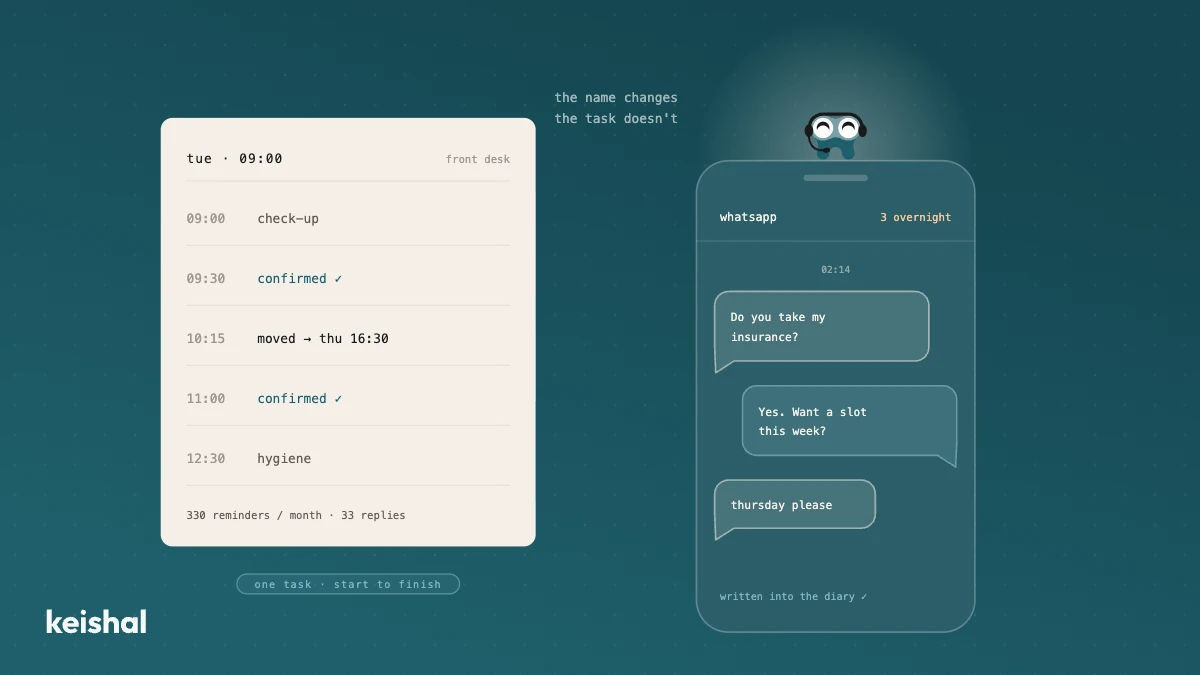
Superintelligence is a hypothetical AI that would outperform people at almost every intellectual task, and it doesn't exist today. The AI dental clinics use is narrow AI: it confirms appointments (15 × 22 = 330 reminders a month), reactivates dormant patients, answers during the 118 hours a week the clinic is closed and flags incomplete records. For a clinic, the name matters less than the specific task the tool gets done in your schedule.