
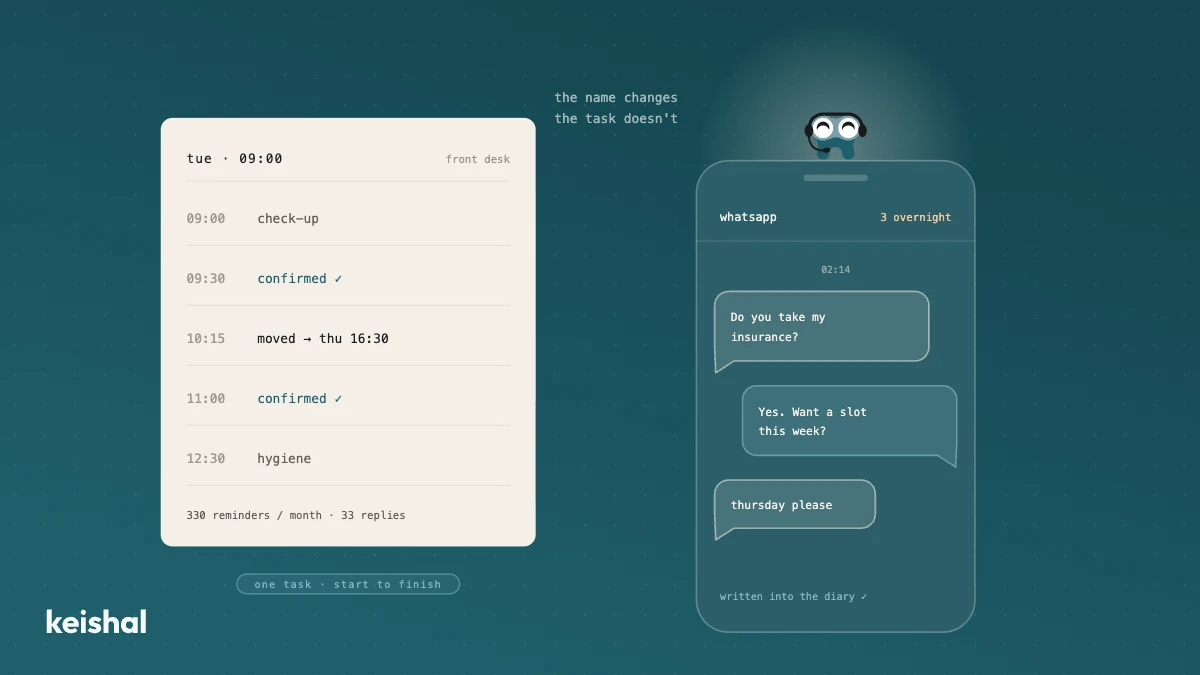
Superintelligence is a hypothetical AI that would outperform people at almost every intellectual task, and it doesn't exist today. The AI dental clinics use is narrow AI: it confirms appointments (15 × 22 = 330 reminders a month), reactivates dormant patients, answers during the 118 hours a week the clinic is closed and flags incomplete records. For a clinic, the name matters less than the specific task the tool gets done in your schedule.
Superintelligence is a hypothetical artificial intelligence that would outperform people at almost every intellectual task, not just one. It doesn't exist today.
The AI dental clinics already use is something else: systems that do specific tasks very well. They confirm appointments over WhatsApp, reactivate dormant patients or answer questions out of hours. For a clinic, the useful question isn't what the technology is called. It's what it reliably does at your front desk today.
This guide separates the two and ends with four questions to tell a promise from a result.
Why superintelligence is in the news now
On 8 October 2026, Donald Trump posted that the White House considers anyone not saying "super intelligence" to be "the enemy", according to Axios. In late September, an executive order had already set that term for US federal agencies, with no penalty for using the old one.
That is all this article needs from the news. Nothing that follows depends on it.
What is superintelligence
The term was popularised by the philosopher Nick Bostrom in his book Superintelligence (2014). He defines it, in essence, as an intellect that greatly exceeds human cognitive performance in virtually every domain. The key word is "every". It isn't about beating a person at chess or at reading an X-ray, but at everything at once.
It helps to separate three levels, because public conversation mixes them up:
| Level | What it would be | Does it exist today? |
|---|---|---|
| Narrow AI | Does one task, or a set of specific tasks, very well | Yes. It's what clinics use |
| General AI | Would match a person at any intellectual task | No. It's a research goal |
| Superintelligence | Would outperform people at almost every task | No. It's a hypothesis about the future |
Experts disagree on whether the last two levels will arrive, and when. What is clear is that no system you can hire for your clinic today belongs to either. Calling today's AI "superintelligence" changes the label, not what the technology does.
How it differs from the AI dental clinics already use
The AI that exists in a dental clinic today splits into two families. The first is clinical: it helps read X-rays or detect caries, and the decision stays with the dentist. The second is administrative: it takes on the work that isn't clinical, such as reminders, appointments, recall and patient questions.
If you want the full map, we cover it in the guide on how to apply artificial intelligence at your dental clinic.
Both families have one thing in common: they are narrow AI. They do bounded tasks, with specific data and a result you can check. A reminder system doesn't "think" about your clinic in general.
It reads tomorrow's schedule, writes to each patient and records who confirms.
That limit is exactly what makes it useful. A bounded task can be measured, reviewed and corrected. A general promise can't.
Why the name doesn't matter to your clinic
Picture a Tuesday at 9am at the front desk. The phone rings, two patients are waiting at the counter, and the clinic's WhatsApp holds the messages that arrived overnight. Someone has to confirm tomorrow's appointments and move the one for the patient who can't make it. Someone has to tell a patient whether you take their insurance.
None of that changes whether the tool is sold as "artificial intelligence", "superintelligence" or "assistant". What changes is whether the task gets done and recorded in your schedule without anyone on your team touching it.
That's why, for a clinic, the naming debate is noise. Every wave of AI news brings new promises, and almost all of them are phrased in general terms. The way not to waste time is to always bring the conversation down to the specific task.
"Every time there's AI news, someone offers me something new. I just want to know who's confirming tomorrow's appointments."
A summary of several 2026 sales conversations with dental clinic managers, not a verbatim quote.
What administrative AI does in a dental clinic today
These are four tasks administrative AI already does reliably. For each one, the arithmetic you can run with your own numbers.
1. Confirming appointments
With 15 appointments a day and 22 working days, your clinic sends 15 × 22 = 330 reminders a month. If 1 in 10 replies to cancel, move or ask something, that's 33 conversations a month someone has to handle.
A system connected to your practice software sends the reminder, collects the reply and updates the appointment. The channel where this works best is the one your patients already check. We cover it in the guide to WhatsApp for dental clinics.
2. Reactivating dormant patients
Count the patients who haven't been in for more than 12 months and multiply by your average treatment value. For example: 1,200 patients × €110 = €132,000 in treatment that isn't happening.
Not all of them would come back even if you wrote to them: some have moved and others no longer need it. But contacting them by hand, at 5 minutes per patient, is 1,200 × 5 = 6,000 minutes, or 100 hours. That's why it almost never gets done.
The full calculation is in the article on how much your dental clinic loses to inactive patients.
3. Answering out of hours
A week has 168 hours. If your clinic is open for 50, that leaves 168 − 50 = 118 closed hours, 70% of the week.
Patient questions (opening times, insurance, how to get there, what to bring to a first visit) don't wait until you open. Administrative AI answers them with the information the clinic chooses to share, and passes the ones that need a person to your team.
4. Flagging incomplete patient records
Check a sample of 100 records. If 6 have no valid phone number, then in a base of 8,000 patients that's around 480 people. No reminder or recall campaign will ever reach them.
A data quality system detects duplicates and validates phone numbers and emails. It fills in fields when the patient replies, and flags to your team what it can't resolve on its own.
None of these four tasks needs superintelligence. They need a reliable connection to your data and someone making sure it works every day. The full inventory, with what's worth automating and what isn't, is in the guide on what to automate at your dental clinic and what not.
What today's AI doesn't do
To keep the comparison honest, it's worth saying where the limits are:
- It doesn't diagnose or decide treatment. That's clinical work and stays with the dentist.
- It doesn't replace the in-person relationship. A nervous patient at the counter needs someone from your team.
- It doesn't handle ambiguity well. A complaint, a delicate situation or an unusual question should reach a person with the full context.
- It can't fix data that doesn't exist. If a record has no phone number, no system can write to that patient until someone gets one.
A vendor who tells you their AI does everything is describing a superintelligence, not a product.
Four questions to tell a promise from a result
When someone offers you an AI tool, whatever they call it, these four questions separate what it does from what it promises:
- What specific task does it do, from start to finish? "It helps with communication" isn't an answer. "It sends the reminder, collects the reply and moves the appointment" is.
- Where does it read the data from, and where does it write the result? If it doesn't read your practice software, it works blind. If it doesn't write to it, someone on your team copies every result by hand.
- What happens when it doesn't know the answer? There has to be a clear way to hand the conversation to a person, with the history, without the patient repeating themselves.
- Who operates it every day? If the answer is "your team", add those hours to the price. A tool nobody has time to use doesn't take work away.
If you only have time for one, ask the second. It's the one that separates a system that works with your clinic from a tool that answers messages. It's the difference between answering and completing the task, which we explain in what an AI agent is and how it differs from a chatbot.
How we do it at Keishal
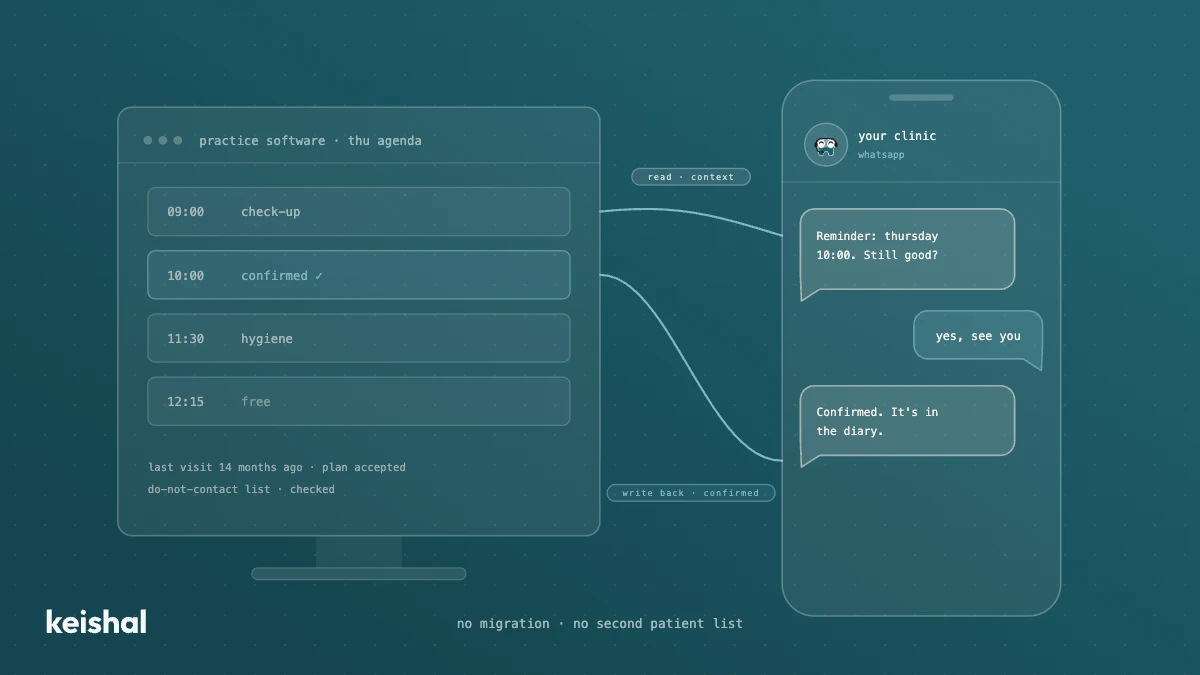
Keishal is an autonomous system that operates the non-clinical side of your dental clinic. It works on top of the practice software you already use, whether that's Gesden, Nubimed, Dentalink, Clinic Cloud or another. It reads your patients' data for context and writes appointments and status changes back into your software. No migration and no duplicated data.
On top of that connection, the system does the four tasks in this article. It sends reminders and handles the replies, reactivates dormant patients and improves the quality of the database. It also answers out-of-hours questions and escalates the ones that need a person to your team. To book, the patient chats over WhatsApp and picks their slot from a calendar link, and the appointment is written into your schedule.
The patient always knows they are talking to an AI assistant. The clinic is the controller of its patients' data. We act as processor under a signed agreement, and the data is stored in the European Union. Handling data well is also a sign of seriousness to your patients.
Your team doesn't learn any new tool. They see the results in the software they already know.
Want to see what it would do for your clinic on any Tuesday at 9am? Book a demo and we'll go through it with your numbers.
Ready to try Keishal in your dental clinic?
Book a demo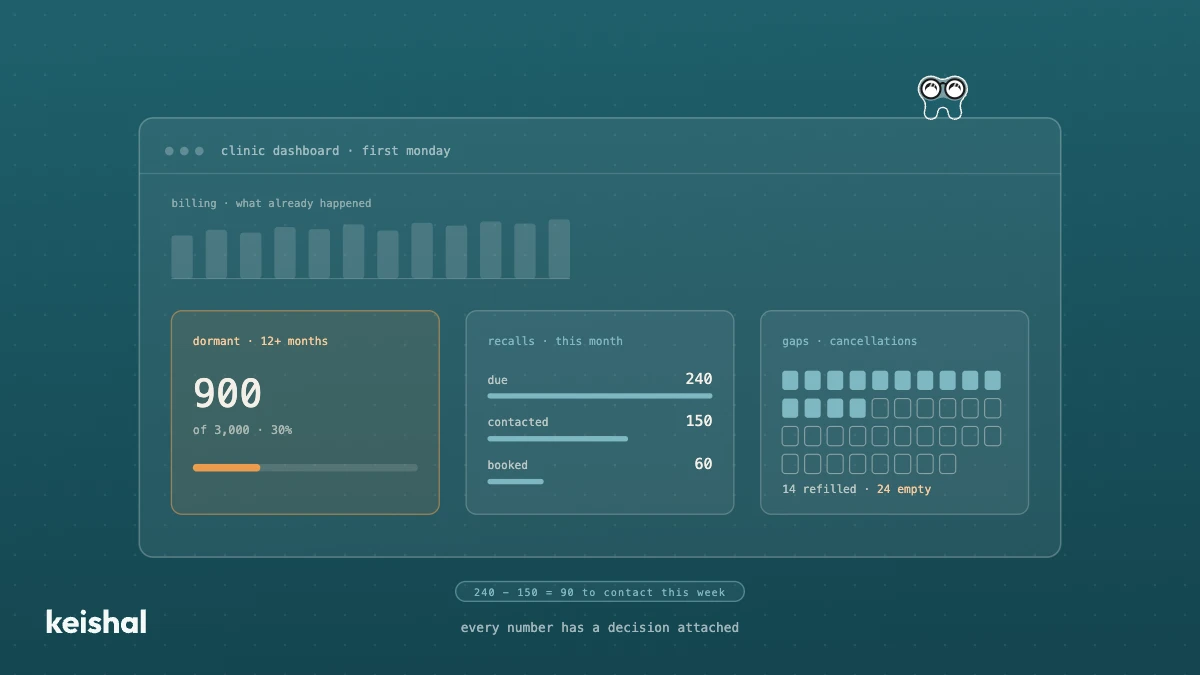
Dental clinic dashboard: what it should actually show you
A dental clinic dashboard is useful if it helps you decide something. The one in your practice management software usually shows billing and the schedule, which is the past. What it usually lacks is the patient base: how many haven't been in for over a year (900 of 3,000 = 30%), which recalls fall due this month, which gaps stayed empty and how much of your base you can actually reach. Six questions, each with its number and its decision.
Integrating AI with your dental practice software: what a real connection means
A real integration with your dental clinic's software does two jobs: it reads your patients' data for context and writes appointments, confirmations and status changes back into your program. A monthly CSV, a calendar connector or a read-only tool leaves the rest to your team: with 330 reminders a month, marking each confirmation at 30 seconds adds up to almost 3 hours. Ask for the list of supported programs and versions in writing, and check that there's no migration and no duplicate patient base.