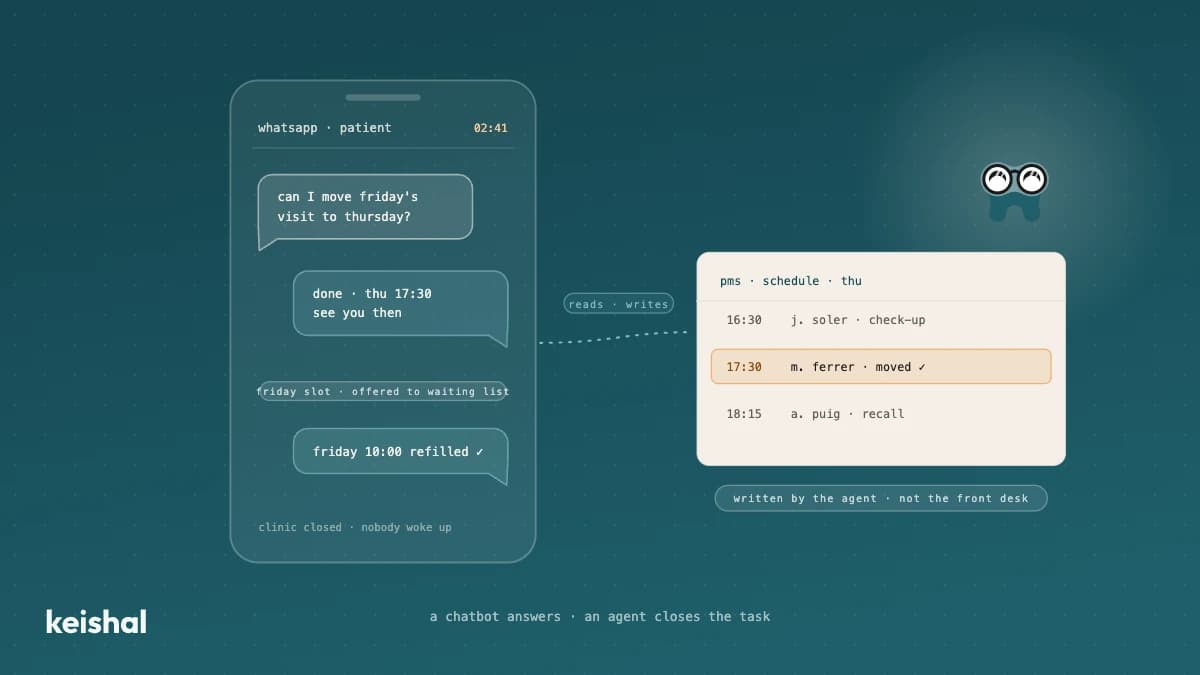
An AI agent for dental clinics is a system that completes whole administrative jobs (reminding, rescheduling, reactivating, answering) and writes the outcome into your practice management software. A chatbot answers messages; an agent closes tasks. The practical difference isn't the intelligence but two things: whether it reads and writes your clinic's real data, and who operates it. To size it with your own numbers: 15 appointments a day × 22 working days is 330 reminders a month; if 1 in 10 gets a reply, that's 33 conversations someone has to handle. An agent exists so that someone isn't your front desk.
"AI agent" is the term the dental sector has settled on in 2026 for a category that until recently went by other names: chatbot, virtual assistant, automation. If you're wondering what an AI agent for dental clinics actually is, the short answer fits in one sentence: a chatbot answers messages; an agent completes whole administrative jobs and writes the outcome into your practice management software.
The new name marks a real jump in capability, not a passing fashion. To see why it matters, one number from your own clinic is enough: of the 168 hours in a week, a typical clinic is open for about 50. During the other 118 — 70% — questions, cancellations and booking requests arrive with nobody there to handle them. A chatbot can answer some of them. An agent can resolve them: reply, reschedule, refill the slot and record all of it where your team actually works.
This article defines the category: what an agent is, what it can do at a dental clinic, and how to tell a real one from a chatbot with a new name.
What is an AI agent for a dental clinic?
An AI agent is a system that carries out a task from start to finish without anyone dictating it step by step. Applied to a dental clinic, that means three concrete things.
It takes initiative. It doesn't wait for the patient to write. It decides who to contact and when, based on the schedule and the patient record: tomorrow's reminder, the recall that lapsed two months ago, the patient who hasn't been in for 14 months.
It's connected to your data. It reads the practice management software to know who has an appointment, who left an accepted treatment plan halfway, and who hasn't come back. And it writes to it: the confirmed appointment, the status change, the summary of the conversation. Without that read-and-write connection there is no agent — just a polite answering machine.
It closes tasks, not just conversations. The output of its work isn't a well-written reply. It's an appointment on the schedule, a refilled slot, a patient with a check-up booked again.
A chatbot, even a good one, stops at the first point of contact: it answers what it's asked, when it's asked, and there its job ends. If your real question is whether you need a chatbot at all, in chatbots for dental clinics: what they solve and where they fall short we evaluate that category honestly. This article defines the one that comes after it.
From answering to doing: the jump the name sums up
In how to apply artificial intelligence at my dental clinic we explain the generations of this technology: the first systems answered through rigid menus ("press 1 to book"), the current ones understand natural language, and the ones that genuinely change how a clinic runs work connected to its real data. "AI agent" is the name the market has given that last step in 2026.
The word matters because it reorders the conversation with any vendor. When something is called a chatbot, the natural question is "what can it answer?". When something is called an agent, the right question changes: "what jobs does it do, with what data, and who is accountable for them getting done?". Those are different questions, and the second one is the filter.
It's no coincidence that at Expodental 2026 dental software vendors presented patient-communication modules: the whole category is moving this way, and the "agent" label will show up in plenty of catalogues this year.
What an AI agent can do at your clinic, with your numbers
The list of tasks matters less than the arithmetic behind each one. Run it with your own data; here it is with a typical clinic's.
Reminders that handle the reply. 15 appointments a day times 22 working days is 330 reminders a month. If 1 in 10 gets a reply — "can I move it to the afternoon?", "I won't make it after all" — that's 33 conversations someone has to handle. An agent confirms, reschedules and, when the cancellation happens anyway, offers the slot to the waiting list. The reminder is the easy part; the work is what happens after you send it.
Recall. It detects who is past their check-up interval, reaches out, answers the questions and leaves the appointment booked on the schedule. It's the discipline that in almost every clinic "is supposed to happen" and slips the moment the week gets complicated.
Reactivating dormant patients. Doing it by hand doesn't fit in a front desk's day: 1,000 dormant patients × 5 minutes per contact is 5,000 minutes, about 83 hours. An agent holds hundreds of personalised conversations at once, each with that patient's context. The limit needs saying just as plainly: not everyone will come back even if you contact them; some have moved away and others no longer need it. The number that matters is how many return from among the people nobody would have had time to call.
24/7 booking. The patient asks questions over WhatsApp — opening hours, insurance, what a first visit includes — and, when they want an appointment, receives a calendar link where they pick the slot themselves. The confirmed appointment is written into the clinic's schedule. That hybrid format, conversation plus calendar, is more reliable than an AI that "notes down" the time it thinks it understood in the chat: the patient picks the slot, and the interpretation error disappears.
Escalation with context. When the conversation is clinical, sensitive, or the agent simply doesn't know the answer, it hands it to the team with the full thread and the patient's details in front of them. Escalating without context isn't solving anything; it's moving the problem to another inbox.
None of this replaces your receptionist: the goal is to take away the repetitive volume that doesn't fit in a working day, so they can look after the patient standing at the desk. In virtual receptionist for your dental clinic: what it can take on and what stays human we draw that boundary task by task.
The difference isn't the intelligence — it's your data and who operates it
The language models behind all of these products are, by now, very good at conversation. That's why intelligence barely differentiates anymore: almost any demo impresses. The two questions that separate a real agent from a renamed chatbot are different ones.
First: does it read and write to your practice management software? A system with no access to the schedule and the patient record can't know who to remind, who to reactivate or where to record the appointment. It works on a parallel database that someone on your team will end up reconciling by hand — exactly the kind of work you wanted to get rid of.
Second: who operates it? Setting up campaigns, reviewing difficult conversations, maintaining the integration when the PMS updates: that work always exists, whoever does it. The difference between a tool your team operates and an autonomous system the provider operates is structural, and it comes before any brand. We develop that choice in software vs. service: communication at your dental clinic.
A composite summary of 2026 sales conversations (not a verbatim quote from a single client, and translated here) condenses it well: "We've had a chatbot on the website for two years. It answers well. But what the patient asks for afterwards, nobody does: the front desk still books the appointment."
There's a third dimension worth looking at squarely: communicating with patients means handling sensitive data, whatever the channel and whoever manages it. A serious vendor explains plainly where conversations are stored, with what permissions and under what data processing agreement; the specific framework is best defined with specialised data protection advice. A clinic that gets this right signals seriousness, and patients notice.
Five questions to tell whether an "AI agent" really is one
In front of any catalogue that says "agent", these five questions separate the category from the adjective.
- What data does it work with? If it doesn't read your practice management software, it decides blind: it doesn't know who has an appointment or who hasn't been in for a year.
- Where does it write the outcome? If it's a separate dashboard rather than your schedule and patient records, your team inherits new work instead of shedding it.
- Does it take initiative? Ask for a concrete example of a contact the system decides on its own — a recall, a reactivation — not one the patient starts.
- How does it book, exactly? A documented flow of conversation plus calendar link is a better sign than the promise that "the AI writes it all down".
- Who operates and maintains it? With a name and a written commitment. If the answer is "your team, with our training", it's a tool you're buying, not an agent working for you.
And if you're weighing up commissioning one built for you, the analysis changes: in developing a chatbot for your dental clinic: what it takes and when it pays off we break down what genuinely drives the cost of a custom build and when it makes sense.
Does it work with my practice management software?
It should be the first question you ask any vendor: an AI agent is worth exactly as much as its connection to the data you already have.
Keishal, our autonomous system, connects to the practice management software you already use — Gesden, Nubimed, Dentalink, Clinic Cloud, Klinikare, Flowww and others — with no migration and nothing new for your team to learn. The conversations happen on WhatsApp; the outcomes are written into your schedule and your patient records, and your team simply sees the appointments appear.
If you want to see what an agent would do with your database — how many dormant patients you have, how many reminders would go out each month — book a demo and we'll run the numbers with your data, not with averages.
Ready to try Keishal in your dental clinic?
Book a demo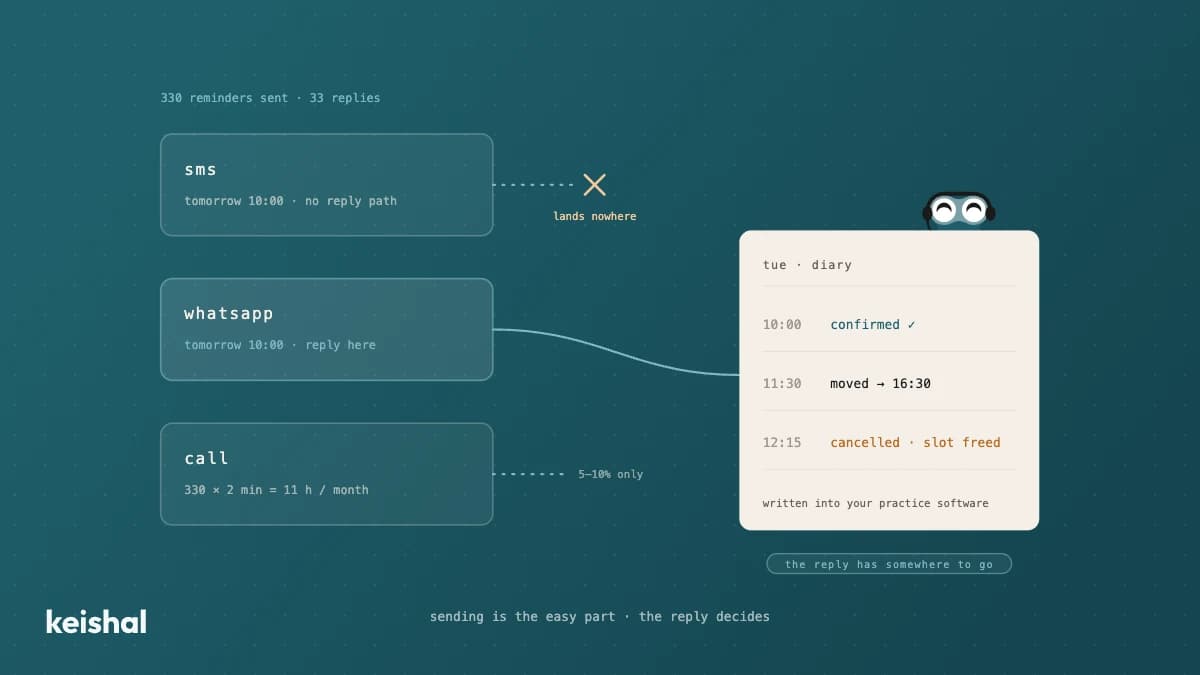
Appointment reminders for your dental clinic: SMS, WhatsApp or phone call
A diary with 15 appointments a day across 22 working days generates 330 reminders a month. If one patient in ten replies, that's 33 conversations someone has to handle: confirmations, reschedules, cancellations that open a slot. That's why the channel matters less than the reply: SMS notifies but rarely listens, WhatsApp resolves things in the same thread, and the phone call is for the cases that need it. In 2026, the real purchase decision isn't "which channel do I buy?" but "who handles what patients reply?".
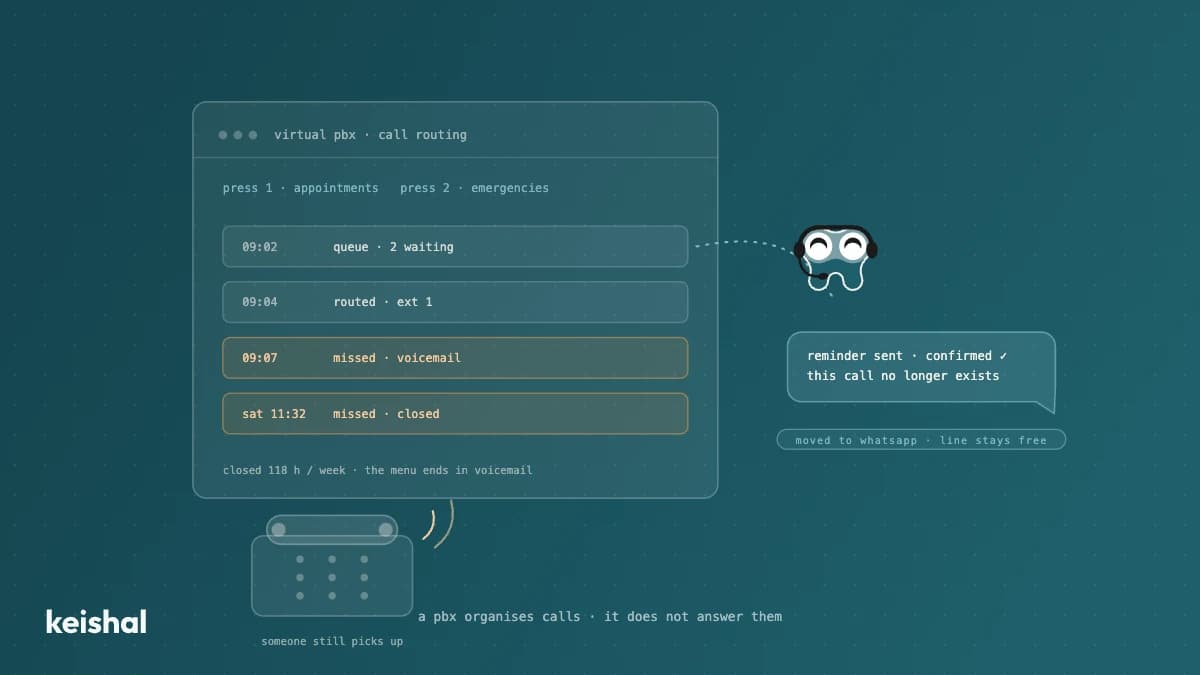
Virtual phone system for dental clinics: what it solves and what keeps ringing
A virtual phone system organises your dental clinic's calls: voice menus, hold queues, forwarding and missed-call logs. What it doesn't do is answer them: someone still picks up, and with 50 opening hours the clinic is closed for 118 of the week's 168 hours (70 %). It makes sense with several locations or lines, or when calls are lost to saturation. If the problem is volume — 40 calls × 3 minutes = 2 hours a day — the higher-leverage move is migrating repetitive tasks (reminders, bookings, questions) to WhatsApp and keeping the phone for the conversations that need it.