Developing a custom chatbot for your dental clinic involves four costs: the conversation flow (the cheap part), the connection to your practice management software (the expensive one), escalation for when the bot doesn't know the answer, and ongoing maintenance. It pays off if you have singular requirements and a technical team or committed partner to maintain it. For most 2-to-8-chair clinics, the realistic alternatives are a generic chatbot (enough for frequent questions) or an autonomous system that is already built, operated by a third party, and writes into your practice management software. The underlying problem is real: at 50 opening hours a week, 118 of the week's 168 hours (70 %) go uncovered. The decision is not whether to automate the reply, but who carries the system that automates it.
Search for "dental clinic chatbot development" and you get a full page of agencies selling exactly that: custom development. What none of them explains is whether commissioning one is a good idea for you. This guide answers that question: what developing a chatbot for your dental clinic actually takes, where the cost that never appears in the quote is hiding, and what alternatives exist before you sign anything.
The underlying problem is real, and it deserves numbers. A clinic that opens 50 hours a week leaves 118 of the week's 168 hours uncovered: 70 % of the time. A patient who writes on a Tuesday at 9pm to ask whether you take their insurance gets no reply until the next morning, and by then many have already messaged another clinic. Automating that reply makes sense. The question is whether commissioning custom development is the right way to do it.
What developing a custom chatbot actually takes
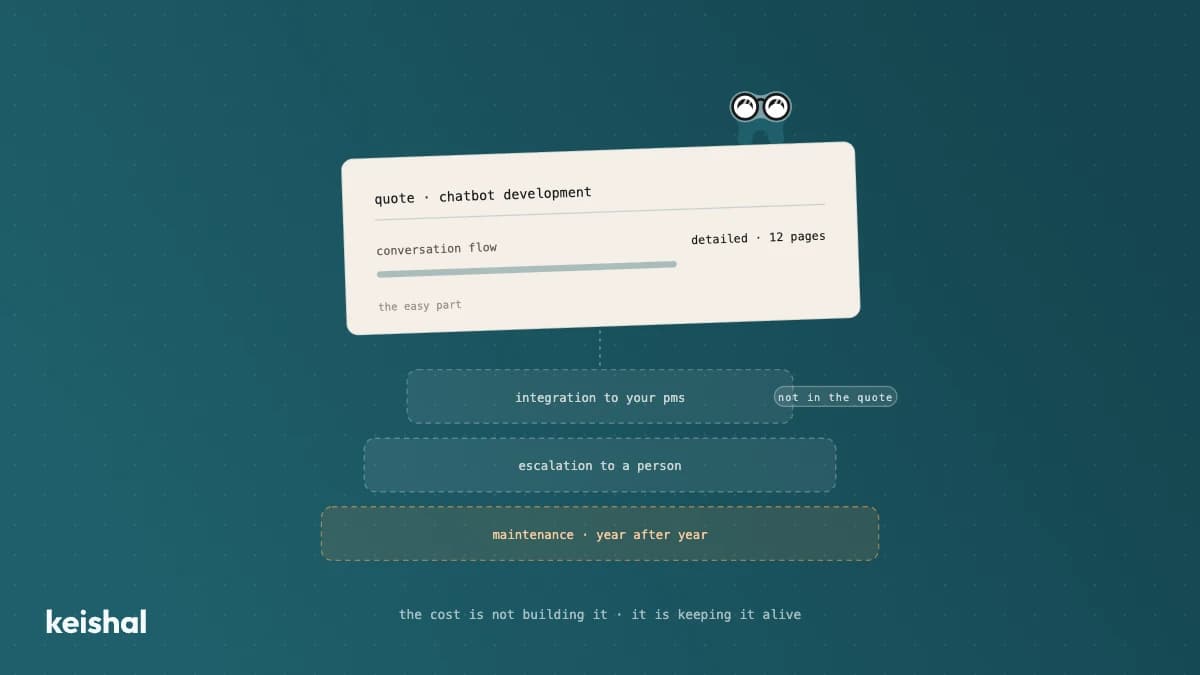
A dental clinic chatbot development project has four parts. Quotes tend to detail the first one, which is the cheapest, and tiptoe past the other three.
The conversation flow: the cheap part
Designing what the bot says (the greeting, the answers about opening hours, treatments or insurance) is the visible part of the project, and today it is the easiest. With current language models, building an assistant that chats naturally about general information takes little time and little money. If a development quote spends most of its pages on "designing the conversation flows", it is detailing the easy part.
The connection to your data: the real jump
A chatbot that only answers general questions is a glorified answering machine. The jump in value comes when the system is connected to the clinic's real data: the schedule, the appointment history, the patient's record in your practice management software. It is the difference between "we're open 9 to 7" and "you've had a cleaning pending since March — does Thursday work for you?".
That connection is the expensive, difficult part of the development. Every practice management system integrates in its own way, and the integration has to be built, tested and fixed again every time the software updates. In our guide on how to apply artificial intelligence at a dental clinic we call this the generation jump: what separates a chatbot from a useful system is not the model's intelligence, it is the connection to your clinic's data.
Connecting a bot to patient data also adds another layer of work: you are handling sensitive data. That is not a reason to drop the project, but it is a reason for the design to cover, from day one, how that data is protected — something best defined with specialised data protection advice. A project that takes this seriously signals seriousness to the patient too.
Escalation: what happens when the bot doesn't know
No chatbot answers 100 % of questions, and it shouldn't try. A patient in pain after an extraction, a complaint, a clinical doubt: the bot must not improvise there. The project has to define what happens at that moment: who the conversation reaches, with what context, and how fast. A bot without well-designed escalation doesn't reduce the front desk's workload; it adds to it, because it creates one more inbox somebody has to check.
Maintenance: the cost that never appears in the quote
The development is delivered once; the chatbot works, or stops working, every week. Opening hours change, the team changes, your practice management software updates and the integration breaks, the language model you built on becomes obsolete. Somebody has to be on the other side to fix it, and that somebody costs money every month. Before signing a development contract, the key question is not "how much does it cost to build?" but "who maintains it a year from now, and with what written commitment?".
Who handles the replies: the question almost nobody asks
Suppose the development goes well. The bot works, patients write more because now they actually get answers, and a share of those conversations needs a person: confirming a particular case, resolving a clinical doubt, handling an urgency.
Run the numbers on your own clinic. If 3 conversations arrive per weeknight outside opening hours and around 8 over the weekend, that is about 23 a week: more than 90 a month. The bot will resolve part of them; the rest reaches your team, and it reaches them at any hour. A well-built chatbot doesn't eliminate the care workload: it shifts it and makes it visible. If the plan is for reception to absorb it "when they can", the project has an operational hole, not a technical one. How to organise that coverage without growing the team is what we cover in the guide to 24/7 patient support without expanding reception.
"They quoted the chatbot in full detail. What nobody explained was who would answer when the bot didn't know what to say." That is not a verbatim quote: it is a summary of several sales conversations we have had in 2026 with clinics coming out of a custom development, and it condenses the pattern we hear most often.
When custom chatbot development pays off
There are cases where custom development is the right choice, and it is worth saying so plainly:
- You have genuinely singular requirements. Flows no existing product covers: a large group's own protocols, integrations with uncommon internal systems, a very specific operation that justifies building instead of adapting.
- You have an in-house technical team, or a partner committed for the long term. Having someone build it is not enough: you need someone to operate it, update it, and respond when it fails on a Sunday. If your group has a technology team, this is viable.
- The chatbot is one piece of something bigger. If you are building your own platform, as some chains do, the chatbot is one more module of an investment you have already decided on for other reasons.
If you recognise yourself in one of those three cases, a well-planned development can give you exactly what you need. For a 2-to-8-chair clinic with no technical team, it rarely fits: the real cost is not building it, it is keeping it alive for years.
When a generic chatbot is enough
If what you need is to answer frequent questions (opening hours, location, directions, first doubts about treatments), a generic chatbot with no custom development may be enough. It is configured in days and solves the most superficial layer of the problem.
The market is moving too: at Expodental 2026, dental software vendors themselves presented patient-communication modules, a sign that automated replies are shifting from an exotic project to an expected layer. That works in your favour: there are more and more options that don't require developing anything.
The generic chatbot's limits are just as clear: it doesn't know who the patient is, it can't see the schedule, and it writes nothing into your practice management software. We analyse that option in depth in what chatbots for dental clinics solve and where they fall short: if your question is "do I need a chatbot at all?", start there. The guide you are reading answers the next question: "should I commission one to be built for me?".
The third option the search results don't show you
Between the generic chatbot (cheap but disconnected) and custom development (connected but yours forever) there is a third path the agencies in the search results rarely mention: an autonomous system that is already built, connected to your practice management software, and operated by a third party.
That is the category Keishal works in. The conversation with the patient happens over WhatsApp; when they want to book, they receive a calendar link where they pick the slot themselves, and the appointment is written into your schedule. Questions the system shouldn't answer are escalated to a person with the full context of the conversation. And the maintenance (integrations, models, schedule changes) is not yours: the system is operated for you, and your team only sees the results.
The structural difference with custom development is who carries the system for the next five years. The difference with the generic chatbot is the connection to your data. We develop that category comparison in software vs. autonomous system and, applied to the reception role, in what a virtual receptionist can take on and what stays human.
The five questions that decide it
If you are weighing chatbot development for your dental clinic, these five questions separate a good project from an expensive problem:
- Does it connect to my practice management software, reading and writing? If it only "answers questions", it is an answering machine: your team will still be booking the appointments by hand.
- What happens when it doesn't know the answer? Ask to see the real escalation flow: who the conversation reaches, with what context, how fast.
- Who maintains it a year from now, and under what commitment? A development delivered without contracted maintenance stops working silently.
- Who handles the conversations the bot generates? If the answer is "your team, when they can", size that workload before signing, not after.
- How much of the quote is conversation flow and how much is integration? If almost all of it is the former, you are being charged for the easy part.
A serious provider answers all five without flinching. And if, going through them, you conclude you don't want to carry the development, or the maintenance, or the replies, the question changes: it stops being "who builds it for me?" and becomes "who operates it for me?". If you want to see how that third option works with your clinic's own numbers, book a demo and we'll show you on your real case.
Ready to try Keishal in your dental clinic?
Book a demo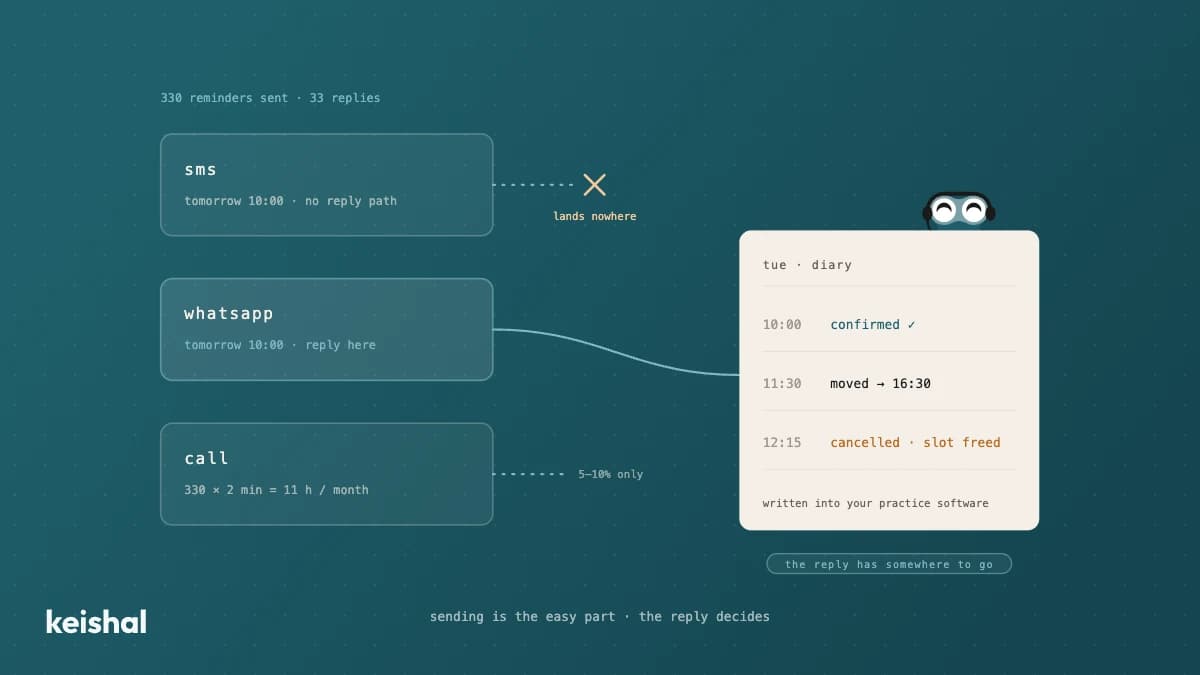
Appointment reminders for your dental clinic: SMS, WhatsApp or phone call
A diary with 15 appointments a day across 22 working days generates 330 reminders a month. If one patient in ten replies, that's 33 conversations someone has to handle: confirmations, reschedules, cancellations that open a slot. That's why the channel matters less than the reply: SMS notifies but rarely listens, WhatsApp resolves things in the same thread, and the phone call is for the cases that need it. In 2026, the real purchase decision isn't "which channel do I buy?" but "who handles what patients reply?".
Virtual phone system for dental clinics: what it solves and what keeps ringing
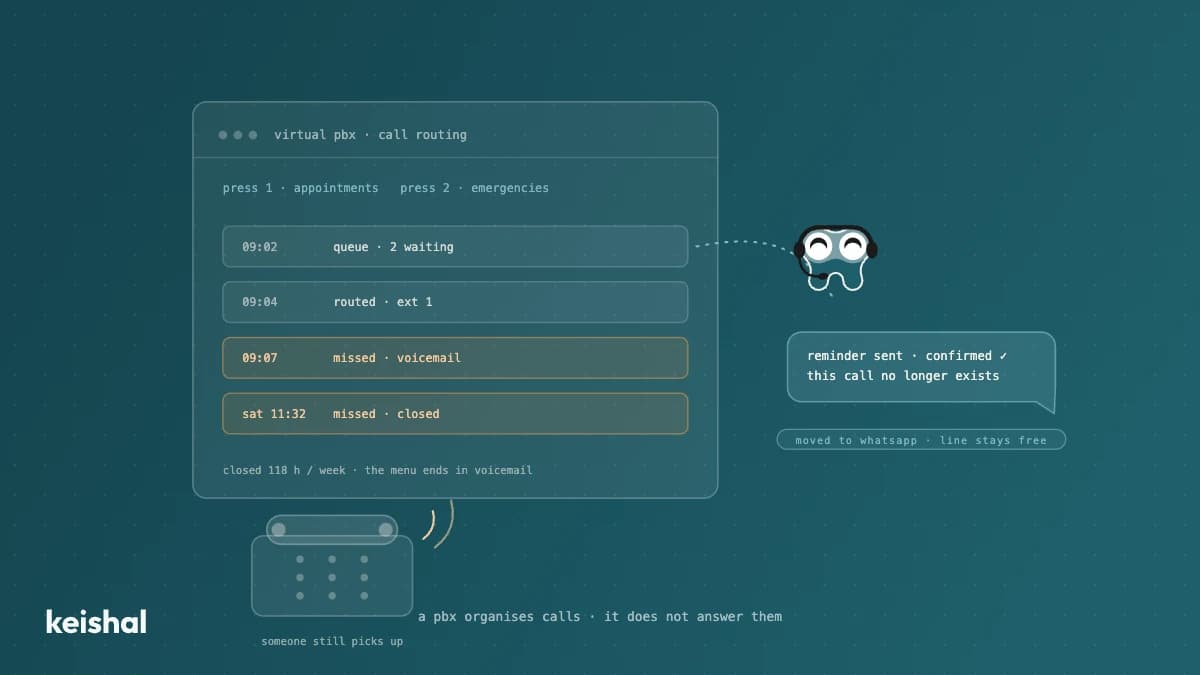
A virtual phone system organises your dental clinic's calls: voice menus, hold queues, forwarding and missed-call logs. What it doesn't do is answer them: someone still picks up, and with 50 opening hours the clinic is closed for 118 of the week's 168 hours (70 %). It makes sense with several locations or lines, or when calls are lost to saturation. If the problem is volume — 40 calls × 3 minutes = 2 hours a day — the higher-leverage move is migrating repetitive tasks (reminders, bookings, questions) to WhatsApp and keeping the phone for the conversations that need it.