
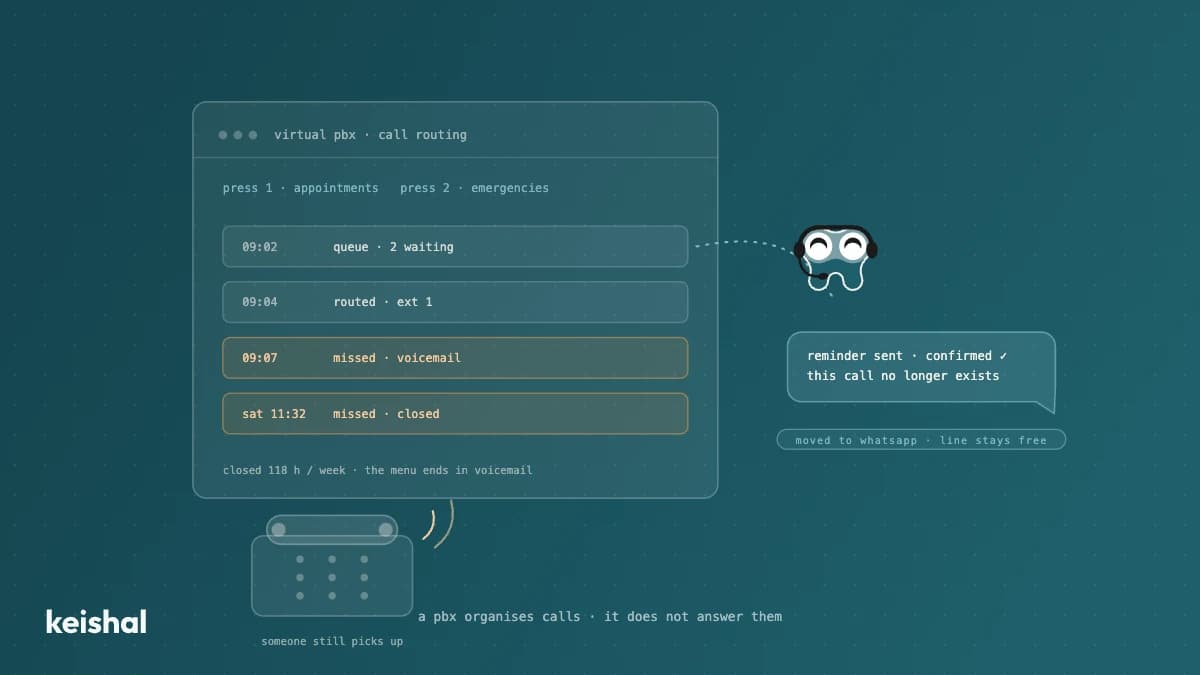
A virtual phone system organises your dental clinic's calls: voice menus, hold queues, forwarding and missed-call logs. What it doesn't do is answer them: someone still picks up, and with 50 opening hours the clinic is closed for 118 of the week's 168 hours (70 %). It makes sense with several locations or lines, or when calls are lost to saturation. If the problem is volume — 40 calls × 3 minutes = 2 hours a day — the higher-leverage move is migrating repetitive tasks (reminders, bookings, questions) to WhatsApp and keeping the phone for the conversations that need it.
If you've ended up here comparing virtual phone systems for your dental clinic, the phone has probably outgrown you: the line is busy when two patients call at once, it rings while the front desk is helping the person at the counter, and nobody knows how many calls go unanswered each week. A virtual phone system fixes part of that, and it deserves to be said plainly. But before comparing voice menus and pricing tiers, separate what it solves from what it doesn't: your clinic can only pick up during opening hours, and even with a generous 50-hour week, 118 of the week's 168 hours have nobody on your end of the line. That's 70 % of the time. During those hours, the best voice menu in the world ends in a voicemail box.
What a virtual phone system is (and what it isn't)
A virtual phone system (a cloud PBX) is internet telephony: it replaces the physical switchboard with a cloud service managed from a web panel. The usual features are recognisable:
- One main number with a voice menu ("press 1 for appointments, 2 for emergencies").
- Extensions for each desk or room, and hold queues with music when every line is busy.
- Schedules and forwarding: outside opening hours, calls go to voicemail or an on-call mobile; on holidays, wherever you decide.
- Call logs: answered, missed, duration, time bands.
- Call recording and professionally voiced greetings.
You pay per line and extension, no new hardware beyond the handsets, and it scales easily: a second location is added in the panel rather than wired in.
What it is not: someone answering for you. Everything it does happens before or after the conversation. It decides the route of each call until a person on your team picks it up, and it logs what happened to the ones nobody picked up. It organises the traffic; the work of answering it stays exactly the same, done by the same people.
What a virtual phone system actually solves
Said fairly, because for certain problems it is the right tool:
- Several locations or lines under one number. If you run two clinics and calls ring at the wrong one, or each location has a different number and patients mix them up, routing is exactly what you need.
- No more calls lost to a busy tone. The hold queue keeps the second caller instead of pushing them out with an engaged signal. For a clinic with early-morning call peaks, that's a real improvement.
- Visibility for the first time. You'll know how many calls are missed, at what times, on which days. Used well, that data lets you size the front desk with numbers instead of impressions.
- Schedules and forwarding that don't depend on anyone's memory. Holidays, summer afternoons, vacations: the logic is configured once and stops failing.
- A more polished first contact. A clear greeting and a short menu make a better impression than twenty unanswered rings.
If your diagnosis is a routing problem — calls arriving badly, at the wrong place, or on a saturated line while another sits free — a virtual phone system solves it well at a reasonable monthly cost.
What no phone system fixes: someone still has to pick up
A hold queue doesn't serve patients; it holds them. A menu doesn't answer; it sorts. At the end of every well-configured route there is still a person on your team picking up the phone, with the same hands and the same hours as before you signed anything.
Run the numbers on your own clinic, because the numbers are what decide this purchase. If you take around 40 calls a day and each lasts about 3 minutes, that's 120 minutes: 2 hours of phone every day. Over a 22-working-day month, 44 hours. A phone system organises those 44 hours and distributes them better; it doesn't shrink them. The person who answered them still answers them, now with statistics.
And outside opening hours it does something uncomfortable: it turns the invisible into a list. The weekend's missed-call log is pending work with names and timestamps. On Monday morning someone has to return those calls, on top of handling Monday's own — and Monday is precisely the heaviest phone day.
"We installed a phone system a year ago. It sounds professional and the line is never busy anymore. But the same people still answer every call, and the front desk goes through Saturday's missed-call list on Monday, when some of those patients have already booked somewhere else."
(Summary of 2026 sales conversations with 2-8 chair clinics; translated, not a verbatim quote.)
The prior question: how many of your calls need to be calls?
Before investing in organising calls better, it's worth asking how many of them should exist at all. Go through one week of phone traffic and sort it:
- Appointment reminders and confirmations. With 15 appointments a day over 22 working days, that's 330 reminders a month. None of it needs a voice: a WhatsApp message with a confirmation button handles it, and only a fraction turns into a conversation.
- Booking or moving an appointment. No voice needed either. 24/7 online appointment booking — a WhatsApp conversation plus a calendar link where the patient picks their own slot — also captures the requests that arrive while the clinic is closed, and with 118 closed hours a week those are not few.
- Repetitive questions. Opening hours, insurance, how to prepare for a visit, whether you treat children. This is the textbook case for answering patient questions 24/7, with escalation to your team when the question calls for it.
- The ones that really are calls. Acute pain, questions about an ongoing treatment, patients who simply prefer to talk. These deserve the phone — and deserve to find it free.
Every repetitive task moved to an asynchronous channel is a call that stops existing. That's the underlying move: WhatsApp as the clinic's communication channel, with its uses and its data-protection layer, not as a replacement for the phone but as the place where the tasks that never needed a voice now live. Not everything migrates — there will always be calls, and that's fine — but the volume left at the end is a different number.
The industry is already moving this way: at Expodental 2026, dental software vendors themselves presented patient-communication modules. The real question is no longer whether these tasks will leave the phone, but who will operate them once they do.
When a virtual phone system does make sense
- You have two or more locations, or several lines, and need the main number to distribute calls properly between them.
- You lose calls to peak-time saturation. The problem is the busy tone, not missing hands: your team can answer if calls arrive ordered and queued.
- You need the data. You want to know how many calls are missed and when, to size the front desk or adjust hours with numbers in front of you.
- Your phone schedule is complex and currently depends on someone remembering to forward the line on the way out.
And the opposite case, said just as plainly: with one location, one line and a team that doesn't pick up because they're with the patient at the counter, a voice menu adds no hands. It will neatly organise a queue that keeps waiting for the same busy person.
Phone system, virtual receptionist or autonomous system: three different purchases
Keep them apart, because they don't compete for the same job:
- The virtual phone system is infrastructure. It answers "where do calls come in?".
- The virtual receptionist answers "who picks up?". If that's your real search — who covers reception — the honest answer, with what it can take on and what it can't, is in what a virtual receptionist can take on.
- The autonomous system answers "how many calls are needed at all?". It operates reminders, bookings, answers and reactivation over WhatsApp, and writes every outcome — the appointment, the confirmation, the status change — into the software you already use: Gesden, Nubimed, Dentalink, Clinic Cloud and others, with no migration and nothing new for your team to learn. What's worth delegating and what isn't is covered in what to automate at your dental clinic and what not.
The part we owe you in plain words: Keishal does not answer voice calls. What it does is reduce the volume that reaches the phone, moving the repetitive tasks to WhatsApp and leaving the line free for the conversations that need it. That's why a phone system and an autonomous system don't exclude each other: the first organises the calls that remain; the second makes fewer calls remain.
Five questions before signing up for a virtual phone system
- How many of your calls could stop being calls? Audit one week. If half are reminders, bookings and repetitive questions, your problem is volume, not routing.
- Who will answer the calls the menu sorts? If the answer is "the same people as today, who already can't keep up", the queue will only make the wait more elegant.
- What happens during closed hours? With a 50-hour week, that's 118 hours. Voicemail? Who listens to it, and when?
- Does it write anything into your practice software? A phone system manages the call, not the appointment: everything agreed by phone still gets typed into the schedule by hand.
- What will you do with the missed-call report? The data is only worth something if someone has hours to return the calls. If nobody does, it's a list of patients who have already phoned somewhere else.
Start with the volume, not the menu
A well-chosen virtual phone system organises your clinic's call traffic, and in specific scenarios — several locations, several lines, calls lost to saturation — it's a sensible purchase. What it cannot do is answer, shrink the 2 daily hours of phone work, or cover the 70 % of the week when the clinic is closed.
If you want to see what your phone looks like once reminders, bookings and repetitive questions stop coming through it — with every outcome written into your practice software — book a demo and we'll go through it with your own numbers.
Ready to try Keishal in your dental clinic?
Book a demo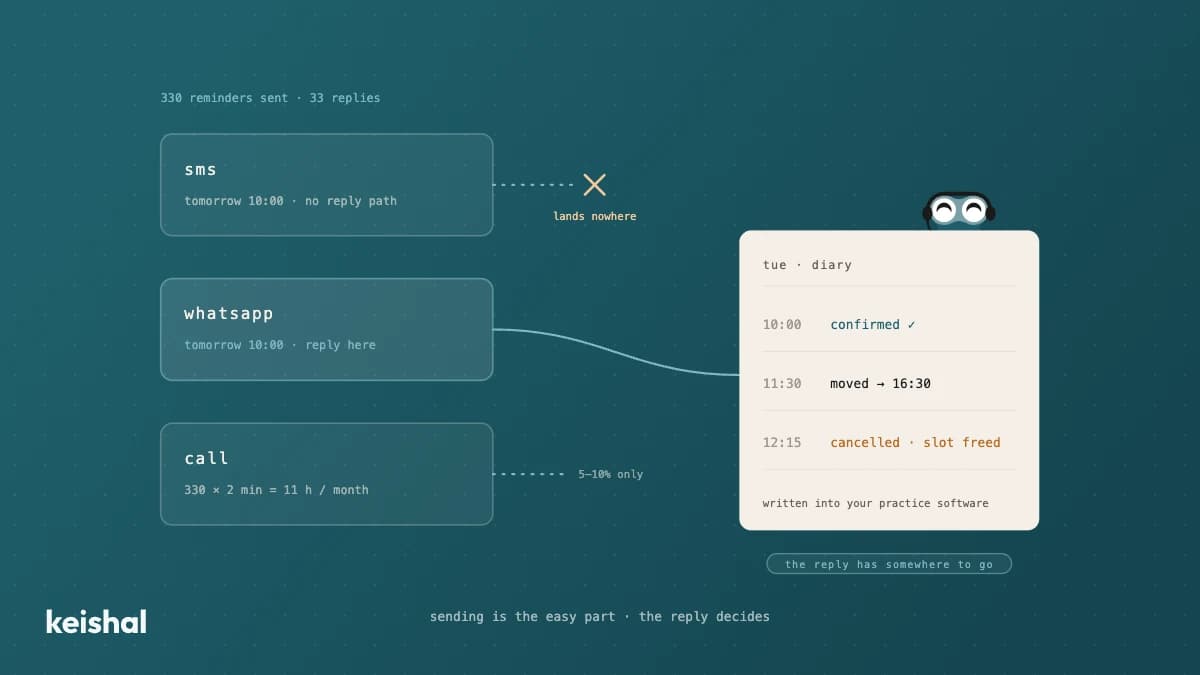
Appointment reminders for your dental clinic: SMS, WhatsApp or phone call
A diary with 15 appointments a day across 22 working days generates 330 reminders a month. If one patient in ten replies, that's 33 conversations someone has to handle: confirmations, reschedules, cancellations that open a slot. That's why the channel matters less than the reply: SMS notifies but rarely listens, WhatsApp resolves things in the same thread, and the phone call is for the cases that need it. In 2026, the real purchase decision isn't "which channel do I buy?" but "who handles what patients reply?".
AI agent for dental clinics: what it is and how it differs from a chatbot
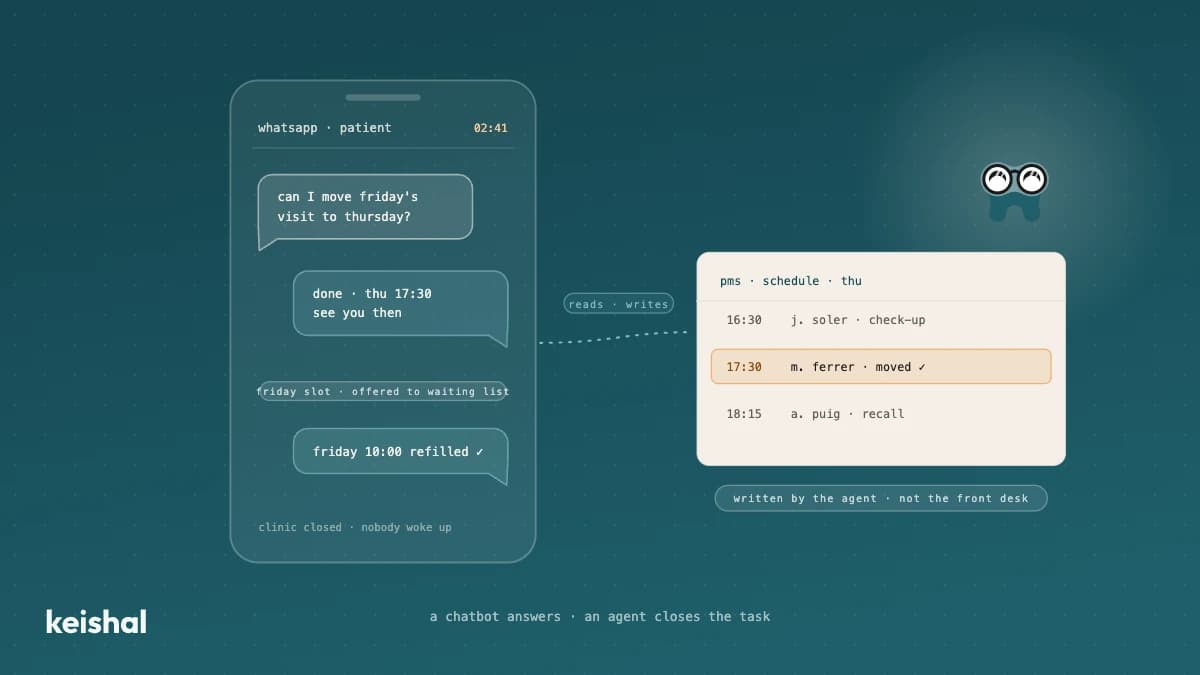
An AI agent for dental clinics is a system that completes whole administrative jobs (reminding, rescheduling, reactivating, answering) and writes the outcome into your practice management software. A chatbot answers messages; an agent closes tasks. The practical difference isn't the intelligence but two things: whether it reads and writes your clinic's real data, and who operates it. To size it with your own numbers: 15 appointments a day × 22 working days is 330 reminders a month; if 1 in 10 gets a reply, that's 33 conversations someone has to handle. An agent exists so that someone isn't your front desk.