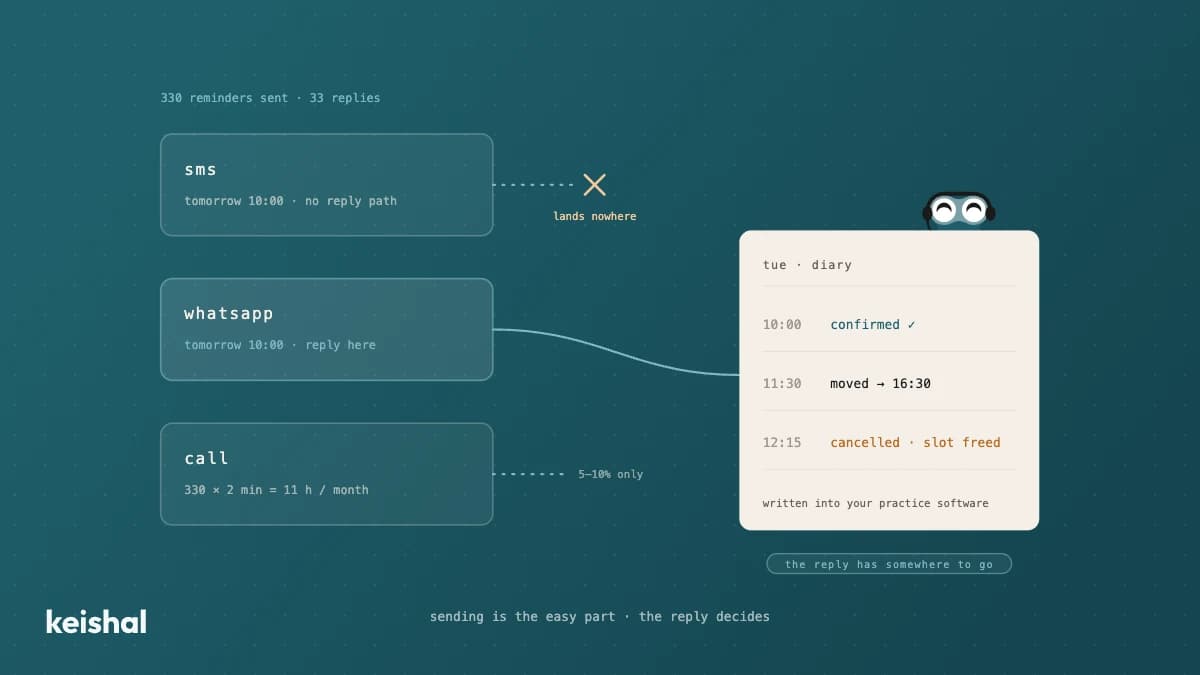
A diary with 15 appointments a day across 22 working days generates 330 reminders a month. If one patient in ten replies, that's 33 conversations someone has to handle: confirmations, reschedules, cancellations that open a slot. That's why the channel matters less than the reply: SMS notifies but rarely listens, WhatsApp resolves things in the same thread, and the phone call is for the cases that need it. In 2026, the real purchase decision isn't "which channel do I buy?" but "who handles what patients reply?".
Search for "appointment reminders for a dental clinic" and you get pages of sending platforms: so many texts for so much a month. They all answer the wrong question. Sending reminders is the easy part; what decides whether your schedule stays protected is what happens when the patient replies.
The numbers come from your own diary, not from any study. A clinic running 15 appointments a day across 22 working days sends 330 reminders a month with just one message per appointment. Multiply your daily appointments by your open days and you have your own figure.
This guide compares the three channels — SMS, WhatsApp and the phone call — honestly: when each one genuinely makes sense, what no sending provider will tell you, and the structural question almost nobody asks before buying: who is going to handle the replies.
A reminder with no reply path doesn't prevent the no-show
A notification the patient can't answer does something more modest than it promises: it documents the no-show instead of preventing it. The patient who can no longer make it knows the moment they read your message. If replying is easy, they tell you, and that slot can be refilled in time.
If they can't reply — or their reply lands in a dashboard nobody checks — the chair stays empty anyway, only now with a "delivered" tick in the sending log.
That's why the reminder is the first layer of your no-show defence, not the whole defence. What to do with the gaps that open up anyway — waiting list, refilling the slot in minutes — is covered in how to reduce no-shows at your dental clinic. Here we focus on the decision that comes first: which reminder system you set up, and over which channel.
It's also worth separating two disciplines that often get mixed up. A reminder confirms an appointment that already exists: tomorrow's, the day after's. Recall brings back the patient who has no appointment at all — the check-up that was due months ago. They are different systems with different metrics, and recall has its own guide.
The arithmetic: 330 reminders and 33 conversations a month
Back to the clinic above: 15 appointments × 22 days = 330 reminders a month. How many patients reply? Use your own figure; to size it, even one in ten replying already gives you 33 conversations a month that someone has to handle. And replies aren't a uniform chore — each one asks for something different:
- The confirmation needs one tap, and needs to be recorded in the diary, not in the memory of whoever read it.
- The reschedule needs solving on the spot. If the patient has to call on Monday to move Tuesday's appointment, that call often never happens — and neither does the appointment.
- The cancellation is worth money if it arrives in time: it's a slot the waiting list can still recover.
Thirty-three conversations a month don't sound like much until they land in the same inbox as the phone, the front desk and the patients in the waiting room. And they arrive whenever they arrive: with 50 opening hours a week, the clinic is closed for 118 of the week's 168 hours — 70%. Some of those replies will be born while the clinic is closed. Keep that figure — we'll need it again when it's time to decide who handles all of this.
SMS reminders: when they genuinely make sense
SMS has real virtues and we won't talk them down. It reaches any phone with nothing to install, it almost always gets read, and for a pure notification — "you have an appointment tomorrow at 10:00" — it does the job. If part of your patient base doesn't use WhatsApp, SMS is the natural fallback, and keeping it for that group is good practice, not nostalgia.
What no SMS provider puts on its pricing page is the return journey. Most sending platforms use alphanumeric sender IDs that can't receive replies, or numbers whose replies land in a separate dashboard someone has to remember to open. In practice, SMS works in one direction. And the usual escape hatch — "to change your appointment, call us on…" — hands the work straight back to the phone line you were trying to unload.
The operational translation: SMS is a good notification channel and a poor conversation channel. It works when what you need is for the patient to know; it falls short when you need the patient to act.
WhatsApp reminders: the channel where the reply has somewhere to go
WhatsApp is the channel most of your patients already open every day to talk to everyone else. For a reminder, that changes the nature of the message: the reply is born in the same thread. Confirming is one tap; asking to move the appointment is one sentence; cancelling doesn't require calling during office hours, so the cancellation arrives earlier and the slot recovers better. And it carries replies an SMS would never collect: "can I come in if I'm on antibiotics?", "will I need someone to drive me home?".
What to actually write in each message — reminder with confirmation, reschedule, cancellation — is covered with copy-ready examples in WhatsApp message templates for your dental clinic.
The honest trade-off: WhatsApp generates more replies precisely because replying is easy. Choosing it doesn't reduce the 33 conversations from the earlier arithmetic — it probably increases them. It's the good version of the problem (every reply is information that protects your schedule), but it is more handling work, not less, and you need to know in advance who absorbs it.
Doing it properly also means doing it seriously: the WhatsApp Business API with recorded consent, not the personal WhatsApp on a front-desk phone. Communicating with patients means handling sensitive data whatever the channel, and a patient who sees their clinic take care of that detail trusts it more. The uses and data protection side of WhatsApp for dental clinics has its own guide.
The phone call: for the appointments that need it
There are appointments where a call is the right channel, and it's worth saying so plainly. Surgery with pre-op instructions — fasting, medication, someone to accompany the patient — deserves a voice confirming the patient has understood. An older patient who doesn't use messaging deserves the channel they do use. And a patient with a history of no-shows sometimes needs the explicit commitment that comes from talking to a person.
What doesn't survive the arithmetic is the call as the default mechanism: 330 reminders × 2 minutes per call = 660 minutes — about 11 hours a month on reminders alone, before counting the patients who don't pick up first time and need retrying. The call is an excellent channel and a terrible system. Reserve it for the 5-10% of appointments that truly ask for it.
The question that decides the purchase: who handles the replies?
Whichever channel you choose, the 33 conversations from the start of this article end up somewhere. There are only two possible answers.
Reception, with a tool. The platform sends and your team replies. It works if the volume is low and someone owns that inbox on Friday at 8pm too. The limit is usually not the tool but the capacity: the same person already covers the desk and the phone, and replies also arrive during the 118 hours a week the clinic is closed.
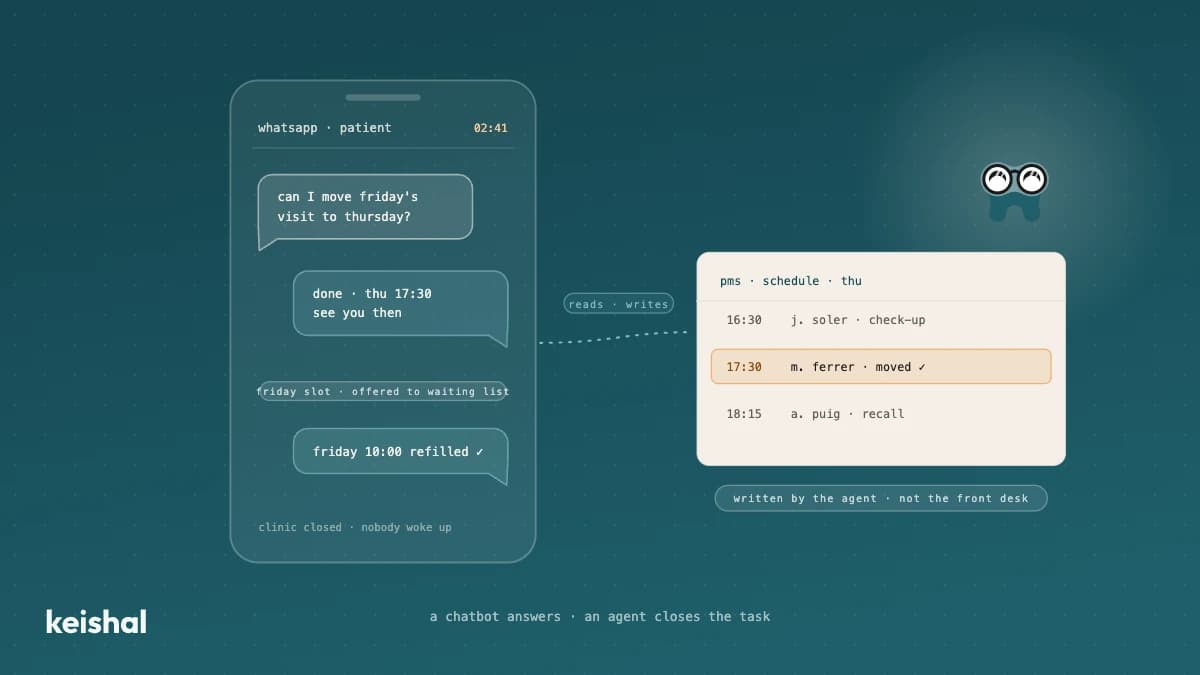
An autonomous system. It sends the reminder, holds the conversation and executes the outcome. The confirmation is recorded in the diary; the reschedule is resolved in the same thread, with the patient picking the new slot in a calendar — they choose it, no AI guesses it for them; the cancellation frees the slot in time to refill it.
And everything is written into the software you already use — Gesden, Nubimed, Dentalink, Clinic Cloud or another — with no migration and no parallel database. Your team doesn't manage an inbox: it sees an up-to-date diary. That's how automatic reminders and confirmations work inside the clinic's communication layer.
The reminder doesn't live alone, either: it's one task in the daily communication inventory. What to automate at your dental clinic and what not sorts that full inventory — what's worth delegating and what should stay human.
A scene we hear often — this is a composite summary of 2026 sales conversations, not a verbatim quote, but the pattern repeats with few variations:
"We set up SMS two years ago. They arrive, we assume. What we discovered late is that the replies were landing in a dashboard nobody had open: last week we found a cancellation from four days earlier."
Five questions before buying a reminder system
- Can the patient reply, and where does that reply land? If the answer is "in a dashboard", ask who will open it every day — and who opens it in August.
- What happens with a Sunday-night cancellation? Does anyone find out in time to refill Monday's slot, or is it discovered with the chair already empty?
- Does it write the outcome into your diary? Confirmations, reschedules and cancellations should end up in your practice software, not in a parallel database someone has to reconcile by hand.
- Who holds the conversation when the patient asks something? "Sending" and "handling" are different products; make the vendor say which one you're buying.
- What's the commitment on consent and data handling? A serious provider explains it before you ask; the specific framework is best defined with specialised data protection advice.
You're not the only one asking these questions: at Expodental 2026, a good share of dental software vendors presented patient-communication modules. The industry's direction is clear; the difference between solutions is still who operates the conversation.
And one honest limit to close on: no reminder system prevents every no-show. There are last-minute emergencies, genuine lapses and patients who simply don't turn up. For those there is the second layer — the waiting list that refills the slot — which is why a reminder is evaluated as part of a system, not as a standalone send.
If you want to see what this would look like at your clinic — with your diary, your practice software and your numbers — book a demo: 20 minutes, and we leave with your arithmetic done, not ours.
Ready to try Keishal in your dental clinic?
Book a demo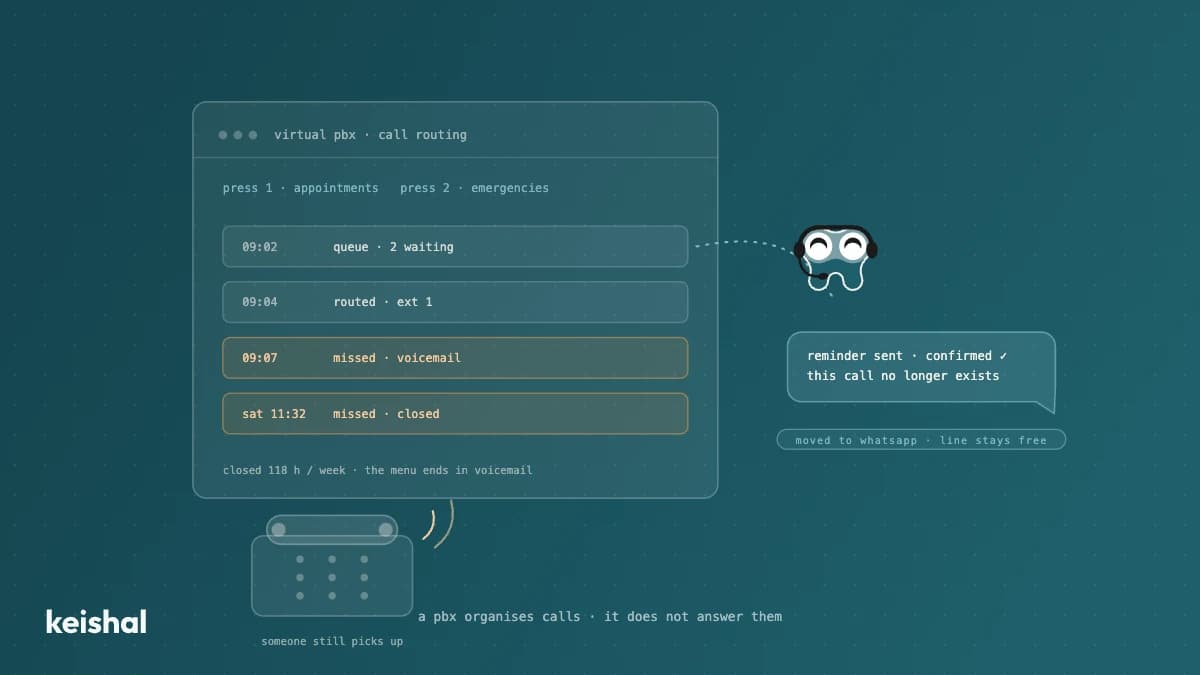
Virtual phone system for dental clinics: what it solves and what keeps ringing
A virtual phone system organises your dental clinic's calls: voice menus, hold queues, forwarding and missed-call logs. What it doesn't do is answer them: someone still picks up, and with 50 opening hours the clinic is closed for 118 of the week's 168 hours (70 %). It makes sense with several locations or lines, or when calls are lost to saturation. If the problem is volume — 40 calls × 3 minutes = 2 hours a day — the higher-leverage move is migrating repetitive tasks (reminders, bookings, questions) to WhatsApp and keeping the phone for the conversations that need it.
AI agent for dental clinics: what it is and how it differs from a chatbot
An AI agent for dental clinics is a system that completes whole administrative jobs (reminding, rescheduling, reactivating, answering) and writes the outcome into your practice management software. A chatbot answers messages; an agent closes tasks. The practical difference isn't the intelligence but two things: whether it reads and writes your clinic's real data, and who operates it. To size it with your own numbers: 15 appointments a day × 22 working days is 330 reminders a month; if 1 in 10 gets a reply, that's 33 conversations someone has to handle. An agent exists so that someone isn't your front desk.