
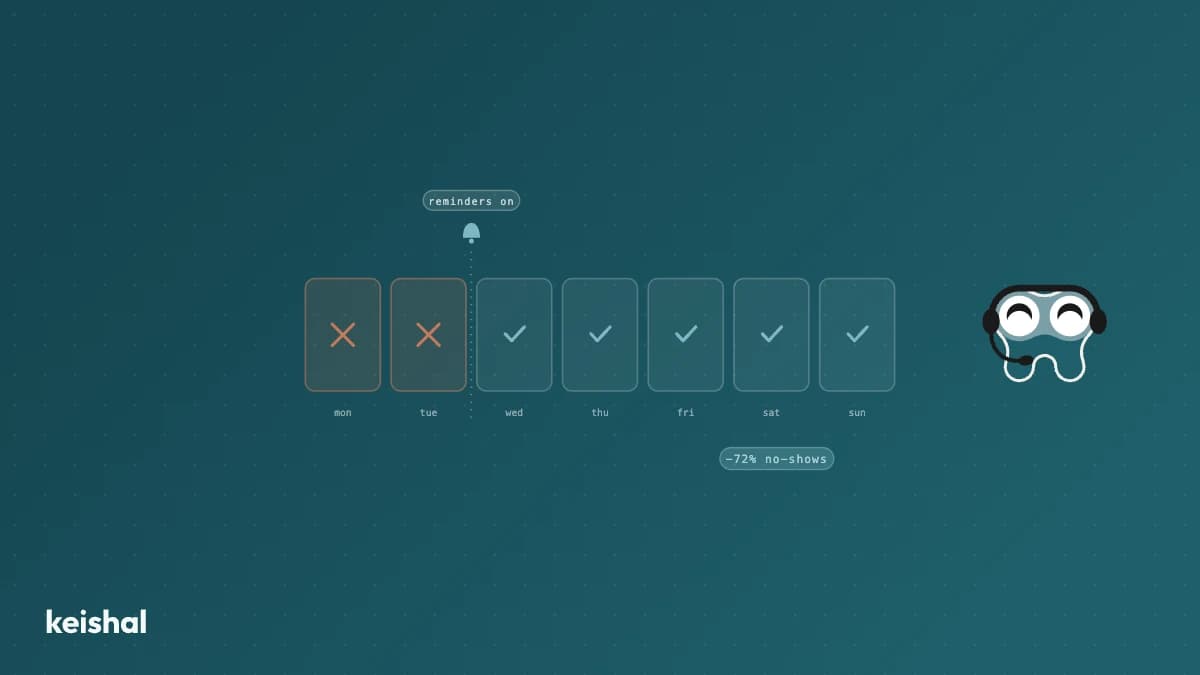
Every no-show is an idle chair with fixed costs still running: 20 no-shows a month × €90 average treatment value is €1,800 a month, €21,600 a year. The defence has two layers working at different moments: WhatsApp reminders that get a response before the appointment, and an automatic waiting list that refills the slot when the cancellation happens anyway. Neither requires changing your practice management software.
Reducing no-shows at your dental clinic has less to do with calling patients more and more to do with understanding when the appointment is actually lost: almost always hours or days before the scheduled time, when the patient already knows they won't come but hasn't said so yet. In 2026 most clinics still defend themselves the way they did ten years ago, with confirmation calls whenever the front desk has a spare moment, and still find the same empty chair. Here you'll see what each missed appointment costs you, why they really happen, and the two layers that reduce them: one prevents the no-show before it happens, the other recovers the slot when it happens anyway.
What each missed appointment costs you
The cost of a no-show isn't just the treatment that didn't happen that day. It's an idle chair with every fixed cost still running: the room, the assistant, the dentist's hour, the lights on.
You can do the maths with your own schedule, no external studies needed:
- Count last month's no-shows. Say 20.
- Multiply by your average treatment value. At €90: 20 × €90 = €1,800 a month.
- Over a year: €1,800 × 12 = €21,600.
It's worth saying what that figure doesn't mean: not all of it is lost outright. Some of those patients rebook and eventually come in, and the odd slot fills itself by chance. But that day's chair time never comes back, and the cost of keeping the clinic open was paid regardless.
There's a second, less visible cost: disorder. An unexpected gap mid-morning breaks the team's rhythm, and an unpredictable schedule ends up shaping how you plan everything else, from shifts to long treatments.
Why patients don't show up
"No-show" sounds like an irresponsible patient. Experience in clinics points to far more mundane causes:
- They forget. The appointment was booked weeks ago, noted on a card or buried in an email. Without a reminder close to the date, memory does what memory does.
- They keep putting it off. People come to the dentist with some reluctance, sometimes with fear. The patient doesn't decide "I'm not going": they decide "I'll call later", and the day slips by.
- Cancelling costs more than not showing up. To let you know, they have to call during clinic hours, wait for the front desk to pick up, and explain themselves. Not showing up requires nothing.
- The appointment stopped fitting. A work shift changed, a trip came up. The slot no longer works, but saying so requires the same awkward phone call as the point above.
Notice the pattern: in three of the four cases, the patient would have told you if telling you were instant and frictionless. That's the first lever, and it isn't "call more".
The defence has two layers
A good reminder prevents part of your no-shows, but not all of them: there will always be last-minute surprises and the occasional silence. That's why the full defence works at two different moments:
- Before the appointment: reminders that get a response (confirm, reschedule or cancel) hours in advance.
- Once the gap exists: an automatic waiting list that fills it again within minutes.
Set up only the first layer and the unavoidable gaps stay empty. Set up only the second and you create more gaps than you need to. Together, each covers the other's weak spot.
Layer 1: reminders that get a response
The classic reminder, a call from the front desk, has two problems. It eats hours: with 40 appointments a day at roughly 3 minutes per call, confirming the whole schedule is 2 hours of phone time a day, which rarely fits. And it arrives through a channel many patients no longer answer: an unknown number calling during working hours has every chance of ending up in voicemail.
An automated WhatsApp appointment reminder system flips both problems. The day before each appointment, the patient gets a message with their specific appointment (treatment, doctor, any pre-visit instructions) and can confirm, reschedule or cancel with one tap, in the channel they check daily. The response is written straight into your schedule, without the front desk dialling a single number.
And here's the nuance that's hardest to accept: you want cancelling to be easy. It sounds counterintuitive, but a cancellation 20 hours ahead is a recoverable slot, while a no-show discovered at appointment time is a lost one. Every patient who cancels with one tap instead of silently not showing up is handing you the chair back in time to fill it.
It's the same principle that runs through applying artificial intelligence at a dental clinic: not replacing people, but doing, every single day, the repetitive work that doesn't fit into anyone's day.
Layer 2: the waiting list that recovers the slot
The second layer kicks in once the first has done its job: the patient gave notice, the gap exists, and there are only a few hours left to fill it.
Done by hand, this almost never works out. The front desk would have to stop what they're doing, work out who asked to be seen sooner, call patients one by one, wait for answers and juggle schedules. With luck the gap gets filled; more often the morning swallows it first.
An automatic waiting list does that work in minutes, with nobody stopping:
- It detects the cancellation in your practice management software.
- It identifies candidates: patients on the waiting list or with later appointments that could be brought forward.
- It offers them the slot over WhatsApp.
- It books the first to accept and lets the rest know the slot is taken.
The practical result: the 9:40 cancellation becomes another confirmed appointment before midday, without a single call.
One note to keep concepts separate: this layer works with active patients, who already have an appointment or are waiting for one. Winning back patients who haven't set foot in the clinic for a year is a different discipline, with different timing and different messages: we cover it step by step in how to reactivate inactive patients.
What it looks like in practice
An ordinary evening: at 17:00, the system sends tomorrow's reminders. By 17:20 most patients have confirmed. At 18:05, a patient taps "I need to change it" and reschedules for Thursday; their 10:15 slot frees up with 16 hours to spare. At 18:07, three patients from the waiting list receive the offer. At 18:15, one accepts and is booked in; the other two get a message saying the slot is taken.
The front desk hasn't made a single call. In the morning, the team opens the schedule and finds it the way they left it: full. The difference with the manual method is in the when: all of this happens outside clinic hours, exactly when patients look at their phones and when the front desk isn't there.
Tactics for reducing no-shows that tend not to work
Three common tactics, and why they don't convince us:
- Confirming by calling everyone. You've done the maths: 2 hours a day. It doesn't scale, and the busiest days, exactly when it matters most, are the ones that go unconfirmed.
- Overbooking. Booking two patients on the assumption one will fail works until the day both turn up. That day, the waiting falls on a patient who did everything right. In our view it isn't worth it: the cost of an annoyed patient outweighs the benefit of a covered gap.
- Charging for missed appointments. It can make sense for repeat offenders, but as a general policy it chills the relationship with patients who failed once for perfectly normal reasons. Prevention is more profitable than penalties: the goal isn't to charge for gaps, it's not to have them.
Does it work with your practice management software?
It's the obligatory question, and the short answer is that you don't have to change anything. Keishal is an autonomous system that works on top of your current practice management software: it reads the schedule to know which appointments to remind, and writes confirmations, cancellations and new appointments back into it. Your team doesn't learn or operate any new tool: they see the same schedule as always, just fuller.
"We used to find out about the gap when the patient should already have been in the chair. Now we find out the evening before, and often the gap arrives already filled." That's a composite sentence built from what we hear in the clinics we operate; it isn't a verbatim quote, but it sums up the change well.
Start by measuring
Before you set anything up, count. From last month, pull three numbers:
- How many no-shows you had.
- How many cancellations came in with less than 24 hours' notice.
- How many of those gaps you managed to fill.
With those three numbers and your average treatment value, you know what the problem costs you and how much room there is. And if you want to see the two layers working on a real schedule, book a demo: we'll show you with the numbers of a clinic like yours.
Ready to try Keishal in your dental clinic?
Book a demo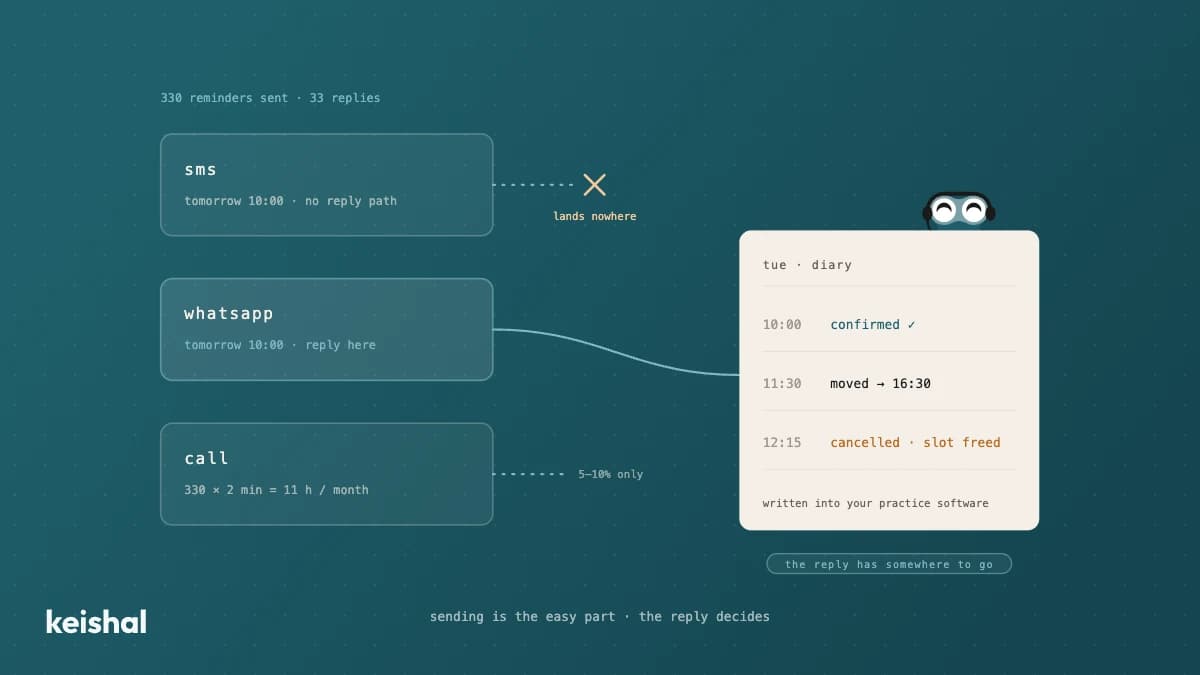
Appointment reminders for your dental clinic: SMS, WhatsApp or phone call
A diary with 15 appointments a day across 22 working days generates 330 reminders a month. If one patient in ten replies, that's 33 conversations someone has to handle: confirmations, reschedules, cancellations that open a slot. That's why the channel matters less than the reply: SMS notifies but rarely listens, WhatsApp resolves things in the same thread, and the phone call is for the cases that need it. In 2026, the real purchase decision isn't "which channel do I buy?" but "who handles what patients reply?".
Virtual phone system for dental clinics: what it solves and what keeps ringing
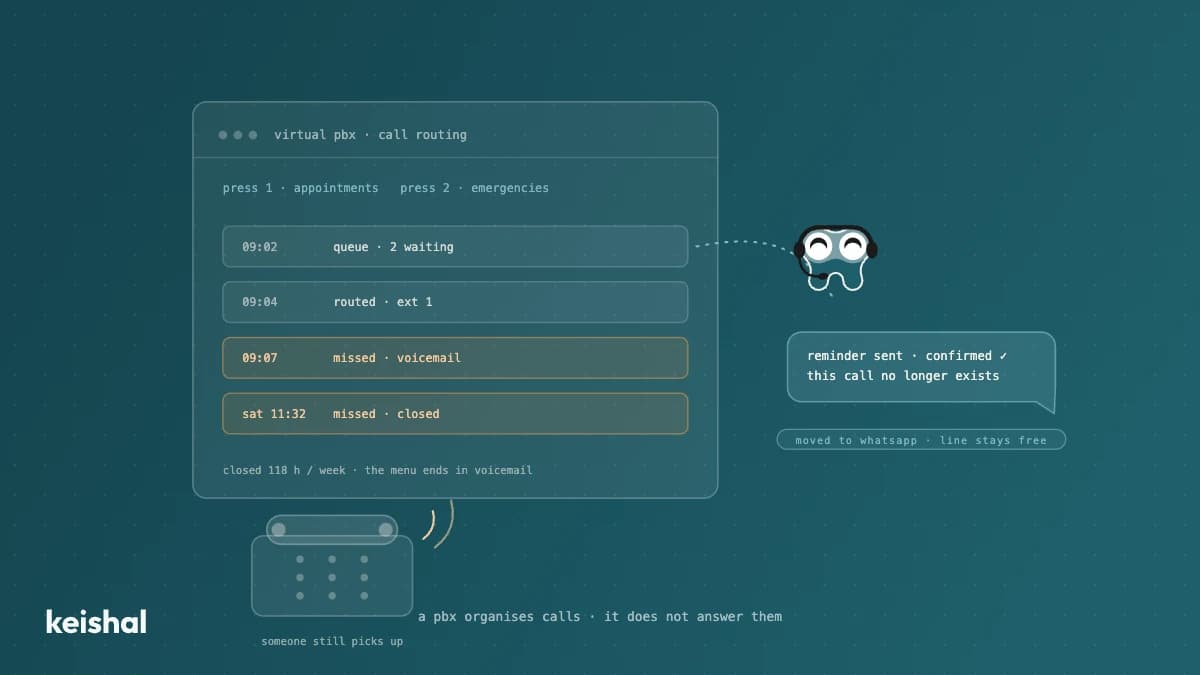
A virtual phone system organises your dental clinic's calls: voice menus, hold queues, forwarding and missed-call logs. What it doesn't do is answer them: someone still picks up, and with 50 opening hours the clinic is closed for 118 of the week's 168 hours (70 %). It makes sense with several locations or lines, or when calls are lost to saturation. If the problem is volume — 40 calls × 3 minutes = 2 hours a day — the higher-leverage move is migrating repetitive tasks (reminders, bookings, questions) to WhatsApp and keeping the phone for the conversations that need it.