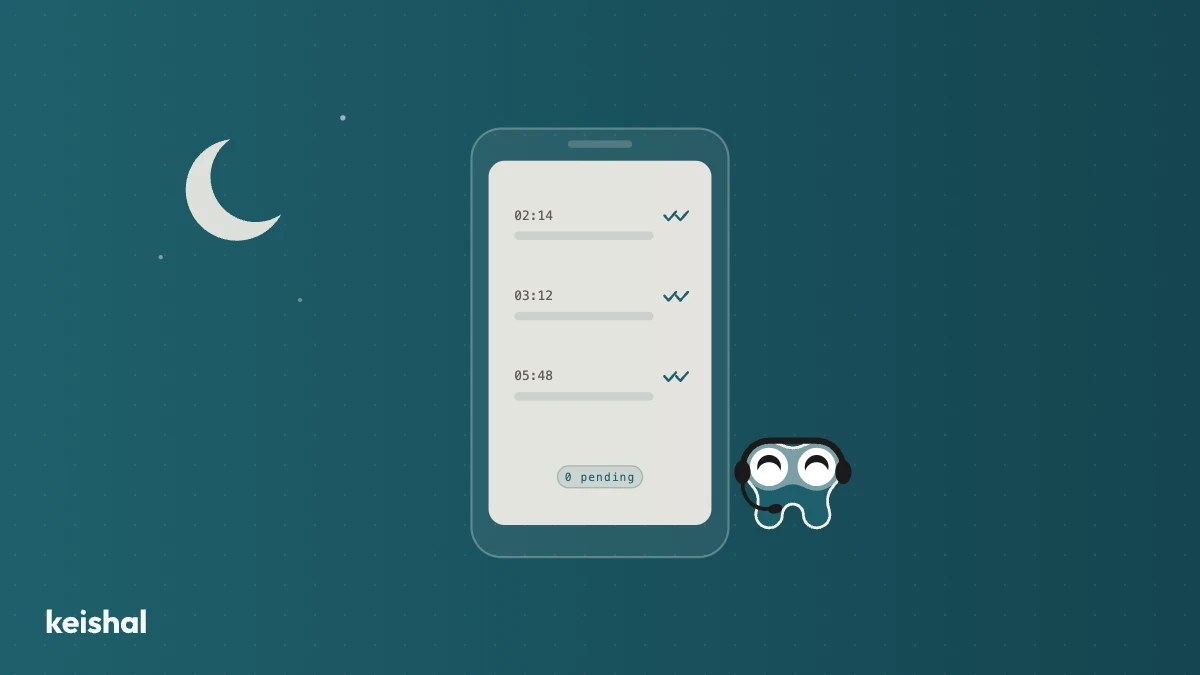
If your clinic is open 50 hours a week, nobody answers the WhatsApp or the phone for 118 of the week's 168 hours: 70% of the week. That's exactly when the questions that decide first visits arrive: "do you take my insurance?", "how much is a cleaning?". An autonomous system answers 24/7 using your clinic's real information and escalates to your team whatever needs a human, without growing the front desk.
It's 9:14pm on a Tuesday. A new patient has just searched "dentist near me", landed on your website and messages you on WhatsApp: "Hi, do you take my insurance? And how much is a cleaning?". Your front desk closed at 7pm. The reply will go out tomorrow, with luck before 11am, between patients at the desk and a ringing phone. By then, that patient has probably already messaged two other clinics.
24/7 patient support at a dental clinic doesn't mean keeping someone awake all night. It means the questions that arrive out of hours (most of the week's hours, as the numbers below show) get answered when they're asked, not when the clinic opens again. Answering out of hours is one of the four fronts we cover in what actually decides patient care at a dental clinic.
Questions don't arrive during clinic hours
Run the numbers with your own schedule. A week has 168 hours. If your clinic is open Monday to Friday from 9am to 7pm, that's 50 open hours. That leaves 118 hours with nobody on the other end: evenings, nights and the whole weekend. It's 70% of the week. With shorter hours, the percentage climbs.
The uncomfortable detail is that patients handle their personal admin precisely in those hours. Comparing clinics, asking about prices, moving an appointment: it happens when the workday ends, on the sofa at 10pm or on Sunday morning.
You don't need to trust any statistic: count it at your own clinic. On a Monday before opening, note how many WhatsApp messages, missed calls and emails arrived since Saturday. Repeat the count every morning for a week. If you get 3 messages per weeknight and 8 over the weekend, that's about 23 conversations a week left waiting: over 90 a month. That's your number, not ours.
What patients ask out of hours
Patients' questions to a dentist repeat endlessly. The usual ones:
- "Do you take my insurance?"
- "How much is a cleaning, braces, an implant?" (a ballpark)
- "Can I move my Thursday appointment?"
- "Where are you, and is there parking?"
- "What should I bring to a first visit?"
- "Do you handle emergencies?"
Notice who asks what. The logistics questions (moving an appointment, what to bring) tend to come from patients who already know you. The insurance and price questions tend to come from new patients comparing clinics. And a patient who compares writes to more than one: the first useful answer arrives with an advantage.
Let's be honest about the limit: not every unanswered message is a lost patient. Many people wait happily until you open. But in the window where a first visit gets decided, answering 12 hours late means competing at a disadvantage, and you won't even know how often it happened, because the patient who chose another clinic doesn't tell you.
Growing the front desk doesn't fix this
The instinctive answer is "we need more hands at reception". But look at the shape of the problem. Out-of-hours messages don't arrive concentrated in a block a shift could cover: they land at 9:40pm, at 7:50am, on Sunday at noon. Covering them with people would mean evening and weekend shifts to handle a few scattered conversations each.
This isn't about how hard your team works. A dental front desk already carries a huge load: patients at the desk, the phone, the agenda, payments. The out-of-hours work isn't being done badly: it arrives when nobody is working, and it wouldn't make sense for anybody to be.
How 24/7 support works with an autonomous system
An autonomous system like Keishal answers on your clinic's WhatsApp, at any hour, using the clinic's real information: hours, location, treatments, insurance and whatever prices you decide to make public. You set the perimeter: what it may answer and what it may not.
Three things matter about the mechanism:
It answers with your data, it doesn't improvise. The system is configured with your clinic's specific information. If you haven't decided to publish the price of an implant, it doesn't give one: it takes the query and passes it to your team.
It escalates what it shouldn't answer alone. A clinical doubt, a complaint, a delicate situation: that goes to a person. Your team receives the whole conversation, with context, and picks it up without starting from zero. The next section covers why this limit is exactly what makes the system trustworthy.
It works on top of your current software. It integrates with the practice management software you already use (Gesden, Nubimed, Dentalink, Clinic Cloud and others), so what happens in the conversation, like a moved appointment or an updated detail, gets written into your systems and not into a separate inbox. That's the structural difference with a generic chatbot, which answers but writes nothing into your calendar: we develop that comparison in chatbots for dental clinics: what they solve and where they fall short.
"On Mondays we'd have 30 conversations piled up between WhatsApp and missed calls. By 11am we hadn't answered half of them." That's a composite of what we hear at clinics we work with, not a verbatim quote, but it describes Monday at most front desks.
What an AI should never answer on its own
The right question isn't "can an AI answer everything?", but "what should it answer, and what should it escalate?". Not every question can be resolved without a human, and a serious system doesn't pretend otherwise: that's why escalation exists.
- Clinical doubts ("my gum has been bleeding since yesterday, is it serious?"): to the team, always. An AI doesn't diagnose.
- Complaints and sensitive situations: to a person, with the conversation in front of them.
- Questions outside the perimeter (unpublished prices, particular cases): collected and handed to the team with context.
On privacy: communicating with patients means handling sensitive data, on WhatsApp and on every other channel. Doing it well (a professional account, clear information, consent) is a signal of seriousness patients notice. We cover using WhatsApp at a dental clinic with data protection as an advantage in WhatsApp for dental clinics.
When the question is "can I book an appointment?"
Many out-of-hours conversations end the same way: doubt resolved, the patient wants an appointment. At that point the system doesn't start guessing slots in the chat: it sends a calendar link where the patient picks the slot that suits them, and the appointment is written into your agenda. We explain that mechanism, and why patients choosing their own slot builds more trust than confirming one in the chat, in 24/7 online appointment booking.
And if the question is "can I move my Thursday appointment?", answering it on the spot has a second effect: a patient who can move their appointment at 10pm is a patient who doesn't silently no-show on Thursday. That mechanic, reminders that get a response plus a waiting list that refills the slot, is covered in how to reduce no-shows.
How to start this week
- Count your out-of-hours messages for 7 days. WhatsApp, missed calls, emails. It costs nothing and turns a feeling into a number.
- Write down the 10 questions your front desk repeats most. Almost certainly: insurance, ballpark prices, opening hours, parking, appointment changes.
- Decide the perimeter. What you'd let a system answer on its own, and what should always reach your team.
- Look at the whole picture. Question handling is one piece of an AI front desk; the full map is in how to apply artificial intelligence at your dental clinic.
If you want to see how Keishal does it with your clinic's information, the detail is on the 24/7 patient support page, or you can book a demo and see it with your own numbers.
In 2026, a patient messaging at 9pm is no longer the exception. The questions will keep arriving out of hours; the only decision is what they find when they do: silence until tomorrow, or a useful answer in the moment.
Ready to try Keishal in your dental clinic?
Book a demo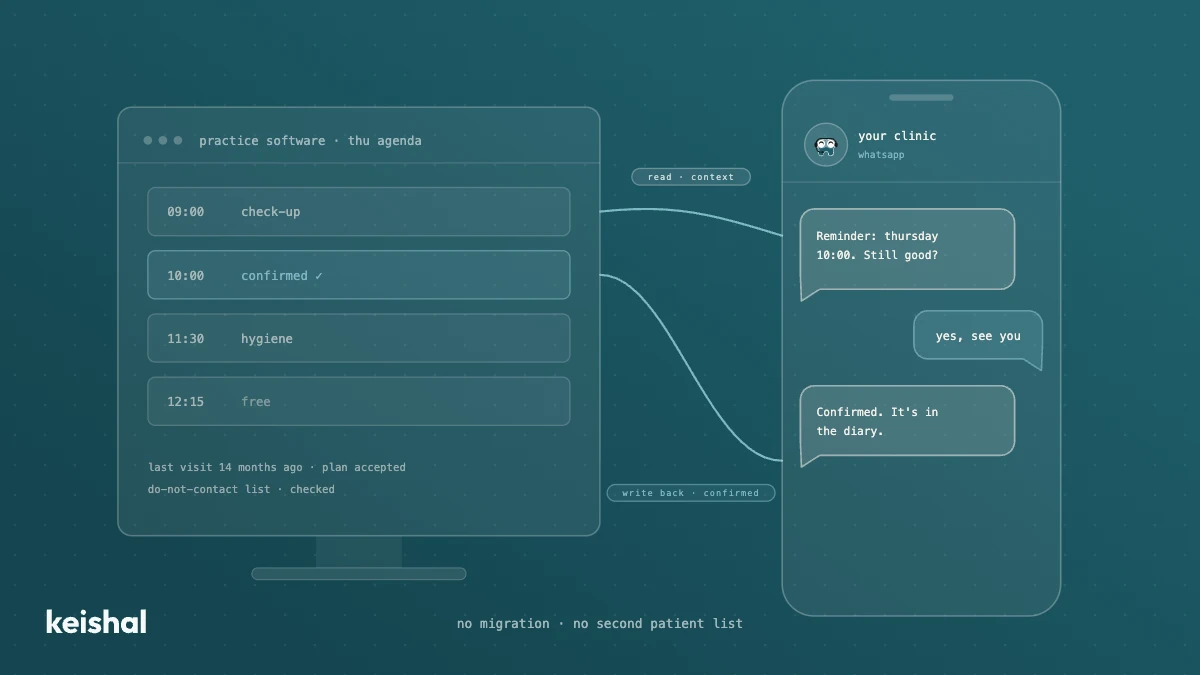
Integrating AI with your dental practice software: what a real connection means
A real integration with your dental clinic's software does two jobs: it reads your patients' data for context and writes appointments, confirmations and status changes back into your program. A monthly CSV, a calendar connector or a read-only tool leaves the rest to your team: with 330 reminders a month, marking each confirmation at 30 seconds adds up to almost 3 hours. Ask for the list of supported programs and versions in writing, and check that there's no migration and no duplicate patient base.
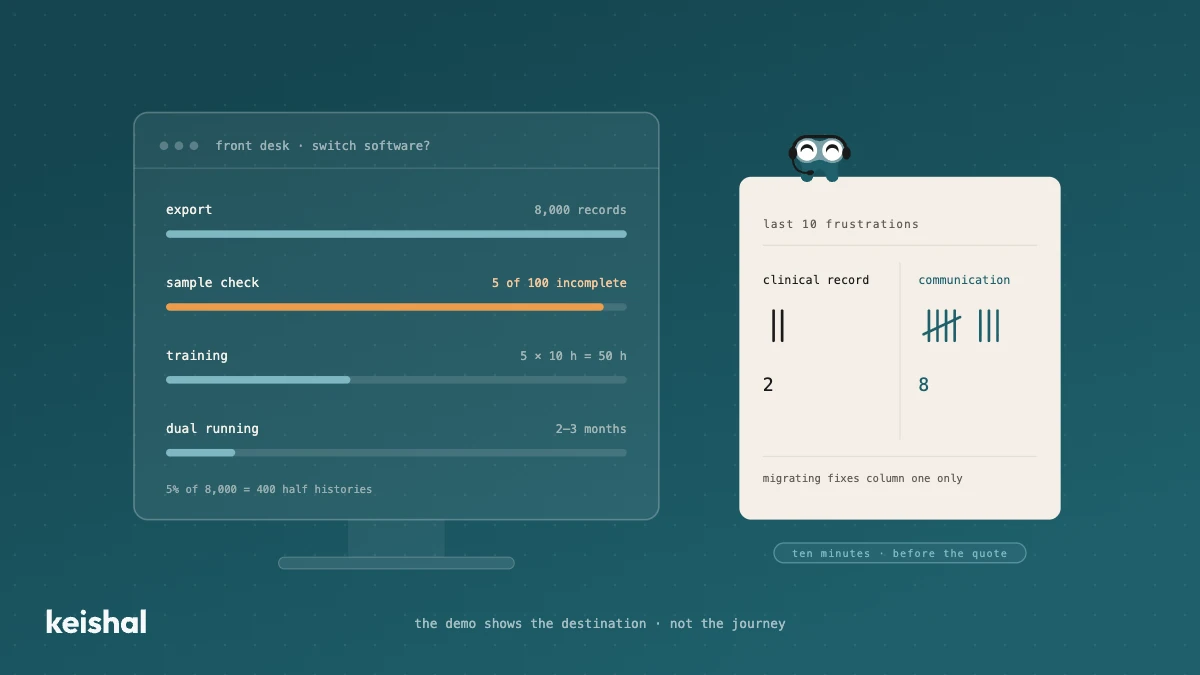
Switching dental software: what migrating really involves and when you don't need to
Switching dental software isn't installing a program: it's exporting and verifying thousands of records, training the team (5 people × 10 hours = 50 hours) and running two systems side by side for two or three months. It's worth it when the software has no support, holds your data hostage or the clinic has outgrown it. But if what's pushing you is unmanaged reminders, recall that never happens and out-of-hours messages, that communication layer can be added on top of your current PMS, without migrating anything.