
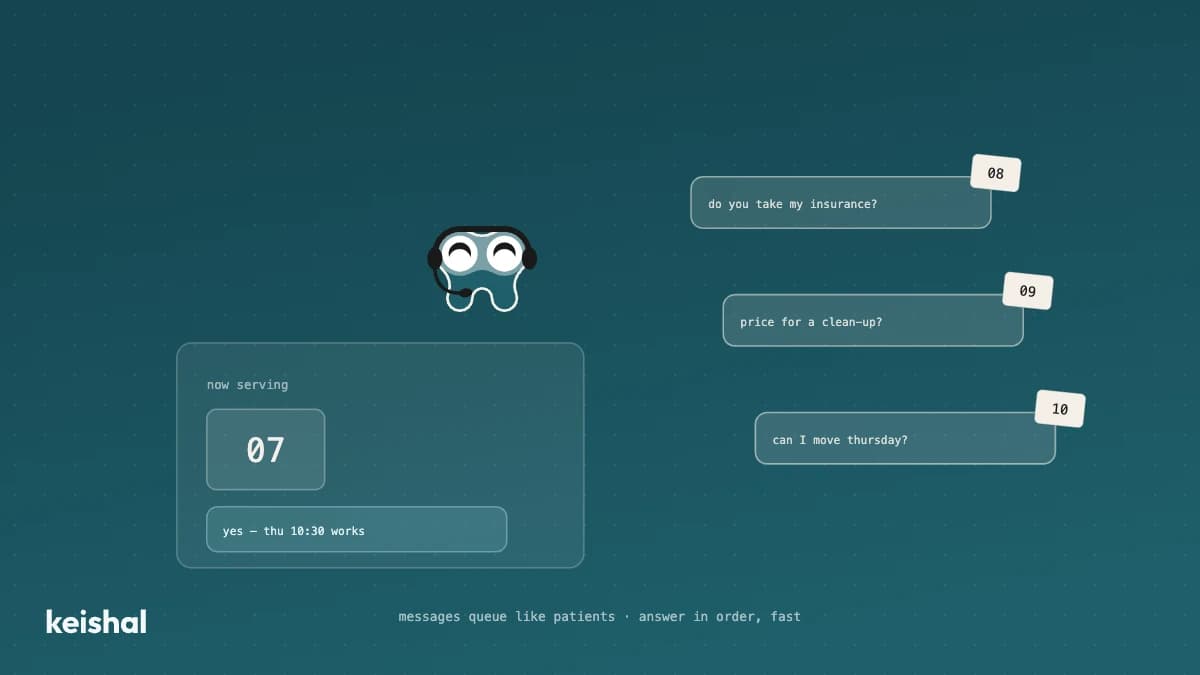
Patient care at a dental clinic is not decided in the chair: it is decided in the gaps between visits. With 50 open hours out of the week's 168, a patient can write during 118 hours (70 % of the time) and find nobody there. Four fronts make it measurable: answering fast even out of hours, reminding for every appointment, following up with patients who leave without a next visit, and asking for feedback afterwards. Running them by hand does not fit into reception's day; an autonomous system operates them on top of your current software.
Search for "patient care at a dental clinic" and you will find mostly the same advice: smile, be empathetic, use the patient's name, look after the waiting room. None of it is wrong. But all of it shares one limitation: it happens once the patient is already in front of you.
The part of patient care that actually decides how cared-for someone feels happens somewhere else: in the gaps between visits. Run the numbers on your own opening hours. A clinic open Monday to Friday for about 10 hours a day is open 50 of the week's 168 hours. That leaves 118 hours, 70 % of the week, in which a patient can write and find nobody there.
In 2026 that wait weighs more than it used to. The patient asking a question on WhatsApp at 9:30 pm is not comparing your clinic with other clinics: they are comparing it with the last business that answered them within five minutes.
Patient care is not judged in the chair
The clinical experience matters enormously. But months pass between one visit and the next. During that time, the patient's relationship with your clinic is a sum of small moments: whether someone answers when they ask, whether someone reminds them of their appointment, whether someone notices they have not been in for a year.
It is a pattern we keep hearing in our 2026 sales conversations. The quote below is a summary of several of them, not a verbatim one: "When the patient is in the chair we do a great job. It's everything else that slips through."
Looking at patient care this way has one advantage: it stops being a question of attitude and becomes measurable. You do not need a satisfaction survey to know where you stand. There are four questions you can answer this week with your schedule and your phone.
The four fronts below cover the full cycle of the relationship: answering when the patient asks, reminding when they have an appointment, following up when they do not, and asking how it went once they have been in. Each has a concrete measure and its own article on this blog that develops it in depth; this piece is the map.
The four fronts that decide it
1. Answer fast, even when the clinic is closed
Response speed is the first thing a patient perceives about your care, and it comes before any smile. Someone who writes "do you take my insurance?" on a Tuesday at 9 pm and hears nothing until the next morning has had plenty of time to message another clinic. They do not always do it, but you do not get to choose when.
Answering fast does not mean anyone answering anything. Frequent questions, opening hours, insurance, indicative prices, how to prepare for a visit, can be answered on the spot with information the clinic has approved. Clinical doubts and complaints need your team, and the right outcome is that they reach your team with full context, not that they sit unanswered until the next day.
The measure is simple: how long does your clinic take to answer a message that arrives out of hours? If the answer is "the next day", this is your most urgent front. We dedicate a whole piece to it, including an exercise to count how many messages arrive while the clinic is closed: how to answer patient questions 24/7 at your dental clinic.
2. Remind, so no appointment depends on memory
A schedule with 15 appointments a day over 22 working days generates 330 reminders a month. A reminder that arrives on time, and lets the patient confirm or move the appointment in one tap, separates a recoverable slot from a silent no-show. And a patient who is given the easy path feels something very concrete: the clinic remembered them before they had to remember the clinic.
The measure: how many of last week's appointments were confirmed before the day of the visit? If confirming means calling one by one, the honest answer is usually "the ones there was time to call". The full mechanism, reminders plus a waiting list, is in how to reduce no-shows at your dental clinic.
3. Follow up when there is no next appointment
The most invisible front. The patient who leaves without a next appointment has not decided to leave: most do not walk away angry, they silently disconnect. Six months later nobody has written to them, and coming back feels like more effort than staying away.
The discipline that prevents it has a name, dental recall, and it is patient care in its purest form: remembering the patient's health when they do not. Doing it well does not mean insisting. Good follow-up is a message with a real reason, "your check-up is due", "we still had that tooth to look at", not a generic campaign every week. More than two unanswered messages is no longer follow-up; it is pressure.
The measure: of the patients who left without an appointment last month, how many have received a message since?
4. Close the loop: find out how it went
The last front is asking. A clinic with 600 visits a year and 5 new reviews hears the opinion of 0.8 % of its patients; about the rest, it knows nothing. Asking for a review right after the visit does two things at once: it closes the relationship with a gesture of interest, and it gives you the real thermometer for the other three fronts.
The measure: how many visits last month ended with a request for feedback? How to automate that request so it does not depend on reception remembering is in how to get Google reviews for your dental clinic.
What communication cannot fix
This deserves to be said just as plainly. If the treatment hurt and nobody explained it, if the estimate came with surprises, or if every visit starts 40 minutes late, no message makes up for it. Communication sustains the relationship between visits; it does not replace what happens inside the practice.
Nor is it a machine for winning everyone back. Among patients who have not been in for a while, some have moved away and others no longer need treatment: however well you write, not all of them would return. The four fronts do not promise miracles. They promise that no patient is lost to something as avoidable as an unanswered message.
How to sustain the four fronts without growing the team
The four fronts can be run in three ways, and the difference between them is not intention but who puts in the hours.
By hand. With a small patient base it is possible, and good WhatsApp message templates help you avoid starting from scratch. The limit is arithmetic: 330 reminders a month, plus the questions arriving during the 118 closed hours, plus the follow-up of everyone who left without an appointment, do not fit into the working day of a person who is also looking after the patient at the desk. It is not reception's fault; the day has the hours it has.
With tools your team operates. Reminder or campaign software organises the work, and there is no shortage of options: at Expodental 2026, nearly every dental software vendor was presenting patient-communication modules. But the tool does not answer the patient who replies to a reminder with a question, and it does not decide who to write to this month. That work still belongs to someone on your team, every day.
With an autonomous system. The third way is for the four fronts to run without your team operating them: an autonomous system like Keishal answers on WhatsApp with information the clinic approves, sends and manages reminders, follows up with patients who have no next appointment, asks for the review after the visit, and escalates to your team, with full context, the conversations that need a human.
It runs on top of the software you already use, Gesden, Nubimed, Dentalink, Clinic Cloud or another, and writes the outcomes into your existing schedule: no migration, nothing new to learn. Your team only sees the results.
It is worth saying what reception gains from this, because it is not a small detail. When reminders, out-of-hours questions and follow-up stop depending on their to-do list, the time freed up goes to the patient standing at the desk, which is exactly the part of care no automation can do. The difficult conversation, the familiar face, the "how did that go?": that stays with your team. What goes away is the repetitive volume that made it hard to do calmly.
Start by measuring your four fronts
You do not need to decide anything today. Answer this article's four questions with your own numbers: how long you take to reply out of hours, how many appointments confirm themselves, how many patients without an appointment get a follow-up, how many people you ask for feedback. You will have a more honest map of your patient care than any survey.
And if you want to see what those four fronts look like running on their own on top of your schedule, book a demo and we will show you with a clinic your size.

Ready to try Keishal in your dental clinic?
Book a demo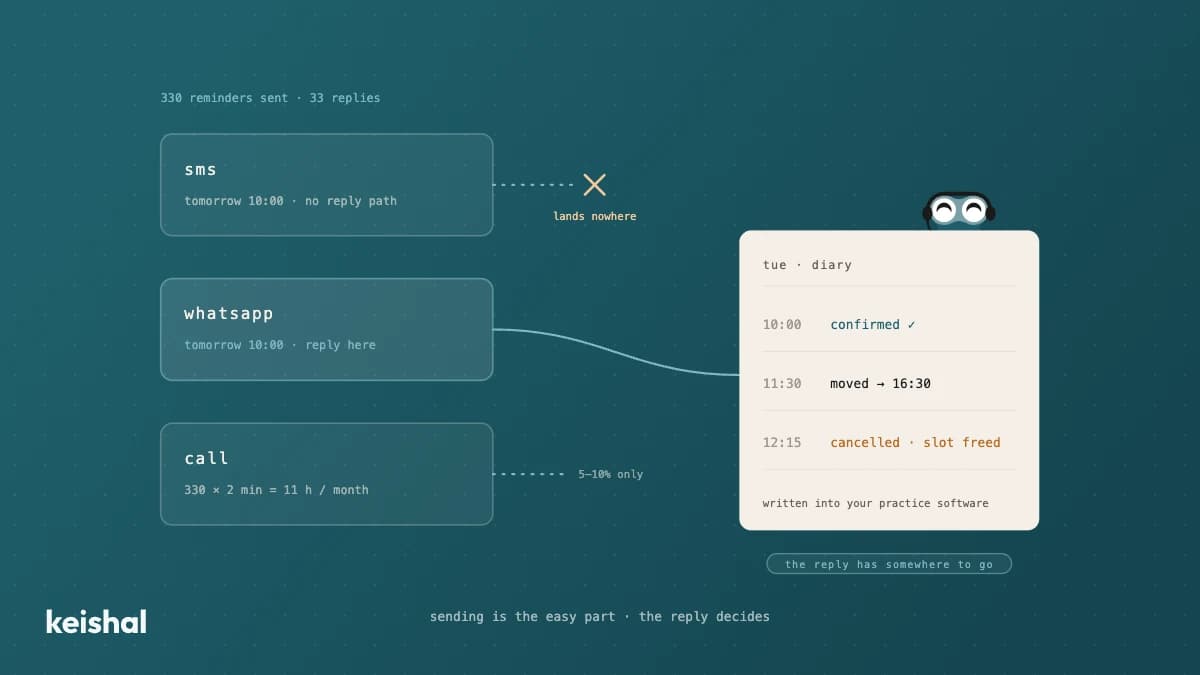
Appointment reminders for your dental clinic: SMS, WhatsApp or phone call
A diary with 15 appointments a day across 22 working days generates 330 reminders a month. If one patient in ten replies, that's 33 conversations someone has to handle: confirmations, reschedules, cancellations that open a slot. That's why the channel matters less than the reply: SMS notifies but rarely listens, WhatsApp resolves things in the same thread, and the phone call is for the cases that need it. In 2026, the real purchase decision isn't "which channel do I buy?" but "who handles what patients reply?".
Virtual phone system for dental clinics: what it solves and what keeps ringing
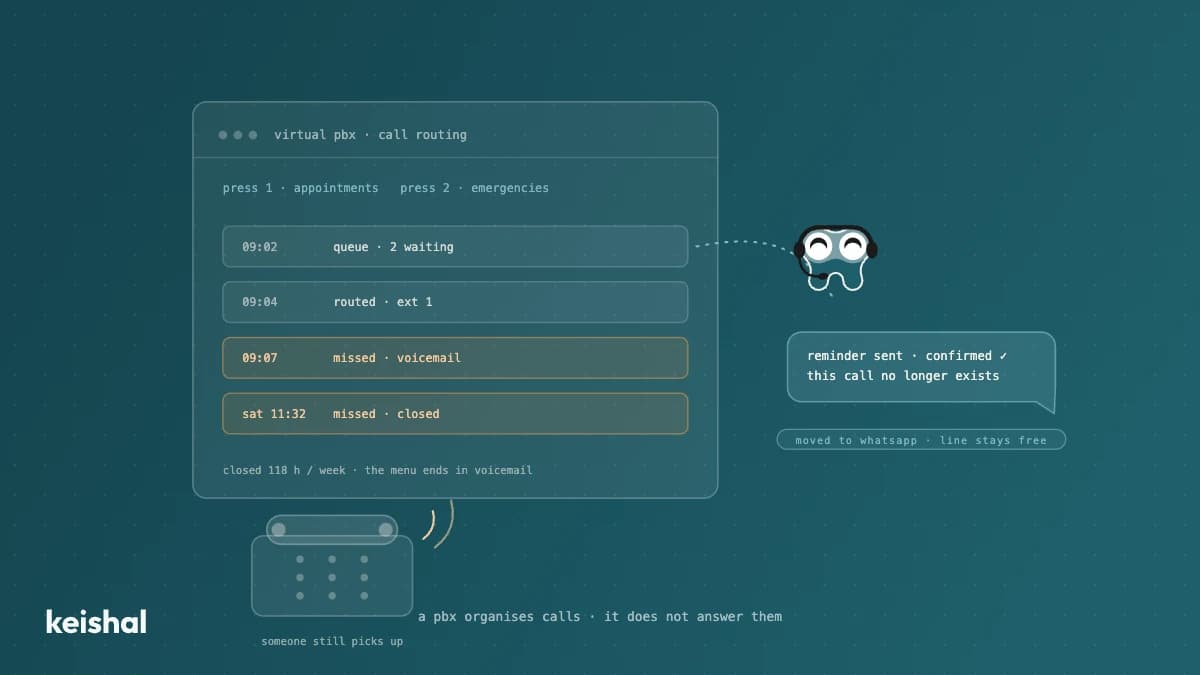
A virtual phone system organises your dental clinic's calls: voice menus, hold queues, forwarding and missed-call logs. What it doesn't do is answer them: someone still picks up, and with 50 opening hours the clinic is closed for 118 of the week's 168 hours (70 %). It makes sense with several locations or lines, or when calls are lost to saturation. If the problem is volume — 40 calls × 3 minutes = 2 hours a day — the higher-leverage move is migrating repetitive tasks (reminders, bookings, questions) to WhatsApp and keeping the phone for the conversations that need it.