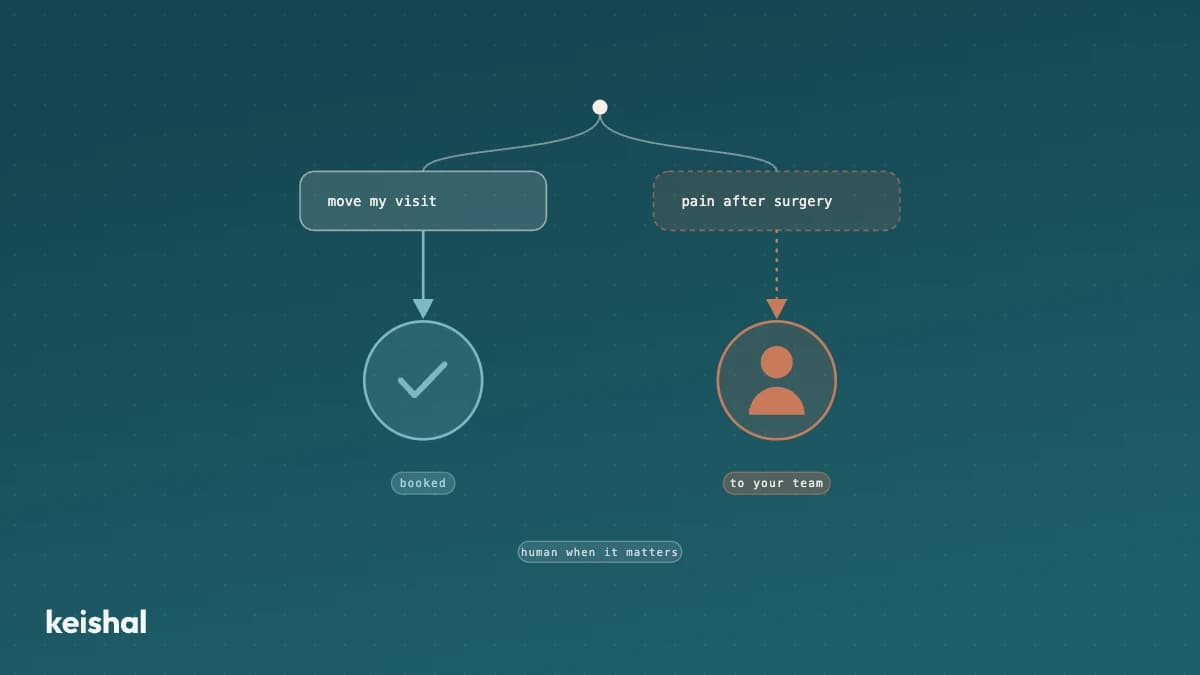
A generic chatbot solves a real part of the problem: answering frequent questions when the front desk isn't there, which is 76% of the week's hours if you answer 9 to 5 on weekdays (40 of 168 hours). It falls short at everything that comes next: it doesn't read your practice management software, it can't book appointments or record confirmations, and it doesn't escalate to a person with context. The difference with an integrated system isn't the quality of the answers but the category: one replies to messages, the other finishes the work in your agenda.
A dental clinic chatbot promises something very specific: no patient left without an answer when the front desk can't pick up. The problem it points at is real, and you can size it with your own opening hours. A front desk that answers from 9 to 5, Monday to Friday, covers 40 of the week's 168 hours. For the other 128 hours, 76% of the time, whoever messages the clinic finds nobody.
That arithmetic explains why in 2026 so many clinics are considering a chatbot or a virtual assistant. The reasonable doubt is a different one: does it solve the whole problem, or only the first layer? This guide separates the two. What a generic chatbot genuinely solves, where it falls short by design, and what changes when the system is connected to your clinic's real data.
What a generic chatbot genuinely solves
By generic chatbot we mean the kind installed on a website or connected to WhatsApp with no integration with the agenda, the patient history or the practice management software. Within that perimeter, it does three things well.
It answers frequent questions instantly. Opening hours, address, parking, payment options, whether you work with a specific insurer. This kind of query makes up most inbound traffic and needs nobody on your team to resolve.
It's available when the front desk isn't. The patient who writes on a Tuesday at 10:30pm gets an answer in seconds instead of silence until 9am. For simple questions, that's already an objective improvement.
It takes repetition off the front desk. Every opening-hours question the chatbot answers is one less interruption for the person looking after the patient in front of them.
Worth saying plainly: if your only goal is keeping repetitive questions away from the front desk, a well-configured generic chatbot does the job. For some clinics that's enough, and for them it's a reasonable purchase.
Where it falls short
The limits of a generic chatbot aren't configuration mistakes you can fix with better answers. They come from its design: it isn't connected to anything.
It doesn't know your clinic or your patients
A generic chatbot doesn't read your practice management software. It doesn't know whether the person writing is a patient of the clinic, when their last visit was, or whether they have a treatment half-finished. If the patient asks "do I have an appointment this week?", the only possible answer is asking them to call.
It makes no difference which program you use: Gesden, Nubimed, Dentalink, Clinic Cloud or any other. Without integration, the agenda and the history simply don't exist for the chatbot.
It answers, but it doesn't operate
It's the difference between explaining and doing. A generic chatbot can explain how to book an appointment; it can't book one, because it doesn't write to the agenda. Nor does it confirm visits or record status changes in your system.
You see the result every morning: conversations that ended in "call us after 9" and that the front desk has to redo by phone, starting from scratch. The automatic reply happened, but the work came back to the desk anyway.
It doesn't escalate to a person with context
Every patient conversation eventually goes off script: pain that can't wait, a complaint, a case that needs human judgement. Faced with that, a generic chatbot repeats variations of the same answer or gets stuck.
And when a person finally steps in, the conversation starts over from the beginning: name, reason, context. The patient notices, and reads it as what it is: nobody was really on the other side.
"We put a chatbot on the website and at first it was fine: it answered opening hours and basic questions. But every morning there was a list of half-finished conversations we had to redo by phone." This is a composite quote built from real conversations with clinics; we use it because it sums up a pattern we hear often.
The three generations of AI at the dental clinic
In our guide on how to apply artificial intelligence at a dental clinic we distinguish three generations of tools, and the generic chatbot is exactly the first one.
First generation: chatbots. They answer text with text. They aren't connected to the clinic's systems and can't complete any task. Their ceiling is informing.
Second generation: AI software your team operates. More capable tools, but ones that need someone at the clinic to configure them, watch them and feed them every week.
Third generation: autonomous systems. Connected to the practice management software, they run tasks end to end and the provider keeps them working. Your team sees the results, not the tool.
The jump that matters isn't intelligence, it's connection. A first-generation chatbot can carry a very recent language model inside and still hit the same ceiling: without access to the agenda or the history, its best possible answer stays generic. The third generation doesn't answer better; it answers with your clinic's data and finishes the job.
What changes when the system is connected
A system integrated with the clinic turns the three gaps above into the starting point. This is how a 24/7 patient support system connected to real data works in practice:
Inbound questions get answered with context, and the ones that need it reach a person. The usual questions are resolved on the spot, at any hour. When a case needs human judgement, the conversation is handed to your team with all the context already gathered: who is writing, what they need, what they've been told. Nobody starts from zero.
Booking ends in the agenda, not in a "call us". The mechanism is hybrid, deliberately: the patient resolves their questions chatting on WhatsApp and, when they want an appointment, receives a calendar link where they pick the slot themselves. The confirmed appointment is written into the clinic's agenda. We cover it in detail in our guide to 24/7 online appointment booking. The classic objection ("what if the AI books me on the wrong day?") disappears because the patient picks the slot.
Outcomes get recorded. Confirmations, status changes, updated contact details: every conversation leaves a trace in the system your team already uses. The conversation isn't the end product; it's the means for the agenda to move.
The channel matters too. Most of these conversations happen on WhatsApp, where the patient already is; in our guide to WhatsApp for dental clinics we cover the use cases and how to handle data carefully on that channel.
Five questions to evaluate any solution
If you're weighing up a chatbot, a virtual assistant for your dental clinic or a complete system, these five questions separate the categories quickly.
1. Does it read and write to my practice management software? Not "integrates" in the abstract: does it see the real agenda and write appointments, confirmations and status changes into it? If the answer is no, you're looking at first generation, whatever the brochure decides to call it.
2. What happens when it doesn't know the answer? The useful test isn't the polished demo, it's the odd case. Does it escalate to a person? With what context? How fast?
3. Does the task get finished, or described? Ask to see the end of the journey: the appointment in the agenda, the confirmation recorded. If the journey ends with "a person wraps it up tomorrow", the work is still on your desk.
4. Who operates it every week? Configuring answers, reviewing mistakes, keeping it current: your team or the provider? An autonomous system is operated by the provider; your team sees the results.
5. How does it handle patient data? Any patient communication means handling sensitive data, whatever the channel. Ask where conversations are stored, who has access and under what guarantees. A clinic that takes care of this signals seriousness, and patients notice; the specific framework is best defined with specialised data protection advice.
The honest summary
A generic chatbot is better than silence. It solves the visible layer of the problem: frequent questions outside opening hours. If that's all you need, it's a defensible purchase.
It falls short as soon as you expect the conversation to end in something: an appointment in the agenda, a recorded confirmation, a person picking the case up with context. That takes a system connected to the clinic's real data, and that's a different category of tool.
The fastest way to see the difference is on your own case: book a demo and we'll show you what these conversations look like when they end in the agenda, with your practice management software and your patient volume.

Ready to try Keishal in your dental clinic?
Book a demo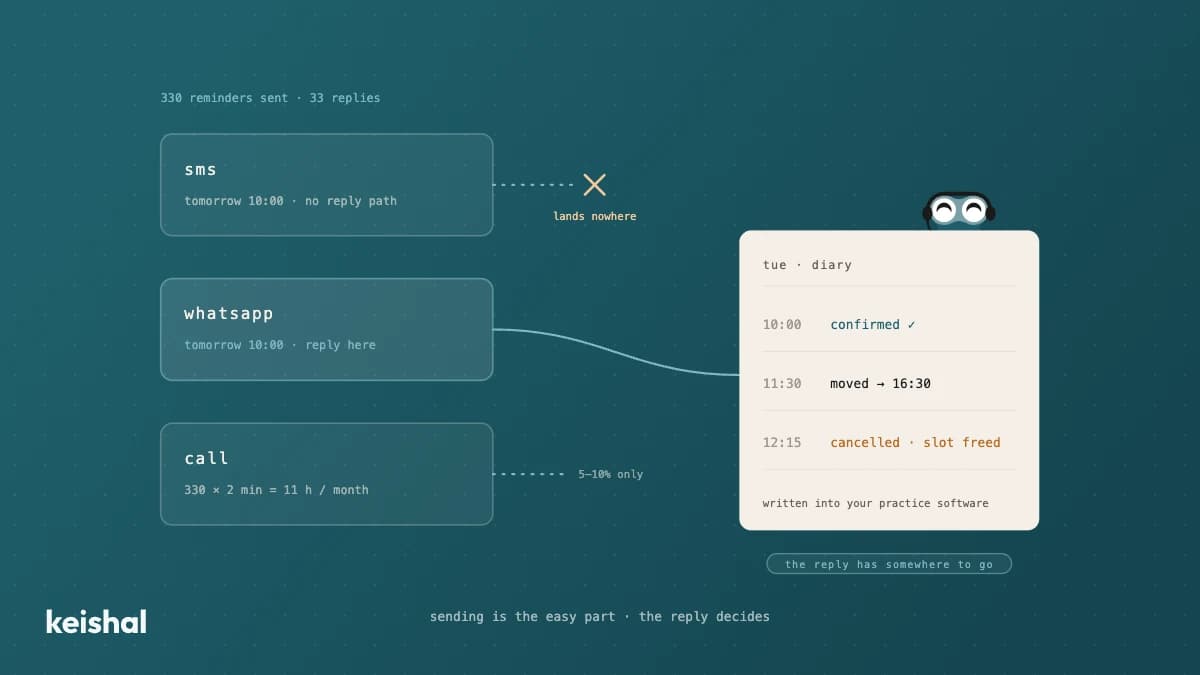
Appointment reminders for your dental clinic: SMS, WhatsApp or phone call
A diary with 15 appointments a day across 22 working days generates 330 reminders a month. If one patient in ten replies, that's 33 conversations someone has to handle: confirmations, reschedules, cancellations that open a slot. That's why the channel matters less than the reply: SMS notifies but rarely listens, WhatsApp resolves things in the same thread, and the phone call is for the cases that need it. In 2026, the real purchase decision isn't "which channel do I buy?" but "who handles what patients reply?".
Virtual phone system for dental clinics: what it solves and what keeps ringing
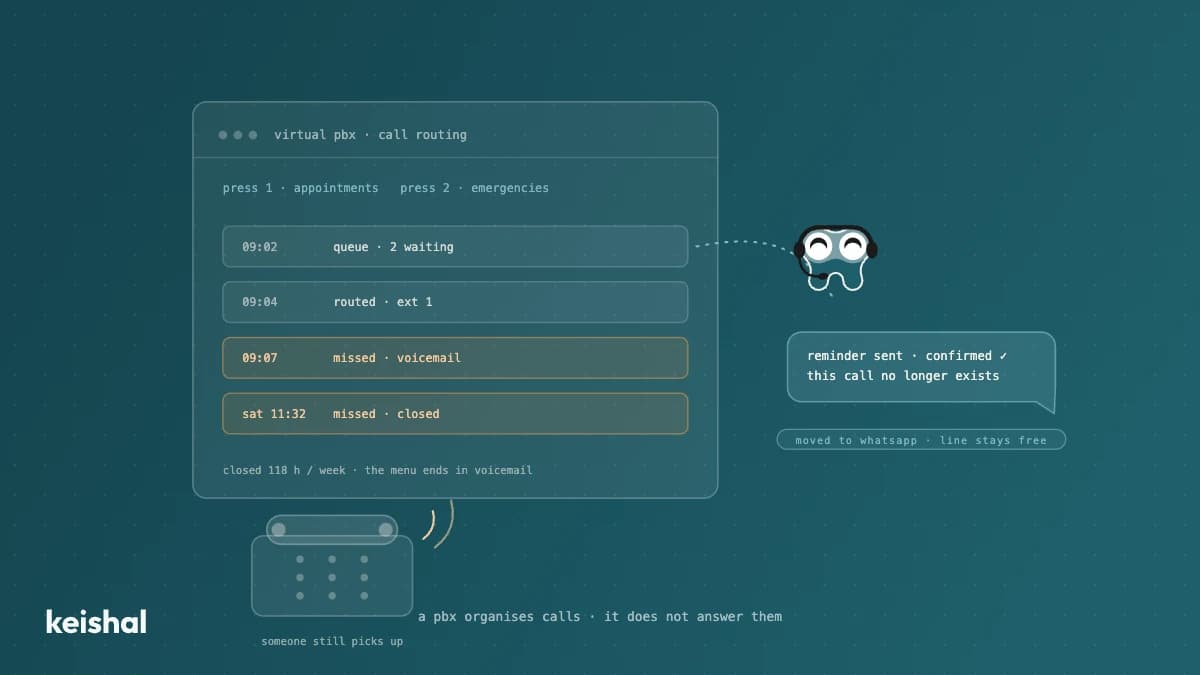
A virtual phone system organises your dental clinic's calls: voice menus, hold queues, forwarding and missed-call logs. What it doesn't do is answer them: someone still picks up, and with 50 opening hours the clinic is closed for 118 of the week's 168 hours (70 %). It makes sense with several locations or lines, or when calls are lost to saturation. If the problem is volume — 40 calls × 3 minutes = 2 hours a day — the higher-leverage move is migrating repetitive tasks (reminders, bookings, questions) to WhatsApp and keeping the phone for the conversations that need it.