
The order matters more than the channel. Before paying for ads: (1) capture the demand that already arrives and gets lost — if you're open 50 of the week's 168 hours, nobody answers 70% of the time —, (2) reactivate the base you already have — 1,000 dormant patients × €110 average treatment value is €110,000 in stalled treatment — and (3) only then invest in advertising. Ads work, but they're the third layer, not the first.
Search for "how to get more patients for your dental clinic" and almost everything you'll find starts in the same place: paying for ads. That makes sense, because much of that content is written by agencies whose business is managing them. We don't sell ads, so we can offer you a different starting point.
Before deciding anything, run one calculation with your own numbers. If your clinic is open 50 hours a week, that leaves 118 of the week's 168 hours with nobody on the other end. That's 70% of the time. And part of the patients already looking for you — through a review, a recommendation, your website — write or call precisely during those hours.
That's why this article follows a specific order of operations: first capture the demand you already generate and lose, then reactivate the patient base you already have, and leave advertising for the end, once the funnel no longer leaks.
Why getting more patients is a question of order, not channel
New patients come from three places: people already looking for you on their own, people who already know you and haven't come back, and people who don't yet know you exist. Advertising only works on the third group, which is the most expensive to convince and trusts you the least.
The first two are already paid for. A patient who finds you on Google Maps and writes on a Tuesday at 9:30pm doesn't need more marketing: they need an answer. A patient who had a cleaning two years ago and disappeared doesn't need to discover you: they need a concrete reason to come back.
When a clinic invests in ads without solving those two layers first, it pays to attract strangers into a funnel that loses them through the same holes it was already losing patients through. In sales conversations we hear versions of the same sentence — it's a recurring pattern, not a verbatim quote: "We invest in ads, but I couldn't tell you how many of those contacts actually ended up in the chair."
Layer 1: capture the demand that already arrives and gets lost
This layer doesn't require attracting anyone new. It only requires that when someone already interested takes the first step, that step doesn't land in a void.
The hours when nobody answers
Do the count this week: check how many WhatsApp messages arrive each night after closing and how many over the weekend. With 3 messages per weeknight and around 8 over the weekend, that's about 23 a week — more than 90 a month. That's your number, not ours: count it on your own phone.
Not all of them are lost patients: some would have happily waited until the next morning. But the one in pain, or the one comparing three clinics at once, usually stays with the first one that answers. How to cover that window without expanding your front desk is explained in detail in our guide to 24/7 patient support.
Reviews: being found and being believed
Before writing to a clinic, a new patient almost always passes through the same place: your Google profile and its reviews. Here most clinics have a mismatch that's easy to measure. If you see 600 visits a month and collect 5 new reviews, you're converting less than 1% of your visits into reviews (5 ÷ 600 = 0.8%).
The problem usually isn't patient satisfaction — it's that nobody asks for the review at the right moment. The request shouldn't depend on reception remembering: it can go out on its own, over WhatsApp, after the visit. The full method is in how to get Google reviews.
Reviews are also the scaled-up version of the channel that has always worked best for you: word of mouth. A happy patient who recommends you to a friend convinces one person; that same patient telling their story on your Google profile convinces everyone who reads it for years.
Booking without having to call
Visibility converts when booking is easy. If the only way in is calling during opening hours, everything above funnels into a bottleneck. The alternative that works is hybrid: the patient sorts out their questions over WhatsApp and, when they want an appointment, receives a calendar link where they pick the slot themselves. We develop this in our guide to 24/7 online booking.
With these three pieces, the demand you were already generating stops leaking away. And you still haven't paid for a single ad.
Layer 2: reactivate the patients who already know you
The second source of "new" patients isn't on Google: it's in your practice management software. These are patients who already know you, already trusted you, and already have an open clinical record.
Dormant patients
Count how many patients haven't visited in more than 12 months and multiply them by your average treatment value. With 1,000 dormant patients and an average value of €110, there's €110,000 of potential treatment sitting idle in your database. Not all of them would return even if you contacted them — some have moved, others no longer need it — but most didn't leave angry: they silently disconnected, and nobody gave them a reason to come back.
Doing it by hand doesn't fit into anyone's day: 1,000 patients × 5 minutes per contact is around 83 hours of work. That's why the usual conclusion ("reactivation doesn't work") is really "reactivation doesn't fit". The full step-by-step is in how to reactivate inactive patients.
Accepted treatment that stalled halfway
There's a second list, even warmer: accepted treatment plans that never started or were interrupted. If you have 40 accepted, stalled plans with an average value of €650, that's €26,000 of treatment the patient already said they wanted. Picking that list back up is cheaper than any campaign, and it's one of the levers we analyse in our guide to dental clinic profitability.
Layer 3: advertising, once the funnel no longer leaks
Ads and local SEO work. They're legitimate tools, there are agencies that manage them well, and we sell neither. The question isn't whether to invest — it's when.
Investing with layers 1 and 2 solved changes the outcome of the same spend: every click that arrives out of hours gets an answer, every patient you win enters a system that reminds them about their check-up and asks for the review, and the database you feed with every campaign keeps working for you years later.
When the time comes to invest, apply the same standards you'd apply to any other purchase for the clinic:
- Ask to measure by appointments, not clicks. An impressions report doesn't fill chairs. What you want to know is how many contacts the campaign generated and how many became a first visit.
- Secure the answering before switching the campaign on. If the ads work, they'll generate messages and calls at all hours. Back to layer 1: without someone — or something — answering, the budget evaporates through the same old hole.
- Start small and compare. One month of a contained campaign tells you more than any sales promise.
There are cases where advertising does come first: a newly opened clinic, with a few hundred patients in the database and a brand-new schedule, has little to capture and little to reactivate. There, investing in becoming known is reasonable from day one. And if your problem isn't new patients but gaps in the schedule, the diagnosis is different: start with the schedule gap audit.
Does this work with your practice management software?
It's the practical question that decides everything above. Layers 1 and 2 only work well when they're connected to the clinic's real data: the schedule, the patient records, the pending treatments.
Keishal integrates with the practice management software you already use, whichever it is, and works on top of your current WhatsApp number. There's no migration and no new software to learn: it's an autonomous system that operates the communication layer — answering out of hours, requesting reviews, reactivating dormant patients — and writes the results into the schedule you already use. Your team just sees patients walking back through the door.
The five questions that put your patient acquisition in order
Before signing anything — with an agency or with us — answer these with your own clinic's numbers:
- How many messages arrive out of hours each week, and who answers them today?
- How many new reviews do you collect per 100 visits?
- How many patients haven't visited in over 12 months, and what do they add up to at your average treatment value?
- How much accepted treatment is stalled right now?
- If you doubled your website visits tomorrow, what happens to the patient who writes at 10pm?
If the answers to 1-4 come out large and the answer to 5 is "nobody", advertising isn't your first problem yet. In 2026, the first contact with a clinic is almost never a phone call during opening hours: it's a message, at any hour, waiting for an answer.
If you want to see the demand you're losing right now with your own data, book a demo and we'll show you on your own case, no strings attached.

Ready to try Keishal in your dental clinic?
Book a demo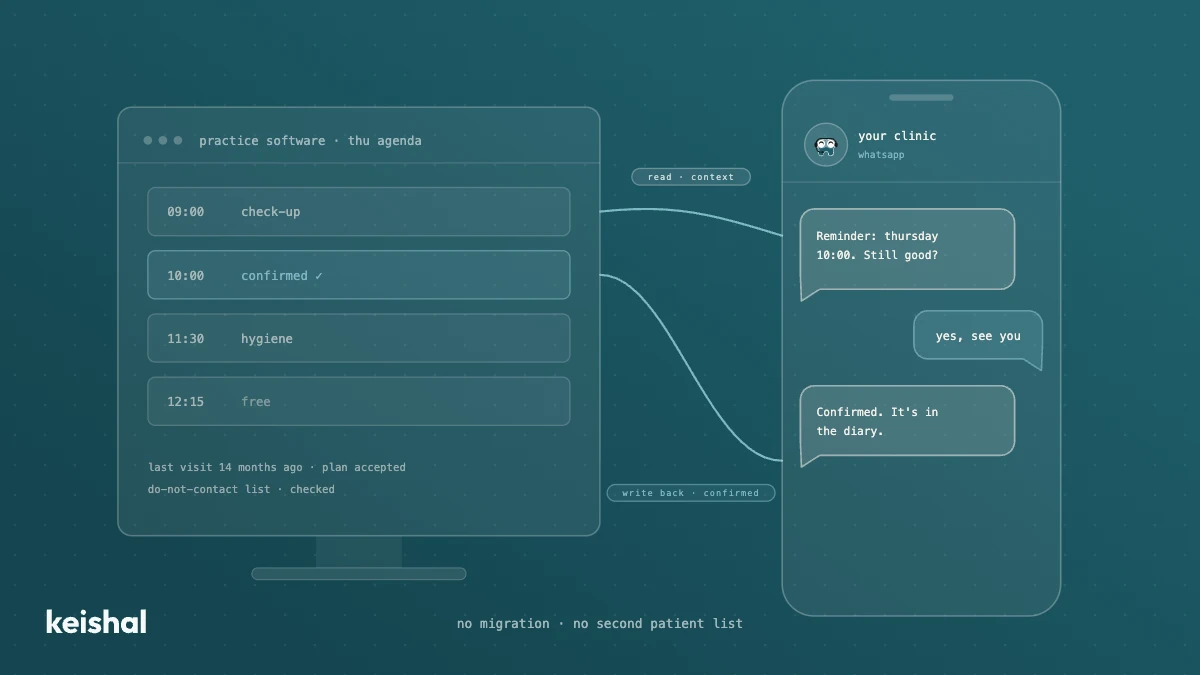
Integrating AI with your dental practice software: what a real connection means
A real integration with your dental clinic's software does two jobs: it reads your patients' data for context and writes appointments, confirmations and status changes back into your program. A monthly CSV, a calendar connector or a read-only tool leaves the rest to your team: with 330 reminders a month, marking each confirmation at 30 seconds adds up to almost 3 hours. Ask for the list of supported programs and versions in writing, and check that there's no migration and no duplicate patient base.
Switching dental software: what migrating really involves and when you don't need to
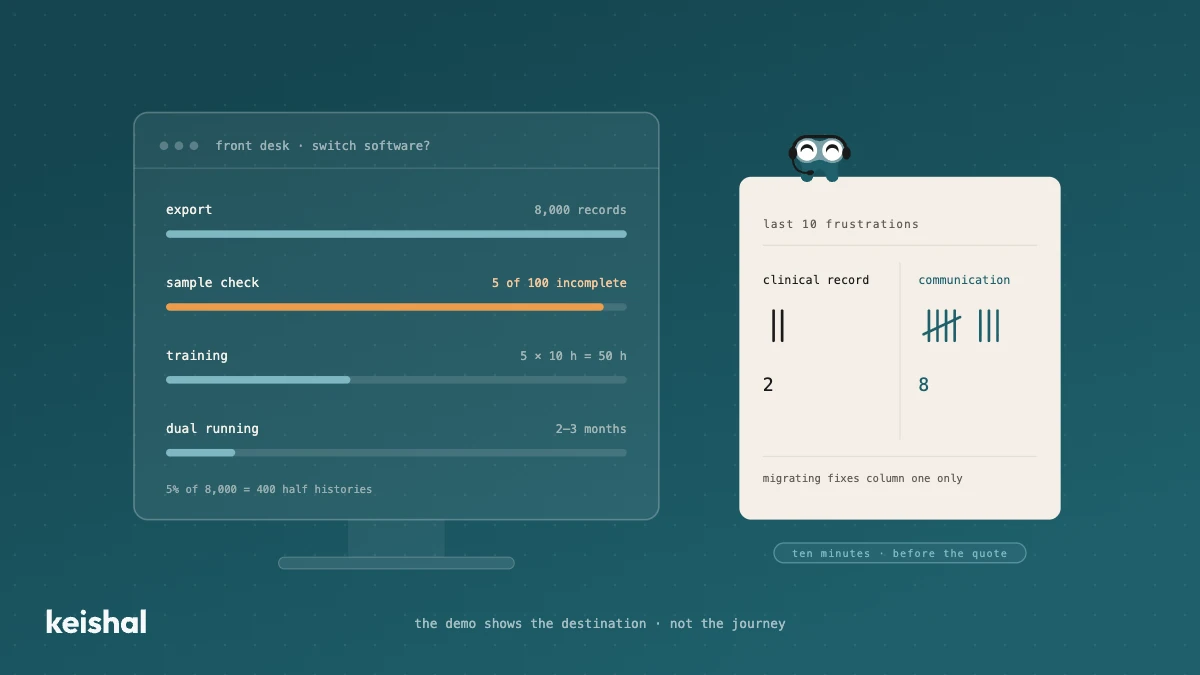
Switching dental software isn't installing a program: it's exporting and verifying thousands of records, training the team (5 people × 10 hours = 50 hours) and running two systems side by side for two or three months. It's worth it when the software has no support, holds your data hostage or the clinic has outgrown it. But if what's pushing you is unmanaged reminders, recall that never happens and out-of-hours messages, that communication layer can be added on top of your current PMS, without migrating anything.