
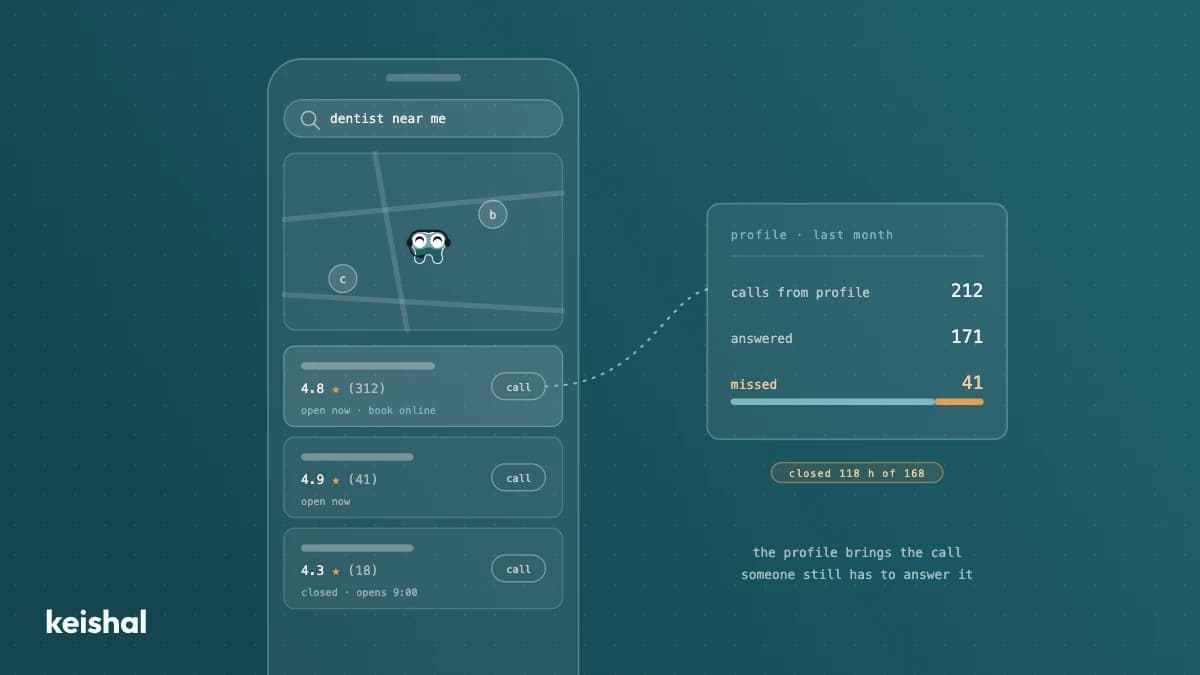
Your Google Business Profile is your dental clinic's real front page: many patients decide and call from there without ever visiting your website. Tuning it up is one afternoon of work and needs no agency: the right category and services, real hours including holidays, your own photos, a booking link and a constant flow of reviews. What the profile won't fix is what happens to the contacts it generates: with 50 open hours out of the week's 168, 118 go uncovered (70%). If the call lands there, the profile has only optimised your volume of missed calls.
When someone searches "dentist near me" or "dental clinic" plus a neighbourhood, Google doesn't show them your website first. It shows a map with three profiles: the rating, how many reviews sit behind it, photos, opening hours and a call button. Many patients decide right there and contact the clinic from the profile itself, without ever touching your website.
That's why your dental clinic's Google Business Profile (formerly Google My Business) is, in 2026, your real front page in local search. It deserves to be treated as what it is: the cheapest acquisition asset you own. It's free, and the initial tune-up is one afternoon of work, with nobody to hire.
This article covers both halves of that sentence. First, what does depend on you: what to fix, in what order, and with an opinion. Then, what no profile can fix: what happens to the calls and messages it generates when they land on a busy line or outside your opening hours. We sell neither SEO nor profile management, so we can say plainly what is an afternoon's work and why you don't need to pay for it.
Why the profile outweighs your website
Local search works differently from classic search. For "dental clinic" plus a city or neighbourhood, Google shows the map block before the normal results. On a phone, that block fills the whole screen.
Inside the map you don't compete with text: you compete with profiles. The patient compares three things in seconds. The rating and the number of reviews behind it. The photos. And whether they can act right now: call, book, ask.
Google explains its local ranking with three factors: relevance, distance and prominence. Distance you cannot move. Relevance and prominence you can, and everything below works on those two. The profile is one piece of the full acquisition picture; for the whole map, see how to get more patients for your dental clinic.
What does depend on you: seven fixes in order of impact
Ordered by return. If you only have one afternoon, start at the top.
1. Primary category and services
The primary category should be "Dental clinic" (or "Dentist" for a single-chair practice). It sounds obvious, but many profiles still carry the generic category someone picked when creating them years ago. Add the secondary categories that apply and the real list of services: implants, orthodontics, cleanings, emergencies, cosmetic work.
Relevance starts here. Google can't show you to someone searching for orthodontics in your neighbourhood if your profile doesn't say you do it.
2. Real opening hours, including public holidays
A wrong "open now" is the worst lie your profile can tell: it generates a call nobody answers and, sometimes, an angry review. Confirm special hours every time Google asks (it does before each public holiday) and check long weekends, which is where most profiles fail.
3. The booking link
The profile takes a booking link. Add one, and make it point somewhere the patient can actually close an appointment at any hour, not a form that answers "we'll call you". The patient comparing profiles at 10pm goes with the first clinic where they can settle it now. How to build that door is covered in 24/7 online appointment booking for your dental clinic.
4. Your own photos, not stock
The front of the building (so people find the door), reception, treatment rooms, the team. A stock photo of catalogue dentists signals exactly the opposite of what you want: that nobody bothered. You don't need professional photos; you need photos that are yours and reasonably current. Refresh a few every quarter.
5. Questions and answers
The Q&A section of the profile can be answered by anyone, including a stranger who's wrong. Seed it yourself: parking, which insurers you accept, whether you take emergencies, how to arrive by public transport. Every answer of yours is an objection resolved before the first call.
6. The review flow, the strongest signal you control
For a clinic, prominence mostly means reviews, and they don't work as a one-off campaign but as a constant flow. Run the numbers with your own figures: if your clinic sees 600 visits a month and collects 5 reviews, that's a 0.8% conversion. It doesn't mean unhappy patients; it means nobody asks for the review at the right moment.
How to systematise the request is covered in how to get Google reviews for your dental clinic. And what to reply when they arrive, including the negative and the unfair ones, in how to respond to Google reviews. A profile with recent, answered reviews says "someone is home"; a high rating from two years ago with no reply since says the opposite.
7. The same information everywhere
Name, address and phone number identical on the profile, on your website and in every directory you appear in. Inconsistencies cost trust, with Google and with the patient comparing.
What the profile won't fix
An optimised profile does exactly one thing: generate more contacts. Calls, messages, booking requests. The profile's own statistics tell you how many each month.
The question no local SEO checklist asks is what happens to those contacts. Run the other calculation. A clinic open 50 hours a week is closed 118 of the week's 168 hours: 70%. And the patient comparing profiles doesn't search during your hours; they search when they can, often at 9pm or on a Sunday.
If the call arrives while the line is busy, or the message comes in on Saturday and gets read on Monday, the profile has done its job and the clinic has thrown it away. Optimising the profile without solving the response side means optimising your volume of missed calls.
A pattern we hear repeatedly in 2026 sales conversations, summarised (translated; the original is in Spanish): "The profile is fine: good rating, photos, hours up to date. What we weren't looking at is that the phone was busy at midday and weekend messages got read on Monday."
Count your missed calls in any given week. If it's 10, that's about 40 a month. Not all of them were new patients; if just one in four was a potential first visit, that's 10 first visits a month deciding at the next profile on the map. That work is no longer SEO but coverage: how to answer the questions that arrive out of hours is in answering patient questions 24/7 at your dental clinic, and how to close the appointment without a call, in the 24/7 booking piece.
Do you need to pay someone to manage it?
For the tune-up, no. Everything on the list above is your work or reception's: one afternoon the first time and a short routine afterwards. Confirm hours before each holiday, upload the odd new photo, answer reviews and questions.
A local SEO agency adds value in two specific cases: a hotly contested area where every competitor already has an impeccable profile, or several locations to keep consistent. Paying for profile management before solving the basics means paying to generate contacts you'll keep losing. The right order, what to fix before hiring and what to demand from an agency, is developed in dental clinic marketing: what to hire and what to fix first.
The one-afternoon review: five questions
- Do the category and services describe what you do today, or whatever was set when the profile was created?
- Are the hours for the next public holiday confirmed?
- If a patient requests an appointment from your profile on a Sunday at 10pm, what exactly happens?
- How many new reviews did you get last month, and how many are still unanswered?
- How many calls did the profile generate last month (its statistics tell you), and how many ended up missed?
The first two you can fix today. The last three aren't about the profile: they depend on who handles what the profile generates.
Where an autonomous system fits
Keishal doesn't manage Google profiles and doesn't do SEO. What an autonomous system does is make sure the demand your profile generates doesn't get lost. It answers the clinic's WhatsApp at any hour, using only information the clinic has approved, and escalates to the team whatever needs a person. It closes the appointment with a hybrid mechanism: the patient sorts out their questions in the chat and picks the slot in a calendar link. It asks for the review after the visit, when satisfaction is highest. And it writes every outcome into your practice management software, whether that's Gesden, Nubimed, Dentalink, Clinic Cloud or another. No migration, and no new tool for your team to learn.
If you want to see it on your own numbers (your uncovered hours, your missed calls, your review conversion), book a demo.

Ready to try Keishal in your dental clinic?
Book a demo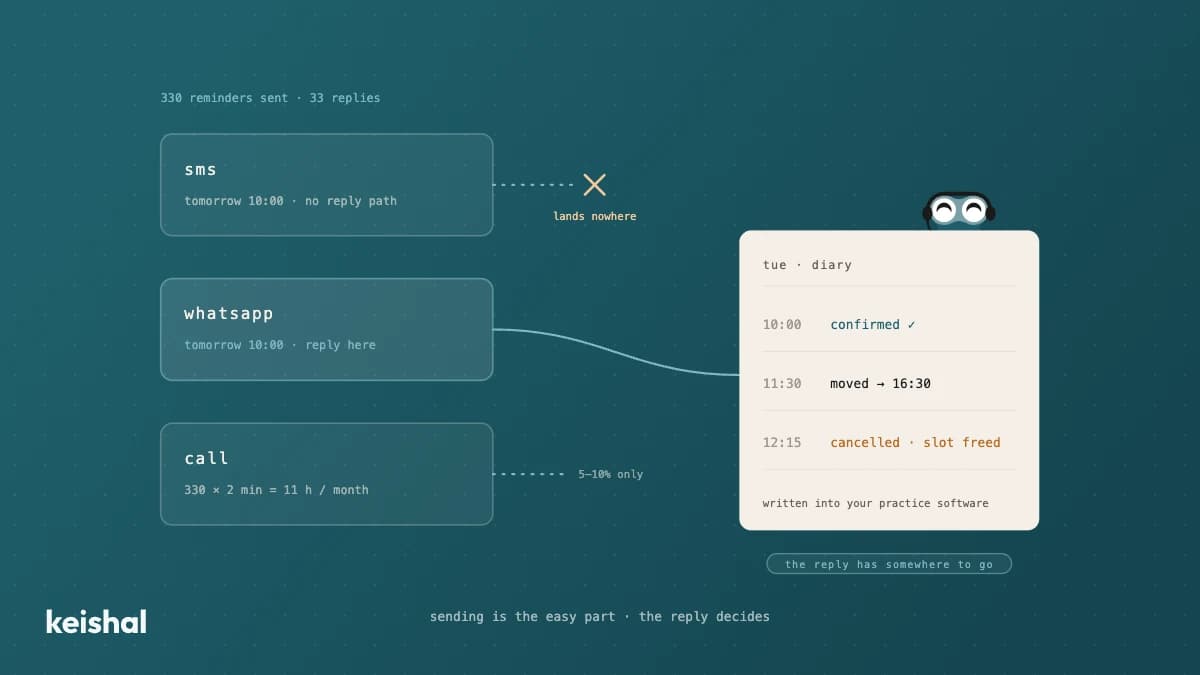
Appointment reminders for your dental clinic: SMS, WhatsApp or phone call
A diary with 15 appointments a day across 22 working days generates 330 reminders a month. If one patient in ten replies, that's 33 conversations someone has to handle: confirmations, reschedules, cancellations that open a slot. That's why the channel matters less than the reply: SMS notifies but rarely listens, WhatsApp resolves things in the same thread, and the phone call is for the cases that need it. In 2026, the real purchase decision isn't "which channel do I buy?" but "who handles what patients reply?".
Virtual phone system for dental clinics: what it solves and what keeps ringing
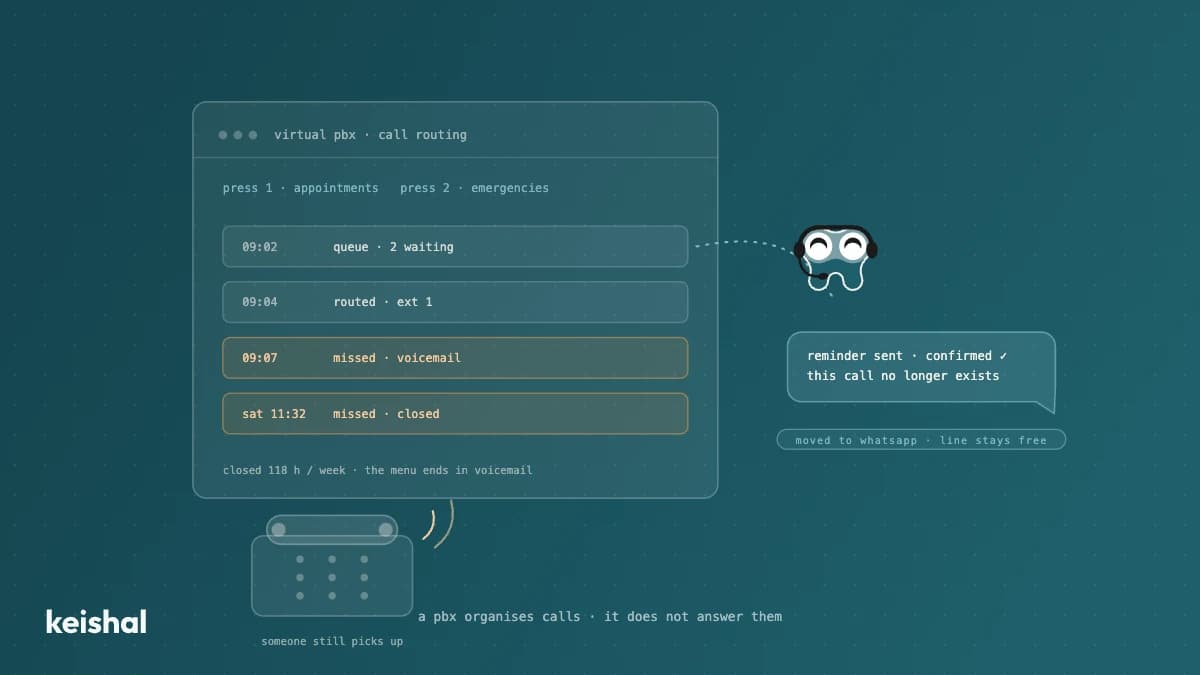
A virtual phone system organises your dental clinic's calls: voice menus, hold queues, forwarding and missed-call logs. What it doesn't do is answer them: someone still picks up, and with 50 opening hours the clinic is closed for 118 of the week's 168 hours (70 %). It makes sense with several locations or lines, or when calls are lost to saturation. If the problem is volume — 40 calls × 3 minutes = 2 hours a day — the higher-leverage move is migrating repetitive tasks (reminders, bookings, questions) to WhatsApp and keeping the phone for the conversations that need it.