
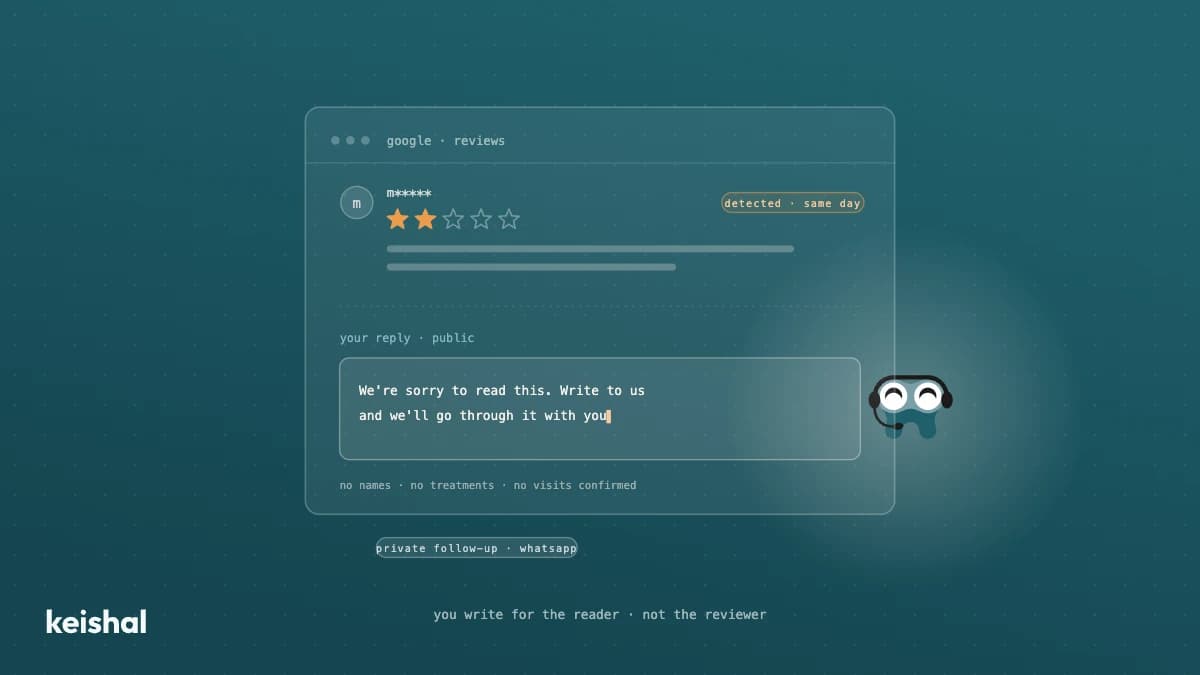
Respond to every review of your dental clinic, and do it as if you didn't know whether the author is a patient: never confirm visits or treatments, because a public reply cannot reveal health data. This guide gives you templates for the four cases (positive, negative with cause, unfair negative, and a review from no patient at all) and an honest split of the work: the public voice is human; asking for reviews, detecting them and the private follow-up of the unhappy patient can be automated. The arithmetic that puts it in perspective: 5 reviews out of 600 visits a month is 0.8%. Every review speaks for hundreds of patients who never write.
A clinic that sees 600 patients in a month and receives 5 reviews has a write rate of 0.8%: 5 ÷ 600 = 0.008. Run the numbers with your own schedule and your own Google profile; the result is usually in that range, and it changes how you read every rating. Whoever writes speaks for hundreds who don't. That's why responding to Google reviews of your dental clinic is not a minor front-desk chore: it's one of the few public conversations your clinic has, and the only one where half of it is up to you.
It also has a particularity that generic reputation guides never mention: a dental clinic cannot respond the way a restaurant would, because every review touches health information. The response has to be useful without revealing anything. In this guide: what a clinic can say and what it can't, templates for the four cases that exist, and an honest split of the work, because one part is yours and another can be automated.
Who reads your response (it's not who wrote the review)
When you respond to a review, you're not writing to its author. You're writing to the person who, six months from now, will compare three clinics on a Tuesday night and read the reviews of all three. The author already made their decision; the reader hasn't yet.
That changes the goal. A response to criticism is not about winning the argument: it's about making the reader think "if something goes wrong, this is how this clinic responds". A well-answered negative review conveys something fifty five-star ratings cannot: how you behave when something fails. Reviews work as the thermometer of your clinic's patient care, and the responses are the part of the thermometer you control.
What a dental clinic cannot do when responding
A restaurant can reply "we're sorry the paella arrived cold on Thursday". A dental clinic cannot reply "we're sorry your root canal got complicated", even if it's true. Publicly confirming that someone is a patient, or going into their treatment, turns a courtesy reply into a disclosure of health data, and that can raise data protection questions worth reviewing with specialised advice. The specific framework isn't set by a guide: it's set by your advisor.
The practical rule that avoids almost every mistake: respond as if you didn't know whether the author is a patient. Don't confirm the visit, don't mention the treatment, don't add a single detail the author hasn't made public themselves. The response can still be warm and specific; what it can't do is inform.
Handled well, this limitation works in your favour. A reader who sees the clinic responding carefully, without airing anyone's details, draws the right conclusion: this clinic takes its patients' information seriously. Data protection, done well, is a trust signal, not a brake.
The four situations and a template for each
There are no other cases: positive, negative with cause, unfair negative, and a review that doesn't belong to any patient. The templates are the starting point; what decides the outcome is what happens after you publish them. It's the same principle as with WhatsApp message templates for dental clinics: the text is the easy part, and the real work starts with the reply.
Positive review
"Thank you, [name]. We're glad the experience was a good one: it's exactly what we try to do every day. Best regards from the team at [clinic]."
Short, personalised with the name, and without going into the treatment, even if the author described it. If they wrote "they took away my fear of the implant", don't reply "we hope you enjoy your implant": don't add clinical content that contributes nothing.
To sustain this you need to be able to:
- detect the new review the same day, without depending on someone remembering to check the profile;
- vary the wording: two identical replies in a row are spotted immediately;
- keep the volume from piling up: answering 3 reviews is easy; owing 30 discourages anyone.
Negative review with cause
"We're sorry to read this. What you describe is not the experience we want to give, and we'd like to understand it properly and put it right. Write to us at [channel] or call us and we'll go through it with you directly."
No excuses and no details: you acknowledge the experience described, you don't confirm any record. The real conversation doesn't happen on Google, it happens in private, and there you can talk to the identified patient with their context in front of you.
You need to be able to:
- make private contact the same day, with the patient's record and conversation history at hand; WhatsApp works well as the channel for that follow-up;
- close the loop: when the problem gets solved, some patients update their review on their own initiative (asking for it as a condition, never);
- log what failed: a justified negative review is an operational data point, not just a fire to put out.
Unfair or exaggerated negative review
"Thank you for writing, although we're sorry to read this rating. We don't recognise the situation as described and we'd like to understand it better. If you wish, write to us at [channel] and we'll go through it with you."
The classic mistake is arguing point by point. The reader doesn't need you to win: they need to see composure. A neutral, factual correction ("our estimates are always provided in writing") is enough; a combative tone confirms the review instead of refuting it.
You need to be able to:
- let a few hours pass between reading it and answering it: the first draft of a reply to an unfair review never gets published;
- keep an internal record of your version of events, in case the matter escalates;
- make sure the person who is angry at that moment is not the one who replies.
A review from no patient at all
It happens more often than it seems: a mix-up with another clinic, a rating inherited from a previous tenant of your address, or plain bad faith. The temptation is to reply "you are not our patient", and that brings back the same problem as always: publicly stating who is or isn't a patient is also talking about data you shouldn't air.
"Thank you for the message. We can't identify the situation you describe and we'd like to clarify it. Write to us at [channel] with more detail and we'll look into it."
In parallel, Google lets you flag reviews that violate its policies. It's a slow process with no guaranteed outcome, so the public response is still needed: it's what the reader will see in the meantime.
Where to start if you have unanswered negative reviews
If you owe several, the order matters. First the most recent justified negative: it's the one that weighs most with whoever is comparing you, and the only one where a real patient is waiting for something. Then the unfair one, then the suspicious one, and the positive ones last, even if it's two lines each. The worst possible pattern is answering only the positive ones and leaving the negatives in silence: the reader interprets it exactly as "when something fails, they hide".
Which part is human work and which part a system can do
The public response is the owner's work, or the work of someone who speaks with the owner's voice. It's judgement, tone and responsibility, and it doesn't pay to delegate it to generic text: readers spot the canned reply instantly, and at a clinic it's signed by the person who fronts the practice.
A summary of what we hear repeatedly in sales conversations through 2026 (a composite quote, not verbatim): "The positive ones we answer when we can. The last negative one sat there for three weeks without a reply, because nobody knew what to say." Three weeks is a long time: it's the first review every new patient read that month.
What you can delegate is everything around it, which is precisely what makes the human part arrive late:
- The volume of new reviews. Asking for the review after each visit shouldn't depend on the front desk remembering: how to get Google reviews for your dental clinic explains that automatic flow. The arithmetic at the top improves by asking more often, not by hoping for luck.
- Detection. Finding out about a new review the same day, not when someone happens to open the profile.
- The private follow-up of the unhappy patient. Reaching out over WhatsApp with the context in front of you, escalating the conversation to the right person on the team when it calls for it, and leaving the outcome recorded in the software you already use: it works on top of Gesden, Nubimed, Dentalink, Clinic Cloud and the other usual programs, without changing anything.
In 2026 this communication layer is no longer exotic: dental software vendors themselves presented patient-communication modules at Expodental 2026. The difference is still who operates it: one more tool your team has to learn, or an autonomous system that does that work and leaves you only the part that is yours, the public voice of the clinic.
If you want to see that full loop with your own numbers — the automatic request, the detection and the private follow-up, with your team answering only what's public — book a demo and we'll show you.

Ready to try Keishal in your dental clinic?
Book a demo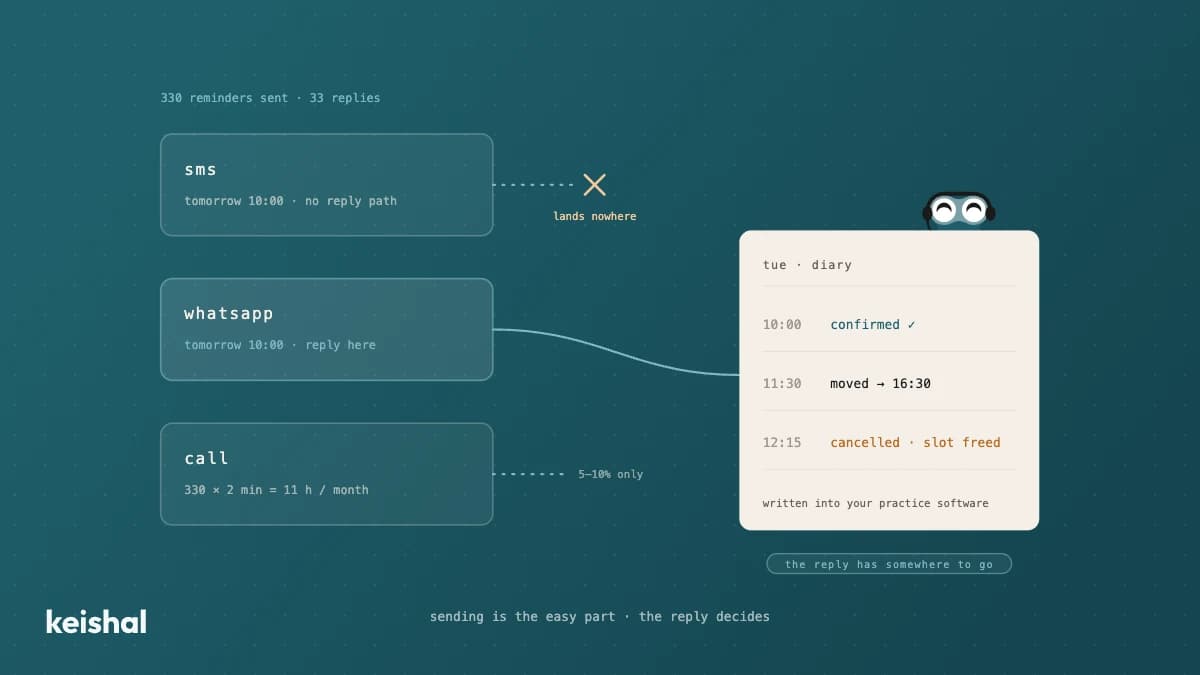
Appointment reminders for your dental clinic: SMS, WhatsApp or phone call
A diary with 15 appointments a day across 22 working days generates 330 reminders a month. If one patient in ten replies, that's 33 conversations someone has to handle: confirmations, reschedules, cancellations that open a slot. That's why the channel matters less than the reply: SMS notifies but rarely listens, WhatsApp resolves things in the same thread, and the phone call is for the cases that need it. In 2026, the real purchase decision isn't "which channel do I buy?" but "who handles what patients reply?".
Virtual phone system for dental clinics: what it solves and what keeps ringing
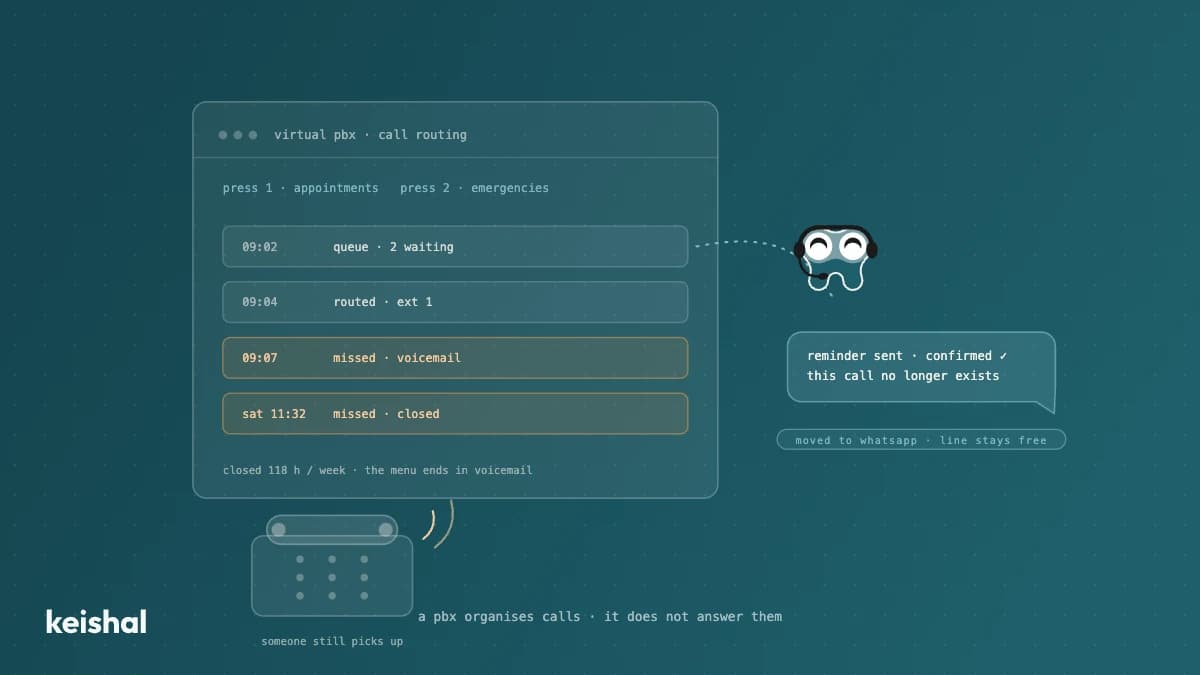
A virtual phone system organises your dental clinic's calls: voice menus, hold queues, forwarding and missed-call logs. What it doesn't do is answer them: someone still picks up, and with 50 opening hours the clinic is closed for 118 of the week's 168 hours (70 %). It makes sense with several locations or lines, or when calls are lost to saturation. If the problem is volume — 40 calls × 3 minutes = 2 hours a day — the higher-leverage move is migrating repetitive tasks (reminders, bookings, questions) to WhatsApp and keeping the phone for the conversations that need it.