
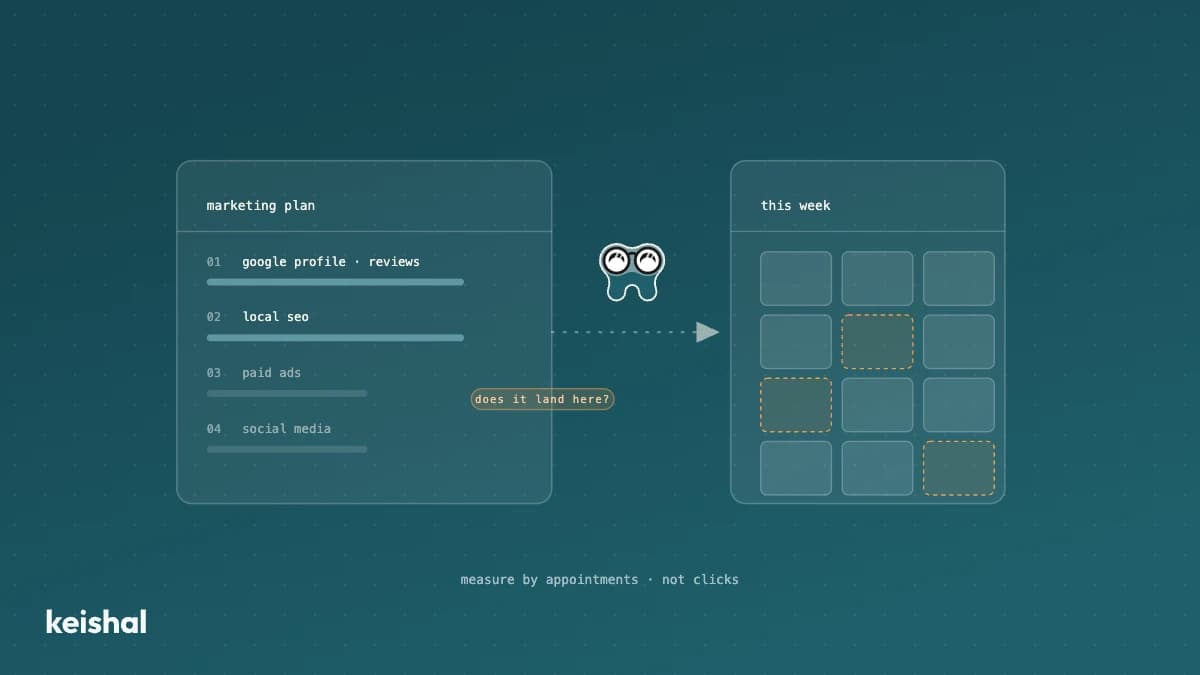
Dental clinic marketing can bring in new demand; what it cannot do is answer the phone. Before signing with an agency, fix what multiplies the return of any campaign: answering outside opening hours too (118 of the week’s 168 hours go uncovered if you open 50), asking for reviews systematically, and reactivating your dormant base (1,000 dormant patients × a €110 average treatment value = €110,000 in stalled treatment). And when you do hire, measure by appointments on the schedule, not by clicks.
If you are searching for dental clinic marketing, you have probably already made the decision: you want to invest so more patients come in. This article will not try to talk you out of it. It will try to make sure that investment does not leak away.
Before signing anything, run one calculation with your own numbers. If your clinic opens 50 hours a week, 118 of the week's 168 hours are left with nobody answering: 70% of the time. Every advertising euro that generates a call or a WhatsApp message during those hours is competing against a phone nobody picks up.
One honest clarification before we start: at Keishal we do not sell marketing, advertising or SEO. We operate patient communication for dental clinics. That is exactly why we can write this guide without selling you anything that appears in it.
What marketing can fix (and what it cannot)
Dental marketing does two things well. It makes you visible to people already looking for a dentist in your area, and it generates new demand among those who are not looking yet. A good agency does both: ranking your clinic in local searches, keeping a well-tended Google profile, running advertising campaigns that bring first visits.
What no campaign can fix is what happens after the click:
- Unanswered calls and messages. If part of the demand arrives outside opening hours and nobody handles it, you are paying to generate enquiries that go cold. A patient who writes at 9:30pm and gets no reply until 10:00am has had the whole night to message another clinic.
- The dormant base. Count the patients who have not visited in 12+ months and multiply them by your average treatment value: 1,000 dormant patients × €110 is more than €110,000 in stalled treatment. No ad brings them back, because they do not need to be acquired: they need to be contacted. Not all of them would return even if you did — some have moved, others no longer need it — but it is demand you already paid for once.
- Schedule gaps from cancellations and no-shows. If the schedule loses 14 thirty-minute gaps a week and your average treatment value is €90, that is roughly €1,260 a week that no acquisition campaign recovers. There, the problem is not demand: it is the leak.
"We invested in advertising for six months. Calls came in, but the schedule still had the same gaps." That line is a composite of real sales conversations we have had in 2026 with clinics already investing in marketing (translated from Spanish), and it sums up the pattern: marketing fills the top of the funnel. If the funnel leaks at the bottom, filling it faster does not fix it.
If you want to diagnose where your gaps come from before deciding anything, that audit is developed in how to fill your dental clinic schedule without spending more on marketing. Here we stay with the buying question: what to hire and what to demand.
The channels of dental digital marketing, in order
Almost all digital marketing for dental clinics fits into four channels, and they are not worth the same. Our opinion, selling none of them:
- Your Google profile and reviews. It is where the patient decides, it is free, and almost no clinic works it systematically. Always start here.
- Local SEO. Showing up when someone searches "dentist in your city" takes months to build, but it is the traffic that does not switch off when you stop paying.
- Paid advertising. It brings demand from day one and stops the day you stop. It makes sense once capture is secured, with a contained budget and measurement by appointments.
- Social media. It builds brand and trust, almost never direct short-term appointments. Make it the last thing you hire, not the first.
That order matters more than any specific provider: the first two channels multiply the return of the other two.
What to fix yourself before paying for new demand
Three things multiply the return of any later campaign. All three depend on you, not on an agency.
1. Someone answering when demand arrives
Do the exercise with your own WhatsApp: count the messages that arrive outside opening hours over one week. With 3 per weeknight and around 8 over the weekend, that is about 23 a week, more than 90 a month. That is your number, not ours. Each one is an enquiry your marketing — paid or organic — already generated. 24/7 online appointment booking is the piece that turns that demand into appointments while the clinic is closed.
2. Reviews: the marketing you do not hire
Before paying to appear higher, look at what the people who already find you see. Divide your Google reviews from the last year by your visits: 5 reviews with 600 annual visits is a 0.8% conversion rate. And not because patients are unhappy, but because nobody asks systematically. It is the part of local marketing with the best effort-to-result ratio, and the request can be automated over WhatsApp after each visit.
3. The dormant base: the demand you already paid for
Reactivating a dormant patient does not require acquiring them: they already know you and trusted you once. What makes it unworkable by hand is the volume. Contacting 1,000 patients properly, at around 5 minutes per patient between looking up the history, writing and handling the reply, is 5,000 minutes: about 83 hours that fit into nobody's working day. The complete step-by-step method is in how to reactivate inactive patients.
When the agency really is the first step
Let us be honest here too: there are cases where marketing comes first.
- A new or recently taken-over clinic. With no patient database there is nothing to reactivate. Visibility is the real bottleneck and waiting does not fix it.
- A small base. With 300 dormant patients, the exercise above is about 25 hours: it fits into a quiet month, and growth has to come from outside.
- You have lost visibility. If competition opened nearby and you no longer appear where your patients used to find you, recovering positions is urgent.
In those cases, hiring is justified from day one. The questions in the next section apply exactly the same.
Six questions to evaluate a dental marketing agency
We do not sell marketing, so this checklist has no conflict of interest: these are the questions we would ask any provider if the clinic were ours. A good agency answers them naturally. And if the conversation turns uncomfortable, that is information too.
- Will we measure by appointments or by clicks? Impressions, clicks and followers are means. The result is first visits on the schedule. Ask for the monthly report to start there.
- How will we know where each appointment came from? If there is no way to attribute the source — a tracking number, a question at the front desk, a form — nobody will be able to prove what works and what does not.
- Who owns the accounts? The Google profile, the ad account and the domain must be in the clinic's name. If the contract ends and the accounts leave with the agency, you did not buy an asset: you rented one.
- What happens to the calls and messages the campaigns generate? A serious agency will ask how you handle demand before generating more of it. If nobody raises the subject, raise it yourself.
- Can we start small and review at 90 days? A contained budget, concrete goals and a review with the numbers on the table. Distrust the long contract with no exit point.
- What exactly do you promise? Specific Google positions cannot be guaranteed, and whoever guarantees them is telling you how they work. Work, method and measurement can be committed to.
Who operates everything else
The underlying question remains: when the campaign works and demand arrives, who handles it? And who works the demand already sitting in your database?
There is a structural difference between two kinds of solution here. Tools — a chatbot, a reminders module, a campaign platform — are operated by your team: someone configures them, checks them and gives them hours every week. An autonomous system is operated by the provider: your team sees the results on the schedule, not the tool. The difference is not the technology. It is who puts in the hours.
Keishal is the second kind: an autonomous system that answers over WhatsApp at any hour (and sends a calendar link so the patient picks their own visit time), confirms and reminds appointments, asks for the review after each visit and reactivates the dormant base. It runs on top of the software you already use — Gesden, Nubimed, Dentalink, Clinic Cloud and others — and writes the results into your schedule, so your team does not have to learn or operate anything new.
The order we defend is the same as in how to get more patients for your dental clinic: first capture the demand that already arrives, then reactivate the demand you already paid for, and then yes, buy new demand with an agency that passes the checklist — on top of a clinic that answers. If you want to see what that would look like with your numbers, book a demo and we will show you.

Ready to try Keishal in your dental clinic?
Book a demo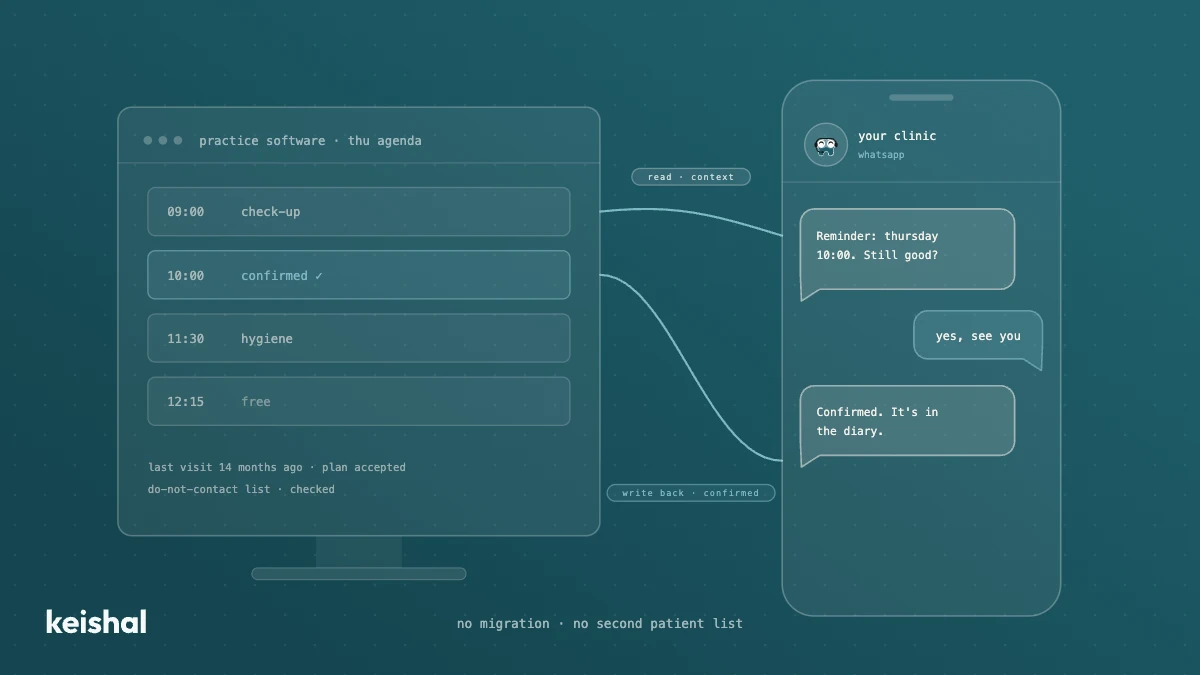
Integrating AI with your dental practice software: what a real connection means
A real integration with your dental clinic's software does two jobs: it reads your patients' data for context and writes appointments, confirmations and status changes back into your program. A monthly CSV, a calendar connector or a read-only tool leaves the rest to your team: with 330 reminders a month, marking each confirmation at 30 seconds adds up to almost 3 hours. Ask for the list of supported programs and versions in writing, and check that there's no migration and no duplicate patient base.
Switching dental software: what migrating really involves and when you don't need to
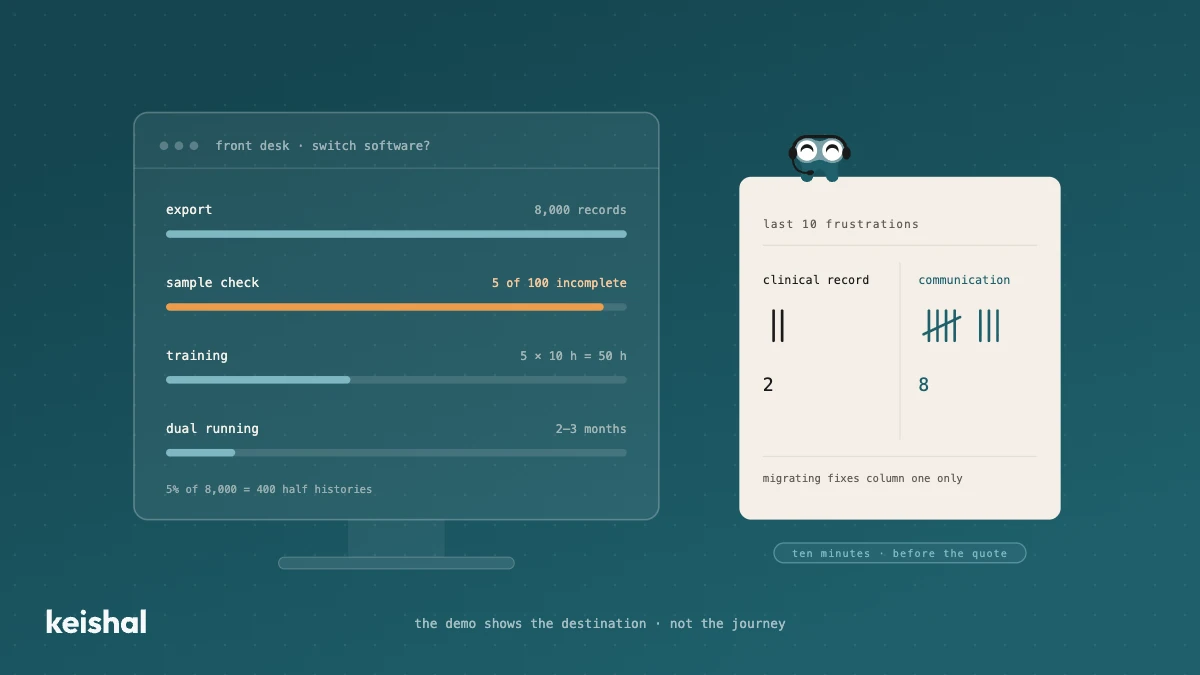
Switching dental software isn't installing a program: it's exporting and verifying thousands of records, training the team (5 people × 10 hours = 50 hours) and running two systems side by side for two or three months. It's worth it when the software has no support, holds your data hostage or the clinic has outgrown it. But if what's pushing you is unmanaged reminders, recall that never happens and out-of-hours messages, that communication layer can be added on top of your current PMS, without migrating anything.