Cookies & privacy
We use essential cookies to run the site and, with your consent, analytics cookies to understand how it's used. You can change your choice anytime.
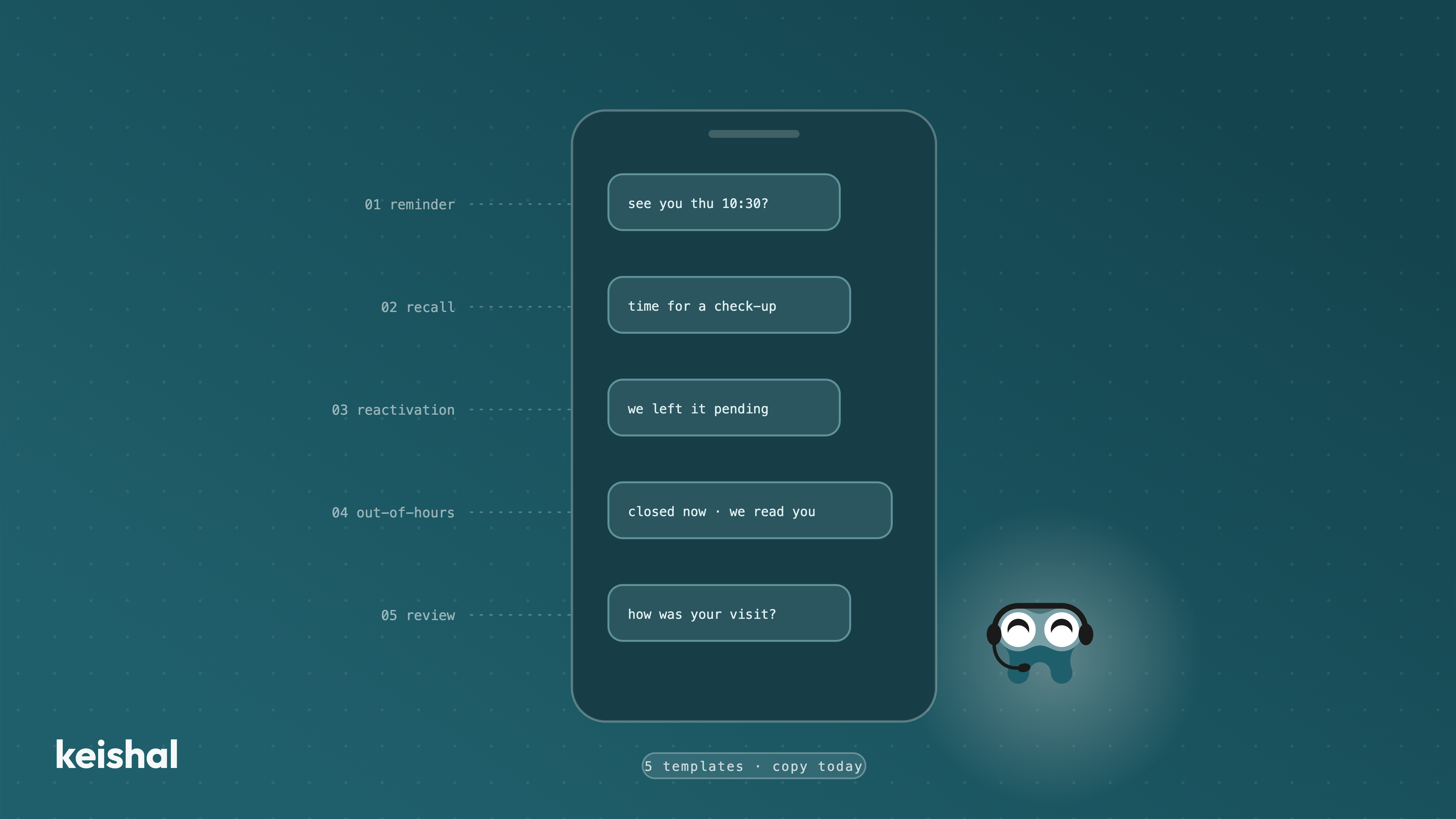
Five WhatsApp templates for your clinic: a reminder with confirmation, a recall message, a reactivation message for dormant patients, an out-of-hours reply and a review request. The text is the easy part: a schedule with 15 appointments a day generates 330 reminders a month, and if 1 in 10 patients replies, that is 33 conversations someone has to handle. Each template comes with the checklist of what that message must be able to handle: confirm, reschedule, escalate and record it in the schedule. Before copying anything, decide who replies.
If you are looking for WhatsApp message templates for your dental clinic, here are five: an appointment reminder with confirmation, a recall message, a reactivation message for dormant patients, an out-of-hours reply and a review request. You can copy and adapt them today. First, run one quick calculation: a schedule with 15 appointments a day, over a 22-working-day month, generates 15 × 22 = 330 reminders. If just 1 in 10 patients replies with anything more than "ok", that is 33 conversations a month someone on your team has to handle.
The text is the easy part. What decides the outcome is what happens when the patient replies.
Almost every list of templates you will find ends where the real work begins. A good message generates replies: that is its job. A reminder nobody can answer is a poster, not a conversation.
That is why every template in this guide comes with a checklist of what that message has to be able to handle. If you send the text without that part solved, the message will still work: it will provoke replies. They will just land in an inbox nobody is watching, and that is worse than not sending anything.
One clear opinion before we start: if you only set up one of the five, make it the reminder with confirmation. It generates the most useful replies per message sent, and it depends least on the quality of your patient database.
Hi [name] 👋 A reminder of your appointment at [clinic] on [day] at [time]. Can you confirm you'll make it? If the time doesn't work, just tell us here and we'll find you another slot.
Why it works: it asks for one concrete action (confirm) and makes cancelling friction-free. That last part is deliberate. You want cancelling to be easy: a cancellation with notice is a recoverable slot; a silent no-show is not. We cover this in how to reduce no-shows at your dental clinic.
What this message has to be able to handle:
The industry standard is at least one recall contact per year; clinics that optimise go to two. If you don't know how many of your patients are due this month, start with what dental recall is and how to automate it.
Hi [name] 👋 This is [name] from [clinic]. It's been [X months] since your last check-up and we like to do at least one a year. Shall I suggest a couple of times this week or next?
Why it works: it gives a concrete reason (time since the last visit) and closes with a question that takes five seconds to answer. No urgency theatre: a yearly check-up is reason enough.
What this message has to be able to handle:
This is not the same as recall. Recall contacts active patients who are due a check-up; reactivation goes after the ones who haven't set foot in the clinic for 12 months or more. The message has to acknowledge that time, not pretend it didn't pass.
Hi [name], this is [name] from [clinic]. Looking at your file, I see we left [treatment / your check-up] pending in [month, year]. You may have sorted it elsewhere; if not, I'd be glad to pick it up with you. Would you rather I call you, or shall we sort it here?
Why it works: the concrete reference to their file shows this is not a mass send, and admitting they may have solved it elsewhere is honest and disarming. Avoid discounting by default: most dormant patients didn't leave over price. The full step-by-step method is in how to reactivate inactive patients at your dental clinic.
What this message has to be able to handle:
A clinic open 50 hours a week leaves 118 of the week's 168 hours with nobody at the other end: 70%. Some of your messages arrive at 9.30pm.
Hi 👋 Thanks for messaging [clinic]. We're closed right now, but we do read you. Tell us what you need and we'll reply first thing. If you'd like an appointment, let us know and we'll send you our calendar link so you can pick the slot that suits you best.
Why it works: it sets an honest expectation (we'll reply first thing) instead of silence. And if the patient wants an appointment, it doesn't make them wait: the conversation continues on WhatsApp and the booking closes with a calendar link where they pick the slot themselves.
What this message has to be able to handle:
The best moment to ask for a review is right after the visit, when satisfaction is highest. If sending depends on someone at the front desk remembering, it will be sent "sometimes".
Hi [name], thanks for coming in today to [clinic] 😊 If you were happy with your visit, would you leave us a Google review? It takes a minute from this link: [link]. It helps us more than you'd think.
Why it works: it's short, it arrives at the right moment and it asks for one thing. Ask every patient, don't filter before asking; pre-filtering is questionable and it also deprives you of the signals you need. The full system is in how to get Google reviews for your dental clinic.
What this message has to be able to handle:
Messaging a patient means handling sensitive data, whatever the channel: WhatsApp, SMS, email or phone. It is not a WhatsApp-specific problem, and it is not an annoying formality either: it is an opportunity.
A patient who sees that their clinic asks for permission clearly, writes from an identified business number and makes it easy to say "no more messages, please" trusts it more. Data protection, done well, is a signal of seriousness that strengthens the relationship.
The specific framework (which consents, which legal texts, which official channel) is best defined with specialised data protection advice. The channel itself and how to use it are covered in WhatsApp for dental clinics: uses and data protection.
Back to the arithmetic from the top: 330 reminders a month means around 33 conversations. Add the recall replies, the reactivation replies and the messages from the 118 hours the clinic is closed. Your front desk already has the phone, the counter and the schedule; asking the same people to also carry all those conversations is not realistic, and it is not their fault.
"I'd rather call patient by patient myself than have to learn to use yet another new thing," the owner of a clinic told us on a sales call in 2026 (translated from Spanish). It is a reasonable reaction: the barrier is not the money, it is having to operate one more tool.
There are three ways to sustain these templates:
The templates on this page work in all three modes. The difference is how many you can sustain at once, and what happens to each reply. If you want to see what this sounds like with the numbers of a clinic like yours, book a demo.
A virtual receptionist should not replace your receptionist: it should absorb the repetitive load that does not fit in their day. A front desk open 50 hours a week leaves 118 of the week's 168 hours unanswered: 70% of the time. An autonomous system covers reminders that get a response, 24/7 booking (WhatsApp chat plus a calendar link), out-of-hours questions with escalation, recall and reactivation. It does not answer the phone: it removes volume from it. The front desk, clinical conversations and complaints stay human.
When you go from one clinic to two or three, the bottleneck stops being the schedule and becomes visibility: the location where you are not is a black box. To manage it without being there, compare locations with four ratios computed the same way everywhere — occupancy (370 out of 528 hours = 70%), no-shows over total appointments, dormant base over total database and contactability — and distrust any comparison made with unequal data quality. Total revenue compares sizes; ratios compare management.