
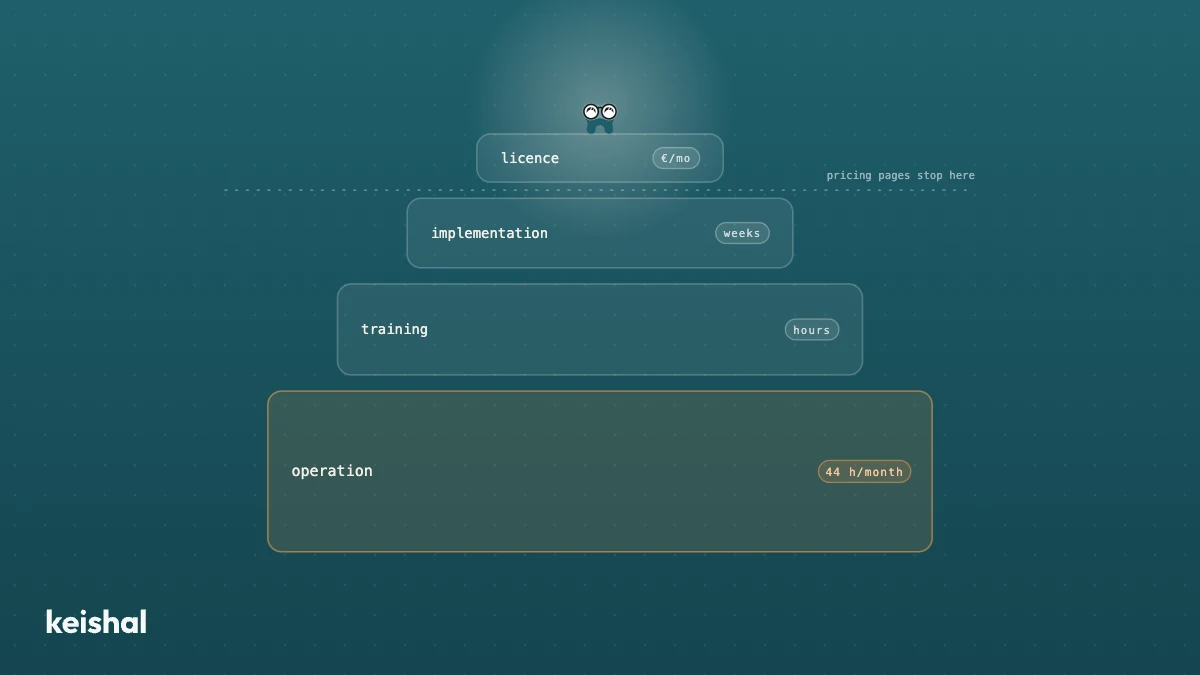
The licence price is only one of the four cost layers of dental clinic software: licence, implementation, training and operation. The most expensive one appears on no price list: just confirming the schedule by hand is 40 calls × 3 minutes = 2 hours a day, and one reactivation campaign of 1,000 dormant patients ≈ 83 hours. Before comparing prices, work out who will put in those hours: a licence nobody operates costs the same and returns nothing.
If you're searching for how much dental clinic software costs, you probably have several pricing pages open already. They all answer the same question: what the licence costs. None of them answers the one that actually decides: what it will cost you to use it.
The difference is not a nuance. Just confirming the schedule by hand, 40 calls at 3 minutes each, is 2 hours a day of someone's time on your team. That layer, the hours, appears on no price list. And it is usually the most expensive one.
In this article we break down the four cost layers of any dental software in 2026, with the arithmetic in plain sight so you can run it on your own clinic. You won't find other vendors' figures here: their prices change with modules, chairs and users, and they publish them on their own websites. What nobody publishes is the rest.
Layer 1: the licence, the only one on the pricing page
The licence is the easy part. It is public, it is comparable, and it comes in a table: so many euros per month depending on chairs, users or modules. That is why every price comparison stops here.
The problem is not the figure, it is the illusion that the figure is the cost. Comparing two software products by their licence is like comparing two treatments by the price of the materials: almost everything is missing.
The licence is the easiest layer to compare and the least decisive of the four. If you are still choosing, we keep a dental software comparison for Spain that sells no PMS and helps you shortlist before you look at price lists.
Layer 2: implementation
Between signing and having the software running there is a stretch that almost never appears in the proposal: migrating data, configuring the schedule, connecting integrations, deciding permissions.
Part of that work is done by the vendor. Another part you put in without noticing: kick-off meetings, configuration decisions, checking the migrated patients are correct. Those are your hours and your team's hours, and they count as cost even though nobody invoices them.
The useful question here is not "how much does implementation cost?" but "how many weeks does it take and how many hours of my team does it need?". If the answer is "it depends", ask for the typical case of a clinic your size. And if this is not your first software but a replacement for the one you already use, this layer grows: we break it down in what migrating to a new program really costs, with the export, the record checks, the training and the months running two systems side by side.
Layer 3: training
On a sales call in May 2026, the owner of a family clinic in the Valencia region summed this layer up better than any table (we've left the tool unnamed):
"I tried it, but I never even got to use it. They set me up, they explained everything, and it needed many hours of training. At the time I didn't have them." (translated from the Spanish original)
Training is paid in hours, and in the hours of the person with the fewest free ones: your front desk. It is also not paid once. Every new hire goes through it again, so a front desk with staff turnover pays this layer every year.
Note the detail in the quote: the licence was paid and the training explained. What was missing wasn't money. It was time.
Layer 4: operation, the layer that decides
Here is the cost no pricing page shows, because it isn't the vendor's: it's yours. Patient-communication software has to be operated every day. Someone has to build the lists, launch the campaigns, answer the messages that come in, log the outcomes and keep the database clean.
Let's run the numbers on concrete tasks:
- Confirming the schedule by phone: 40 calls × 3 minutes = 2 hours a day. Over a 22-working-day month, 44 hours.
- One reactivation campaign: 1,000 dormant patients × 5 minutes per contact ≈ 83 hours. More than two weeks of a full-time day, for a single campaign.
Not every clinic has 1,000 dormant patients: count yours and multiply. The figure will change; the conclusion rarely does. Those hours don't exist spare at a normal front desk, whose day is already full with in-person patients and the phone.
That is why so many purchased tools end up half-used. It isn't that the team is slow or the software is bad: the operation doesn't fit in the available hours. Who puts in those hours is the structural difference between software and an autonomous system, and it is the first question to ask before looking at any price.
The extreme case: the paid licence nobody operates
When layer 4 doesn't fit, the outcome has a name. A dental clinic in Catalonia wrote it to us over WhatsApp, also in May 2026 (tool anonymised):
"We have it under contract but we do nothing with it. We don't even know how to use it." (translated from the Spanish original)
The arithmetic of this case is the simplest in the article: twelve paid instalments × zero use = the full cost of the licence, with zero value. The most expensive software is not the one with the highest fee. It is the one you pay for and don't use.
If this has happened to you, it is not your failing. It is a model that takes for granted hours a normal clinic's front desk doesn't have. We've analysed this pattern, the contracted tool nobody gets to operate, in depth, because it is what we hear most often in sales conversations.
When software your team operates is the cheaper option
Here we should be honest in both directions, because there are clinics where the self-operated licence is the right purchase.
If your front desk has real spare capacity every week, if there is a specific person who enjoys running tools, and if your protocols are stable, software your team operates is the most economical option. You pay the licence, you put in the hours, and you already had the hours.
The same goes if your clinic is small and your database short: with 300 dormant patients instead of 1,000, the campaign is 25 hours, not 83, and it can fit into a quiet month.
Saying this plainly costs us little and saves you a wrong purchase. The mistake is not choosing software or an autonomous system: it is choosing without having counted the hours.
The five questions that reveal the real cost
Before signing any proposal, ask for concrete answers to these five questions. Vague answers are information too.
- How many hours a week of my team does this need to deliver results? Ask for a number, not "it's very intuitive".
- What happens in the months when nobody has those hours? If the answer is "nothing happens", you have just described the licence that gets paid and not used.
- Are implementation and training included, and how many of my hours do they take? The two invisible layers, in writing.
- Does it work with my current PMS or do I have to migrate? For the communication layer, the right answer is that it adds to your PMS rather than replacing it. We've analysed that decision by comparing a PMS's communication modules with an autonomous system.
- Am I paying for a tool or for an outcome? A licence gives you access; the outcome depends on your hours. There is a category of providers that operates the tool for you: we explain what service-as-a-software means for dental clinics and what changes compared with classic software.
So how much does Keishal cost?
Keishal is an autonomous system: it integrates with the PMS you already have and our team operates it for you. Using this article's breakdown, the four layers look like this: we do the implementation, training disappears because your team has nothing to learn, and the operation, the expensive layer, runs on our side. Your team only sees the results in the schedule.
The price depends on the size of your database and on what you need operated, so publishing a single figure would tell you nothing useful. What we do see as a pattern across the clinics we operate: it typically pays for itself within the first month, with revenue movement several times above the cost. We don't publish that as a promise, because it depends on your database, not on us.
If you want the calculation with your own numbers — how many dormant patients you have, how many hours operating them would take, and what Keishal would do with them — book a demo and we'll build it on your own database.

Ready to try Keishal in your dental clinic?
Book a demo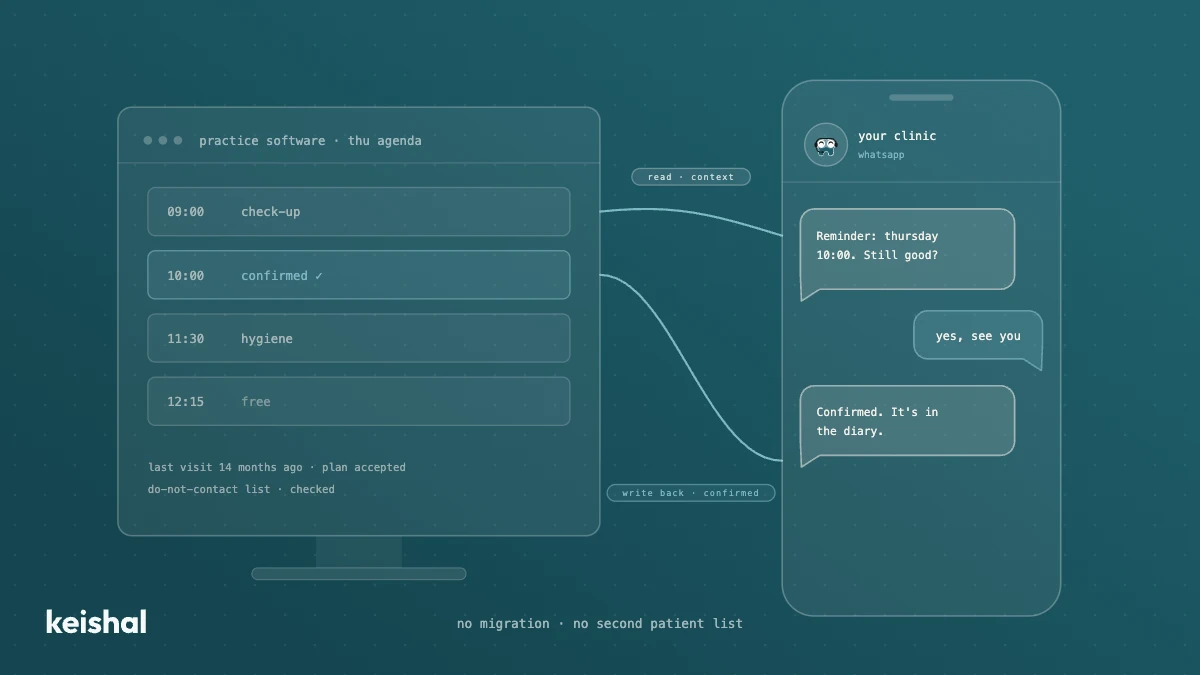
Integrating AI with your dental practice software: what a real connection means
A real integration with your dental clinic's software does two jobs: it reads your patients' data for context and writes appointments, confirmations and status changes back into your program. A monthly CSV, a calendar connector or a read-only tool leaves the rest to your team: with 330 reminders a month, marking each confirmation at 30 seconds adds up to almost 3 hours. Ask for the list of supported programs and versions in writing, and check that there's no migration and no duplicate patient base.
Switching dental software: what migrating really involves and when you don't need to
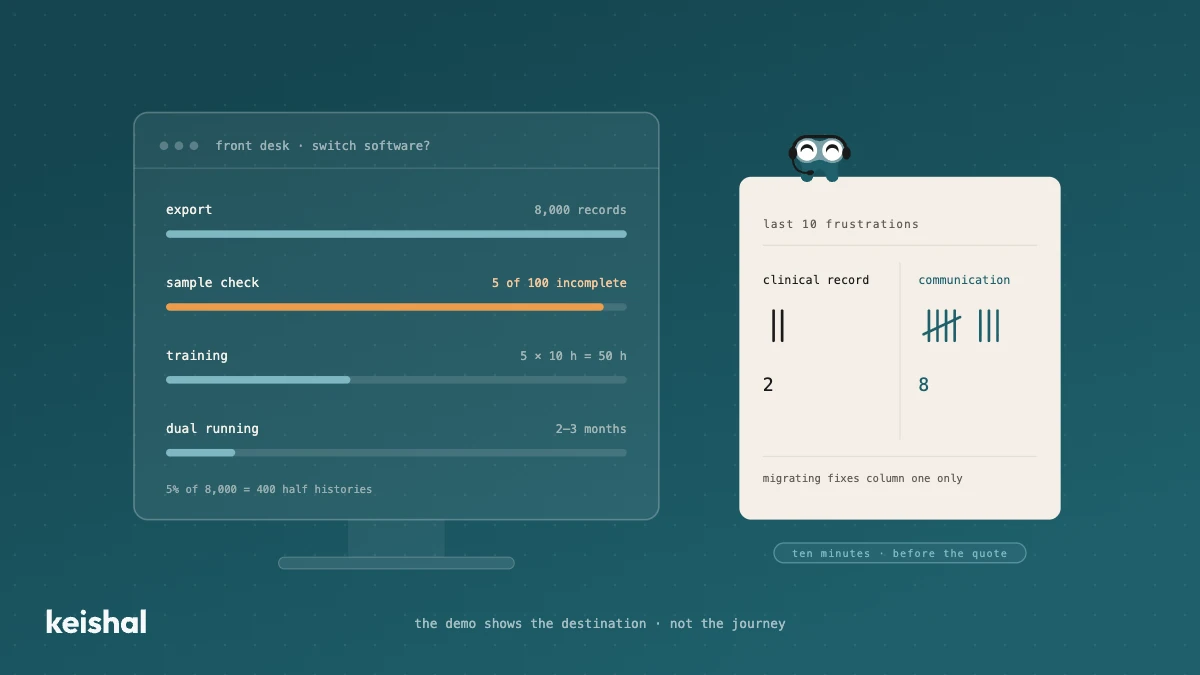
Switching dental software isn't installing a program: it's exporting and verifying thousands of records, training the team (5 people × 10 hours = 50 hours) and running two systems side by side for two or three months. It's worth it when the software has no support, holds your data hostage or the clinic has outgrown it. But if what's pushing you is unmanaged reminders, recall that never happens and out-of-hours messages, that communication layer can be added on top of your current PMS, without migrating anything.