"Service-as-a-software" is the model where the provider doesn't sell you a tool to operate yourself, but operates it for you, and you only see the result. The difference from regular software can be counted in minutes: if your team spends even 15 minutes a day configuring reminders, checking why a template didn't send, or learning a new feature, that's 15 × 5 days × 4 weeks = 300 minutes a month, 5 hours operating a tool before it helps a single patient. In the service-as-a-software model, those 5 hours don't exist. The provider absorbs them.
What "service-as-a-software" means (without the jargon)
The term comes from enterprise software, but the idea is simple. For years, and still in 2026 for most providers, buying technology for your clinic meant one thing: you were sold a license, you (or your team) learned to use it, and the outcome depended on how much time and discipline you put in. That's "software as a service", the SaaS everyone knows: you pay a subscription, but the operating still falls on you.
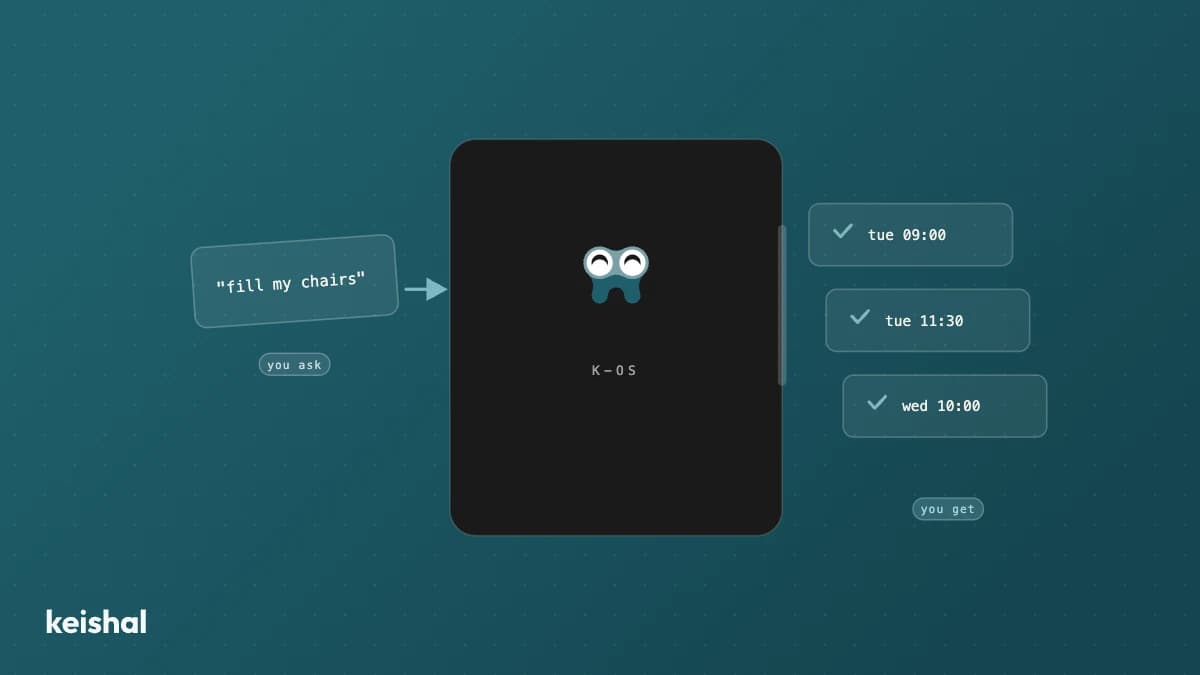
Service-as-a-software flips that logic. The provider doesn't sell access to a tool. It sells an outcome, and to deliver it, the provider operates the technology itself, with its own team or its own AI, inside your clinic. You don't configure anything, you don't log into a dashboard to check automations, you don't train anyone on new software. You see the result: patients contacted, appointments confirmed, reminders sent. How it got done is the provider's responsibility, not yours.
Put in dental clinic terms: it's not "here's a program to manage your patient recall, training is Thursday". It's "your patient recall is handled, and you won't need to touch it".
Software vs. service-as-a-software: the difference that matters
It's worth separating three models that get confused because they all "use technology":
- Software that operates the clinic. You buy a license (scheduling, reminders, patient CRM). The clinic team configures it, maintains it, and decides when to use it. If nobody checks it for a month, nothing happens that month.
- Traditional managed service. You hire a company or an outside person to do a specific task (for example, calling inactive patients). There's a person behind it, but the service doesn't scale on its own: to cover twice the patients, you need twice the contracted hours.
- Service-as-a-software. The provider operates the technology for you, not a person with a phone, not your team with a dashboard. It scales without depending on hiring more people, and it doesn't depend on your team remembering to log in and check it.
The middle category (the classic managed service) solves the "I don't have time to operate this myself" problem, but it does so by adding human hours, which is exactly what doesn't scale. Service-as-a-software solves the same problem without that ceiling: the provider operates a system, not a shift of work. We covered this first split (software vs. managed service) in another article; here we go one step further and define the third category that makes that choice unnecessary.
This isn't a knock on traditional software. A clinic with a team that enjoys configuring tools and has spare hours to do it can get a lot out of a good management platform. The point isn't that one model is bad, but that they solve different problems: one hands you a tool, the other hands you an outcome and keeps the operating part for itself.
What this looks like in your dental clinic, in practice
In a dental clinic, the non-clinical side of the work (reminders, reactivating inactive patients, appointment booking, review follow-up, reporting) is exactly the kind of work that fits this model: repetitive, measurable, and it doesn't require clinical judgment.
With regular software, each of those tasks needs someone on your team to log in, review, adjust, and sometimes fix. With an autonomous system (the way we talk about this with dentists, rather than the technical term "service-as-a-software", the same idea we cover in how to apply artificial intelligence at your dental clinic), those tasks happen on their own: the platform decides which inactive patient to message today, sends the reminder, handles the WhatsApp conversation, and only escalates to a person when human judgment is genuinely needed.
The line we hear most often in early conversations with clinics (a composite of several real conversations, not a single verbatim quote) sums up the problem well: "We bought recall software two years ago. We used it for the first three weeks. Then a busy stretch hit and nobody touched it again." That isn't a failure on the clinic's part or the software's, but what happens when a model depends on someone finding time, on top of their day job, to operate one more tool.
What actually changes for your team (with numbers)
The most honest way to see it is to count the hours your team would spend operating a tool, not treating patients:
- Setting up a reminder or recall campaign: 20-40 minutes, depending on how many templates and segments the tool has.
- Checking weekly which automations didn't fire or failed: 15-20 minutes a week, which is 60-80 minutes a month.
- Training a new hire when the clinic replaces someone on the team: 1-3 hours, depending on the tool.
Added up, it's common for a clinic to spend 3-5 hours a month just keeping a communication tool running, before counting the time spent writing or reviewing the messages themselves. In the service-as-a-software model, those hours disappear because there's no dashboard to operate. The provider takes that part on as part of the service.
What this doesn't mean is that the system makes clinical decisions or speaks on the dentist's behalf without oversight. Everything that gets automated is administrative work (scheduling, reminders, follow-up), not diagnosis or treatment, and conversations that need human judgment get escalated to the clinic's team.
How to tell if a provider is genuinely service-as-a-software (and not just software with a new label)
Any product can call itself "autonomous" or "managed" in its marketing. These five questions separate the real category from the label:
- Who configures the automations on day one? If the answer involves your team sitting down to define rules, flows, or templates, that's software, not an operated service.
- What happens if nobody at your clinic logs in for a month? With software, probably nothing works. With service-as-a-software, the system keeps working the same as always.
- Does the price depend on how many human hours you're contracting? If so, that's a traditional managed service (it scales with people), not service-as-a-software (it scales without them).
- Who fixes a technical issue: your team or the provider? With software, support helps you fix it yourself. With service-as-a-software, the provider fixes it without you having to do anything.
- Do you need ongoing training for your team, or just in the first week? Recurring training is a sign the tool still depends on someone operating it.
None of these questions has one universal "correct" answer. Software operated well by a team with the time and interest to learn it can work very well. What these questions do is tell you clearly which category you're buying into, so the decision is a conscious one instead of a surprise three months in.
Where Keishal fits into this
Keishal is an autonomous system that operates the non-clinical side of a dental clinic: reminders, reactivating inactive patients, 24/7 appointment booking, reviews, and the reports that summarize all of it. It integrates with the practice management software (PMS) the clinic already uses, without replacing it (see how we fit alongside each PMS in our dental software comparison in Spain), and without the team having to learn a new dashboard.
This doesn't mean Keishal is the only possible example of the category, or that the category only exists because we use it. It means the opposite: the category exists independently, describes a real model with its own advantages and limits, and Keishal is one concrete way of applying it to the day-to-day of a dental clinic.
If you want to see what this looks like running on your own clinic's numbers, you can book a demo and we'll show you with your real database, not a generic case.
Ready to try Keishal in your dental clinic?
Book a demo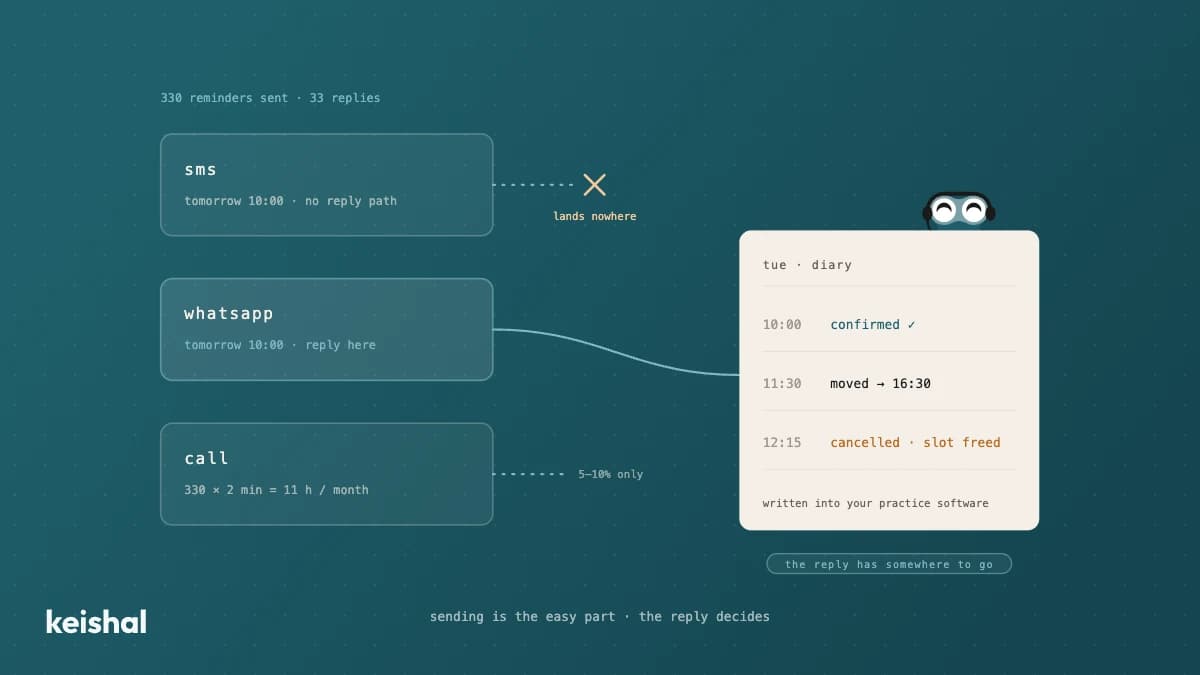
Appointment reminders for your dental clinic: SMS, WhatsApp or phone call
A diary with 15 appointments a day across 22 working days generates 330 reminders a month. If one patient in ten replies, that's 33 conversations someone has to handle: confirmations, reschedules, cancellations that open a slot. That's why the channel matters less than the reply: SMS notifies but rarely listens, WhatsApp resolves things in the same thread, and the phone call is for the cases that need it. In 2026, the real purchase decision isn't "which channel do I buy?" but "who handles what patients reply?".
Virtual phone system for dental clinics: what it solves and what keeps ringing
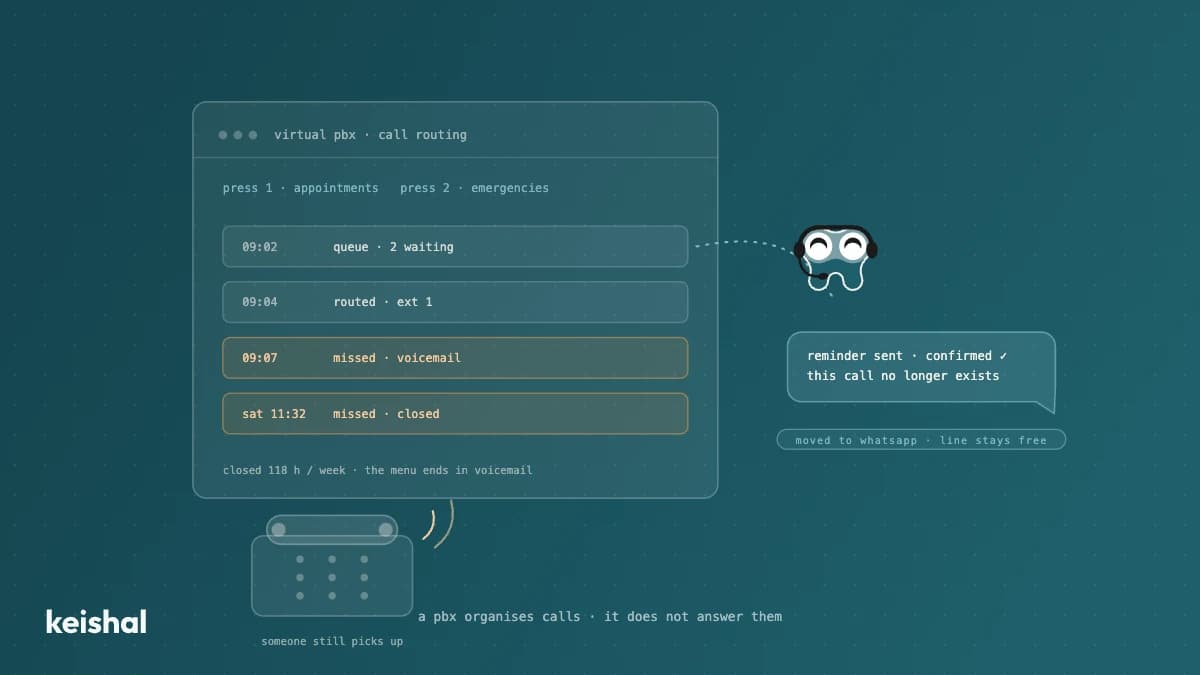
A virtual phone system organises your dental clinic's calls: voice menus, hold queues, forwarding and missed-call logs. What it doesn't do is answer them: someone still picks up, and with 50 opening hours the clinic is closed for 118 of the week's 168 hours (70 %). It makes sense with several locations or lines, or when calls are lost to saturation. If the problem is volume — 40 calls × 3 minutes = 2 hours a day — the higher-leverage move is migrating repetitive tasks (reminders, bookings, questions) to WhatsApp and keeping the phone for the conversations that need it.