Cookies & privacy
We use essential cookies to run the site and, with your consent, analytics cookies to understand how it's used. You can change your choice anytime.
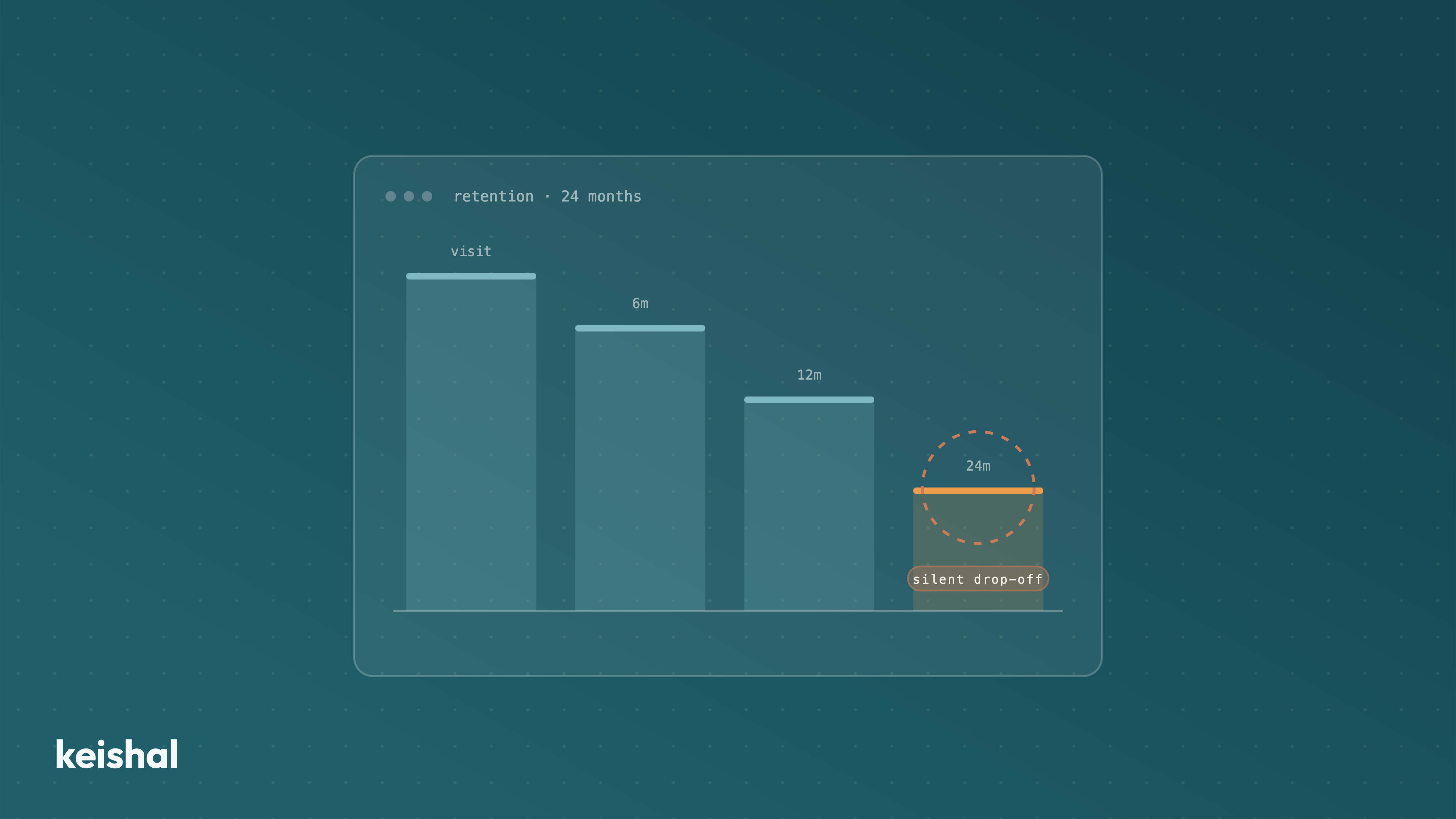
Most patients who stop coming to a dental clinic don't leave angry, and they don't switch to a competitor: they simply disconnect. Life gets in the way, the check-up gets postponed "until next month", and with no one reminding them to come back, that month never arrives. In Spain, only half the population visits the dentist each year — one of the lowest rates in Europe. The five real reasons: the inertia of daily life, perceived cost, dental anxiety, a bad experience they never told you about, and the absence of a system that reminds them to return. The good news: most of these causes can be addressed.
Every dentist knows the pattern. A patient finishes their treatment, leaves happy, says "see you at the check-up" — and disappears. No complaint, no goodbye, no switching to another clinic. They simply don't come back.
And the question that lingers: what did I do wrong?
The answer, in most cases: nothing. But to understand why they leave (and how to bring them back), you need to look at the data and the real causes — not the ones we imagine.
Spain has one of the highest dentist densities in Europe: 87 dentists per 100,000 inhabitants, against a European average of 76. And yet, it's one of the countries where people visit the dentist least: according to the Libro Blanco de la Salud Oral (Spain's oral health white paper), only 51% of the population had visited the dentist in the previous 12 months, and Eurostat data puts the Spanish average at 0.7 visits per inhabitant per year.
The paradox is clear: plenty of dentists, not enough visits.
For an individual clinic, this translates into a silent phenomenon: a significant share of its database consists of patients who came once, or who used to come regularly, and at some point stopped. Each of those patients represents health without follow-up and revenue that never arrives. We cover the financial impact in detail in .
But before talking numbers, let's talk causes.
Most patients who don't return never decided not to return. The check-up simply competes with everything else: work, kids, moving house, holidays, other health priorities. "I'll call next week" becomes a month, then a year.
It's the phrase we hear most often when talking to clinics: "It's not that patients go to another clinic. It's that they forget we exist."
There's no drama, no dissatisfaction. There's inertia. And inertia only breaks with a reminder at the right moment.
According to an American Dental Association survey, 60% of patients cite cost as the main factor for skipping appointments. In Spain, where dentistry is mostly private, this factor weighs even more.
The important nuance: it's the perceived cost, not always the real one. A patient who postpones a €50 check-up often ends up needing an €800 treatment — precisely because they skipped the check-up. Communicating this well (without pressure, with data) is part of the solution.
Dental anxiety is one of the most documented reasons for avoidance. It affects a meaningful share of the adult population and operates in silence: the patient doesn't call to say "I'm scared" — they simply don't call.
These patients need a low-pressure contact channel. A phone call can feel like an ambush; a WhatsApp message they can answer whenever they want gives them control.
Industry studies indicate that over 25% of patients who leave a clinic do so out of dissatisfaction with the experience — long waits, feeling rushed, an interaction that didn't land well. And here's the problem: the vast majority never say so. No formal complaint, no negative review. Just silence.
The only way to detect this is to ask proactively and measure the response. A patient who doesn't reply to two friendly follow-ups probably falls into this category — and at least now you know.
The most avoidable reason of all. Many clinics trust that patients will remember their annual check-up on their own. The data shows they don't: the Spanish dental system runs at 0.7 visits per inhabitant per year when the clinical standard recommends at least one.
One American statistic illustrates the domino effect: according to Athena Health research, a single missed appointment increases the probability of losing the patient by 31.7%. Every no-show without follow-up is a door slowly closing.
This point connects directly to the clinic's recall system: if there's no systematic re-contact process, patient loss isn't an accident — it's the expected outcome.
When a patient disappears, the team's instinctive interpretation tends to be competitive: "they must have gone to the new clinic around the corner." Sometimes that's true. But behavioural data in Spain suggests otherwise: half the population simply doesn't go to the dentist — any dentist.
This completely changes the strategy. If the patient went to a competitor, winning them back is hard. But if they simply disconnected — which is the most frequent case — winning them back is a matter of reconnecting: a personalised message, in the right channel, at the right moment.
The difference between the two scenarios is enormous, and most clinics can't measure it because they've never systematically attempted re-contact.
The first step is knowing who's at risk. A patient who cancelled and never rebooked, a treatment left halfway, a check-up that was due three months ago — all are measurable signals in your practice management software. The problem is that no one has time to review them manually every week.
Effective re-contact is personalised, friendly, and low-pressure. It's not a mass campaign of "come back, we miss you!" — it's a message that acknowledges the patient's context: their last treatment, their history, the time that's passed. WhatsApp works especially well because the patient responds when they want to, without the pressure of a phone call.
Every friction point costs conversions. If an interested patient has to call during office hours to book, some will be lost along the way. If they can book directly from the same WhatsApp chat, at the very moment they decide to return, conversion improves substantially.
If you want the full process —how to segment the list, what exactly to write, when to follow up and when to stop— we've broken it down step by step in how to reactivate inactive patients.
These three layers — detection, re-contact, frictionless booking — are exactly the kind of administrative work that artificial intelligence can operate autonomously at a dental clinic today, without adding load to the front desk team.
Patients who don't come back have rarely truly left. Most are one good message away. The question is whether your clinic has a system to send it — or whether it's still trusting them to remember on their own.
If you want to see how many recoverable patients your clinic has right now, use the calculator or book a call and we'll look at it together with your real database.
A virtual receptionist should not replace your receptionist: it should absorb the repetitive load that does not fit in their day. A front desk open 50 hours a week leaves 118 of the week's 168 hours unanswered: 70% of the time. An autonomous system covers reminders that get a response, 24/7 booking (WhatsApp chat plus a calendar link), out-of-hours questions with escalation, recall and reactivation. It does not answer the phone: it removes volume from it. The front desk, clinical conversations and complaints stay human.
When you go from one clinic to two or three, the bottleneck stops being the schedule and becomes visibility: the location where you are not is a black box. To manage it without being there, compare locations with four ratios computed the same way everywhere — occupancy (370 out of 528 hours = 70%), no-shows over total appointments, dormant base over total database and contactability — and distrust any comparison made with unequal data quality. Total revenue compares sizes; ratios compare management.