
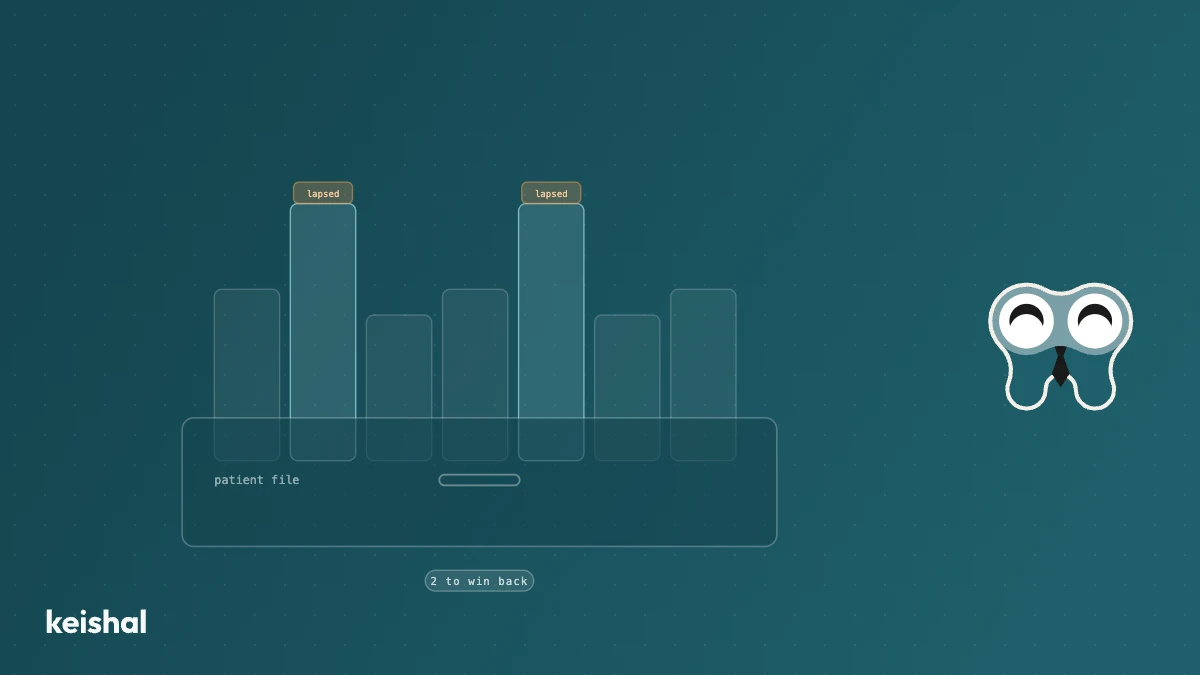
Every dental clinic has a slice of its database that stopped coming back: orthodontic cases that finished, hygiene appointments that drifted apart, patients who were going to book "next week" and never did. That group doesn't show up in any report, but it can be measured. Count how many patients haven't set foot in your clinic in over twelve months and multiply by your average treatment value: that's the revenue sitting still. In a clinic with 1,200 dormant patients and an average treatment value of €110, that's over €130,000. The question isn't whether they're there — it's how many would come back if someone wrote to them.
Every dental clinic has a hole through which revenue leaks every month, and it almost always goes unnoticed. It has nothing to do with material costs or occasional gaps in the schedule. It comes from inactive patients: people who visited the clinic, received treatment, and never came back.
Almost nobody tracks them. And that is why almost nobody knows how much they cost.
The invisible problem: patients who left without notice
What is an inactive patient?
An inactive patient is someone who is in your database but has not visited the clinic in the last 12 months. Sometimes it is 18 months, sometimes 24. The exact figure depends on how you define "active" within your recall protocol.
In any case, the pattern is the same: there was a clinical relationship, and it was interrupted.
Most of the time there is no clear reason. It is not that the patient got upset or changed clinics. They simply stopped coming out of habit: they missed their check-up, did not receive a clear reminder, and a year later nobody remembered to call them.
Why almost nobody quantifies this problem
Your management software shows you monthly revenue, confirmed appointments, and cancelled appointments. What it does not show you is how many patients should have returned but did not.
This figure is invisible. It does not appear in any automatic report. To see it, you have to cross-reference your entire database with appointments from the last 12 months and identify the difference.
When a clinic does this for the first time, the number is almost always surprising. Based on our experience with pilot clinics, between 60% and 70% of registered patients are inactive at any given time.
The numbers: how much does an average clinic lose every month?
The real case: 750 patients contacted, 150 recovered, 16,500€
In a recent pilot, a clinic gave us access to its database. We identified its inactive patients and contacted them via WhatsApp over 90 days.
These were the results:
- 750 patients contacted
- 150 patients recovered (20% conversion rate)
- 16,500€ billed in treatments
- 22€ in revenue generated per contacted patient
The most important detail from the pilot is what did NOT happen: the clinic team did not have to lift a finger. We managed the entire conversation, from the first message to the confirmed appointment.
How this result applies to your clinic
If your clinic has 3,000 patients in its database and 65% are inactive, that means 1,950 patients could return but do not. If you recover 20% within 90 days, that means around 390 appointments and around 40,000€-45,000€ in revenue over the quarter.
This is not an invented projection. It is the pilot's mathematics applied to your case.
If you want to calculate the exact figure for your clinic, we have built a lost revenue calculator. Enter the size of your database and the average value of your treatment, and it will show you the real figure.
Why your patients stopped coming back (the 5 real reasons)
When we contact inactive patients, the answer is almost always one of these five:
1. They missed their check-up. They did not receive a clear reminder and forgot. It is the most common reason.
2. They did not have time at the right moment. They wanted to book an appointment, but it coincided with a busy period and they never thought about it again.
3. They did not know they had pending treatment. There was a recommendation that was never completed: a root canal, deep cleaning, or a second phase of orthodontic treatment.
4. They moved home or changed jobs. The clinic is now too far away, but they have not looked for another option.
5. A one-off bad experience. A long wait, an unexpected bill, or a small detail. They did not complain. They simply did not return.
The five reasons have one thing in common: none of them are definitive. Most of these patients are open to coming back if they are contacted properly. What usually fails is not the patient's willingness, but the clinic's follow-up process.
What happens if you do nothing
If you do nothing, two things happen at the same time.
The first: inactive patients remain inactive. Every month that passes without contact, the probability of recovering them decreases. After 24 months, recovering them is very difficult. After 36 months, it is practically impossible.
The second: your database grows, but your active patient ratio decreases. You have more names in the system, but fewer people in the chair.
This creates a dangerous illusion. The clinic appears stable because revenue remains steady. But productivity per registered patient decreases every year. And when a slow month arrives, you will have nobody to turn to.
How to recover these patients without exhausting your team
The logical question is: why don't receptionists call?
And the honest answer is: because they cannot.
The job of a dental reception team is to look after incoming patients, manage the daily schedule, collect payments, solve unexpected issues, and keep the clinic running smoothly. It is a job with a very high relational and operational workload, and it leaves no room for a second layer of tasks.
Calling 750 inactive patients one by one, leaving messages, following up, recording responses, and scheduling appointments requires between 60 and 80 hours of focused work. That is two full-time weeks. Time that simply does not exist in an active clinic.
The result is that reactivation campaigns are carried out once a year at best, in an improvised way, and results are poor. Not because the team is not capable, but because one person cannot do it properly while also handling their usual responsibilities.
If you'd rather do it yourself, we've written the full guide: how to reactivate inactive patients step by step. It has the seven steps — and the honest maths on how many hours it takes.
The alternative we propose at Keishal is different: we manage the reactivation process for you. We integrate with your management software, identify inactive patients, contact them via WhatsApp, manage the conversation, and write confirmed appointments directly into your calendar.
Your team does not need to learn anything. They do not need to do anything differently. They simply see the results.
Reactivation is just one of the tasks a system like this can take on. If you want the full map, from reminders to insurance, and what should stay human, we cover it in our guide on what AI can do for a dental clinic.
And if you'd rather get down to specific tasks, we've made a task-by-task inventory of what to automate at your dental clinic and what not, in the order that pays back first.
If you want to see how it works in detail, we have recorded a 1-minute video on how we do it.
Calculate your clinic's lost revenue
The fastest way to see the real size of the problem is to calculate your figure. We have built a free calculator that only needs two pieces of information: how many patients you have in your database and what the average value of your treatment is.
In 30 seconds you will know how much your clinic loses every month due to inactive patients, how many monthly appointments you could recover and what additional revenue it would generate.
If you have reached this point, you probably already know that you have inactive patients. The question is how many, and how much they are costing you.
Calculate your exact figure or book a call so we can show you how we manage it.

Ready to try Keishal in your dental clinic?
Book a demo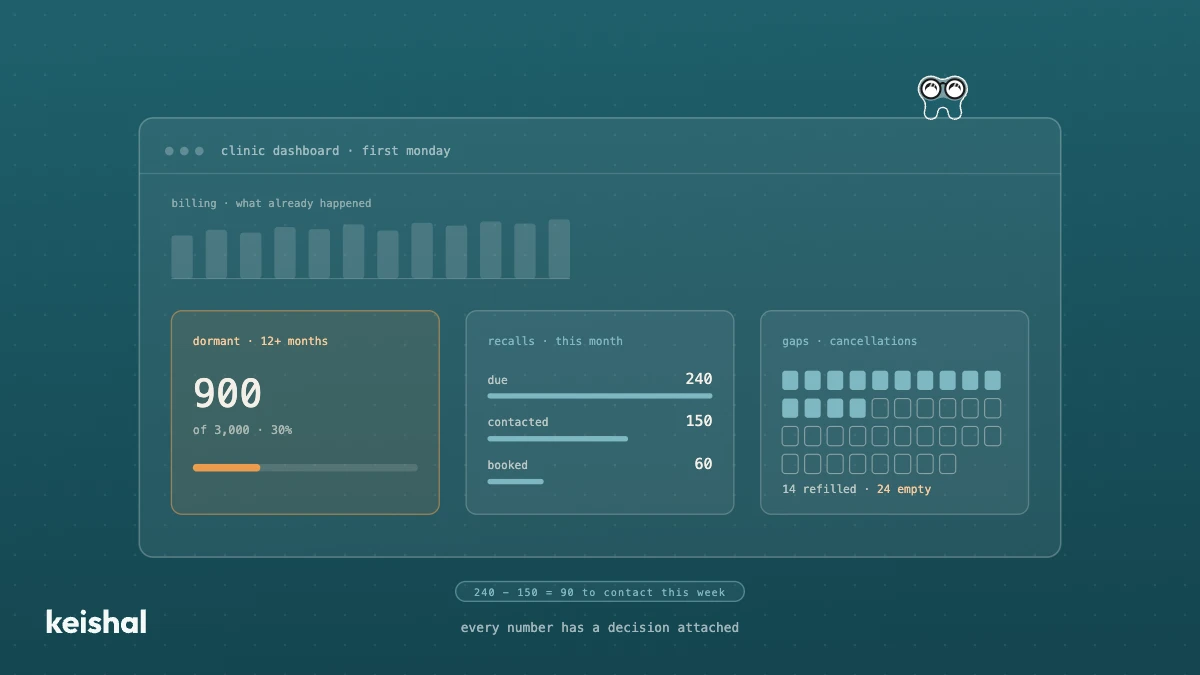
Dental clinic dashboard: what it should actually show you
A dental clinic dashboard is useful if it helps you decide something. The one in your practice management software usually shows billing and the schedule, which is the past. What it usually lacks is the patient base: how many haven't been in for over a year (900 of 3,000 = 30%), which recalls fall due this month, which gaps stayed empty and how much of your base you can actually reach. Six questions, each with its number and its decision.
What is superintelligence and what AI actually does in a dental clinic today
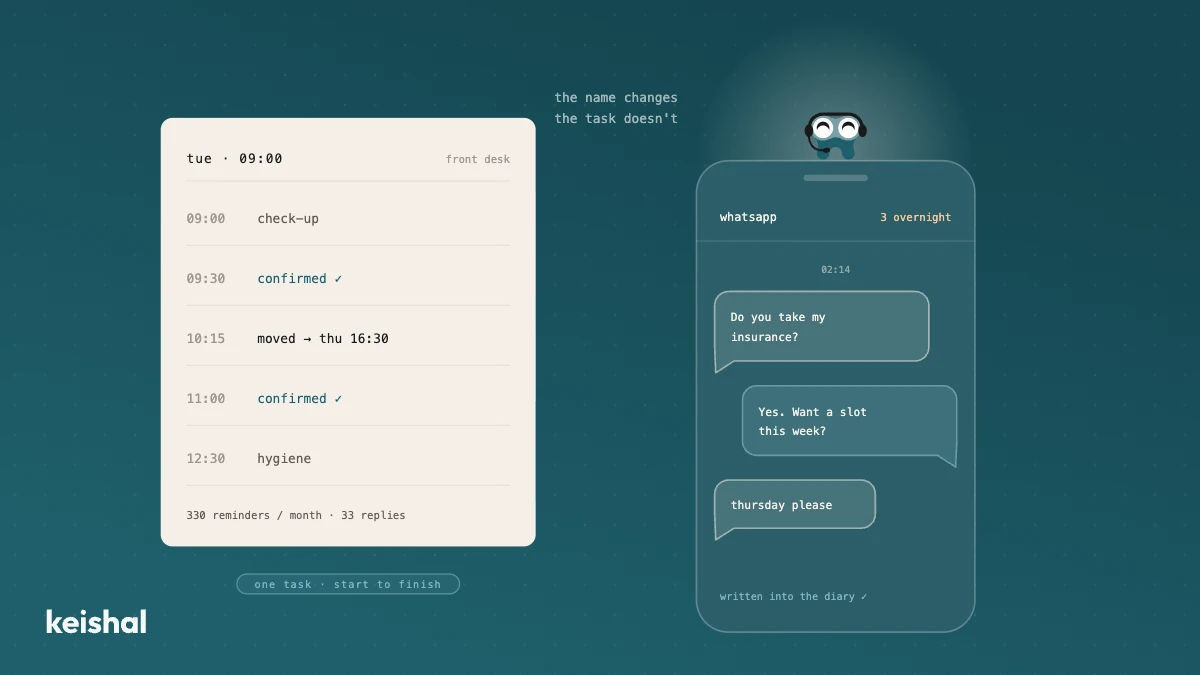
Superintelligence is a hypothetical AI that would outperform people at almost every intellectual task, and it doesn't exist today. The AI dental clinics use is narrow AI: it confirms appointments (15 × 22 = 330 reminders a month), reactivates dormant patients, answers during the 118 hours a week the clinic is closed and flags incomplete records. For a clinic, the name matters less than the specific task the tool gets done in your schedule.