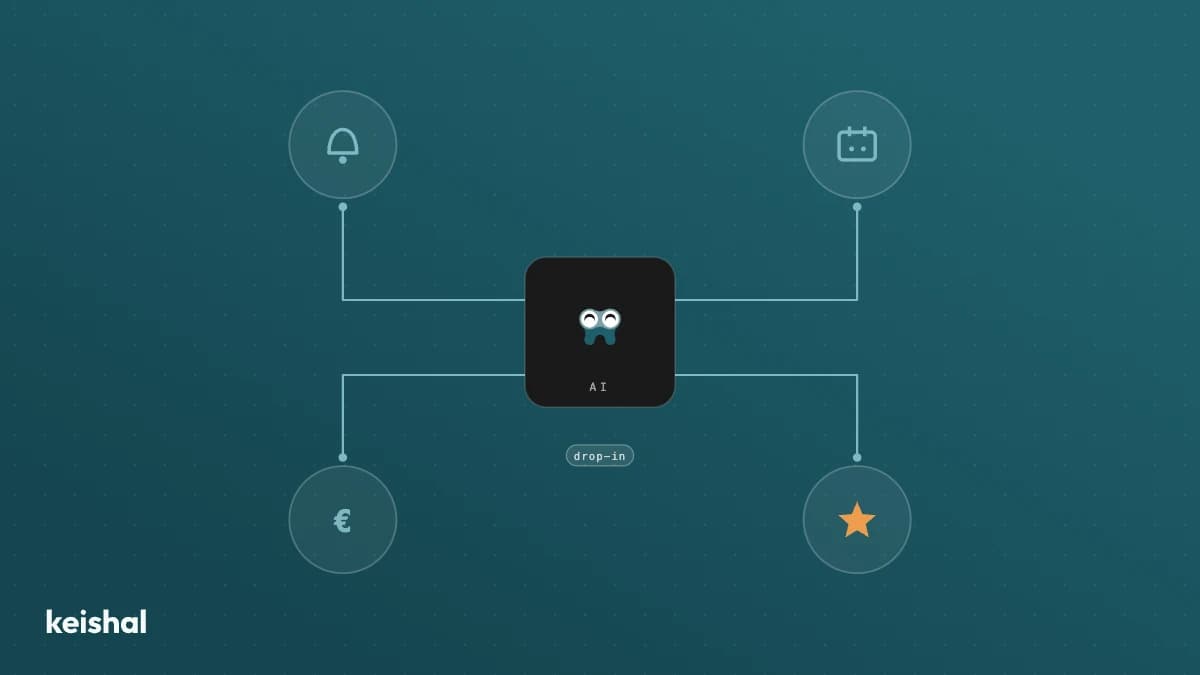
AI for dentists covers two distinct areas: clinical AI (radiography, diagnostics, treatment planning) and administrative AI (patient reactivation, booking management, insurance, reminders, reviews, and forecasting). The first area is where most investment has gone so far. Administrative AI, by contrast, remains less explored, and that's where the impact on revenue and team workload is most immediate. There are three ways to adopt it: simple chatbots, AI software the clinic operates, or autonomous systems that operate on the clinic's behalf.
A few years ago, talking about artificial intelligence in a dental clinic felt distant. Today, according to 2025 market data, around 35% of dental clinics in the United States have already implemented some form of AI, and the global market is projected to grow from roughly $516 million in 2025 to nearly $3.9 billion by 2035.
But behind these numbers there's an important distinction most articles miss: not all dental AI is the same. And that completely changes how you should evaluate it and decide whether it's worth it for your clinic.
What can AI do for a dentist?
The short answer: two different kinds of work. Clinical AI assists the dentist with diagnosis: it reads radiographs, detects caries, helps plan treatments. Administrative AI operates the running of the clinic: it reactivates inactive patients, manages bookings and reminders over WhatsApp, answers questions out of hours, verifies insurance, and calculates the business metrics.
Anyone searching for "AI for dentists" or "dental AI" usually finds only the first half. This guide covers both, with more weight on the second: it's where an average clinic accumulates the most repetitive work hours and where the revenue impact is most immediate.
What "artificial intelligence for dental clinics" means today
When we talk about AI in a dental clinic, we mean systems that learn from data to perform tasks that previously required direct human intervention. These can be systems that read radiographs, answer WhatsApp messages, predict revenue, manage insurance, or identify which patients are worth contacting.
The important thing: there's a critical division worth understanding from the start.
The critical distinction: clinical AI vs. administrative AI
Clinical AI
This is the AI that helps the dentist with medical practice:
- Caries detection in radiographs
- Image analysis for periodontitis and other pathologies
- Orthodontic treatment planning
- Assisted diagnosis in endodontics or implantology
This is the part of AI that has received the most coverage in recent years. Companies like Pearl, VideaHealth, and Diagnocat operate in this space, and studies show AI can detect caries with up to 90% accuracy, compared to 40% in conventional readings.
This AI is a support to clinical judgement. It doesn't replace it. The dentist remains the one who diagnoses and treats.
Administrative AI
This is the AI that operates everything around the medical practice:
- Inactive patient reactivation
- Bookings and appointment reminders
- 24/7 frequently asked questions handling
- Insurance verification
- Consent and review collection
- Filling gaps when patients cancel
- Patient database quality improvement
- Business analytics and forecasting
This is the part where a clinic loses the most time on a daily basis and where, paradoxically, AI has been less explored. For many clinics, automating here has a direct impact on revenue and on the workload of the front desk team.
This article focuses on administrative AI — the part that affects how the clinic is managed as a business, not as a medical practice.
What administrative tasks can AI actually automate in a dental clinic
Here's a concrete list of tasks AI can operate today in a dental clinic. This isn't theory: each of these tasks is already being automated in clinics running autonomous systems.
Patient communication
- Inactive patient reactivation. Contacting patients who haven't visited in over 12 months and inviting them back. Personalised based on their history.
- Automated appointment reminders. Message the day before via WhatsApp, with confirmation or rescheduling without a phone call.
- 24/7 booking. Patients can request appointments via WhatsApp at any time, and the system writes the appointment into the clinic's calendar.
- 24/7 question handling. Information about hours, location, treatments, generic pricing — without your team responding each time.
- Filling gaps when someone cancels. When a patient cancels, the system contacts the waiting list or patients with later appointments.
- Review collection. Asking for reviews from patients who've had a good visit, at the right moment.
- Digital consent collection. Sending and receiving GDPR documents signed before the first visit.
Administrative operations
- Insurance verification. Checking patient coverage before the appointment, without phoning insurers.
- Database quality improvement. Detecting duplicates, completing incomplete records, validating contacts.
Business intelligence
- Results analytics. Knowing exactly how many patients the system has reactivated, how much revenue has been generated, what pipeline has opened.
- Forecasting. Predicting revenue, schedule occupancy, and other metrics based on the clinic's historical behaviour.
Each of these tasks, added together, represents between 5 and 15 hours per week of manual work for a clinic with a mid-sized database. Automating them isn't marginal — it's freeing the team to focus on the patients in the consultation room.
What AI should NOT do at a dental clinic
As important as knowing what AI can do is knowing what it shouldn't do:
- It shouldn't make clinical decisions. Diagnosis, treatment indication, and any medical decision are and must remain with the dentist. Clinical AI assists, but doesn't decide.
- It shouldn't replace the human touch when it matters. An in-person visit, a delicate conversation with an anxious patient, attention to a complex case — these are human moments. AI operates the repetitive work so your team can give that attention without distraction.
- It shouldn't operate without transparency. Patients have the right to know when they're talking to an AI. The EU AI Act requires it, and it's a sound design principle.
- It shouldn't process data without a clear legal framework. Any AI touching patient data must operate under a Data Processing Agreement with the clinic and comply with GDPR.
The three generations of administrative dental AI
To understand what options are on the market today, it helps to categorise the offering into three generations, ordered by autonomy level:
Generation 1: Simple chatbots
Messaging assistants with predefined responses. They work for basic questions but break down with any complex conversation. The clinic has to train and update them manually.
When they work: clinics with highly standardised queries and low volume.
Limitations: they don't understand patient context, don't read the PMS, don't book real appointments.
Generation 2: AI software the clinic operates
Platforms with integrated AI that the clinic contracts, configures, and operates internally. They can generate lists of patients to contact, draft personalised messages, and propose actions — but someone on the team must operate the system, review responses, and keep it active.
When they work: clinics with someone dedicated to digital operations.
Limitations: if no one has time to operate the software, it stays contracted but inactive. It's a very common pattern. We discuss it in detail in this article.
Generation 3: Autonomous systems
AI platforms that integrate with the clinic's PMS and WhatsApp, and operate all administrative tasks autonomously. The clinic team doesn't learn any new tool, doesn't operate anything, doesn't configure anything. They just see the results. The piece that makes this leap possible, going from answering to carrying out the task, is what's known as an AI agent for dental clinics.
When they work: clinics with overloaded teams or previous failed software implementations.
Limitations: provider dependency — the clinic delegates the operation.
Five questions to evaluate an AI solution for your clinic
If you're evaluating options, these are the five questions that will help you decide better:
1. Does it integrate with my current practice management software? AI that doesn't read your PMS can't personalise anything and will generate errors.
2. Who operates the system day to day? If the answer is "your team", honestly calculate how many weekly hours you have available. If the answer is "we do", ask to see how the operation works.
3. Does it comply with GDPR and the EU AI Act? Ask to see the Data Processing Agreement (DPA), ask whether they have a designated DPO, and where data is stored. If the answer isn't "in the EU", think twice.
4. Does the patient know they're interacting with AI? GDPR and the EU AI Act require transparency. If the platform "hides" the AI, there's a legal and reputational problem.
5. How long until it's operational, and what results can I expect in the first month? A good solution should be running in 2-3 weeks and start generating results during the first month. If they tell you "3-6 months to start", implementation will probably be more complicated than it sounds.
Where to start
If administrative AI is new to your clinic, the practical recommendation is:
-
Start with a task that has direct impact. Inactive patient reactivation usually generates the most revenue with the least initial friction. Calculate the potential with your clinic's database before committing to anything.
-
Measure results from the first month. Ask to see concrete metrics: reactivated patients, booked appointments, generated revenue. A good solution should be able to show you measurable results in the first 30 days. If they ask you to wait three months to see data, something probably doesn't add up.
-
Evaluate by results, not by features. Don't be dazzled by pretty dashboards. Ask: what concrete results can I expect?
-
Start small and grow. If a solution works for one task, expand to more. If it doesn't work, you won't have migrated your whole system.
AI for dental clinics isn't magic and doesn't replace the human team. What it does well is operate the repetitive tasks that fill up the front desk's day, so your team can focus on what only they can do: the human touch with patients who are in the consultation room.
If you want to see how an autonomous administrative AI system works in a clinic like yours, book a call and we'll show you in 20 minutes.

Ready to try Keishal in your dental clinic?
Book a demo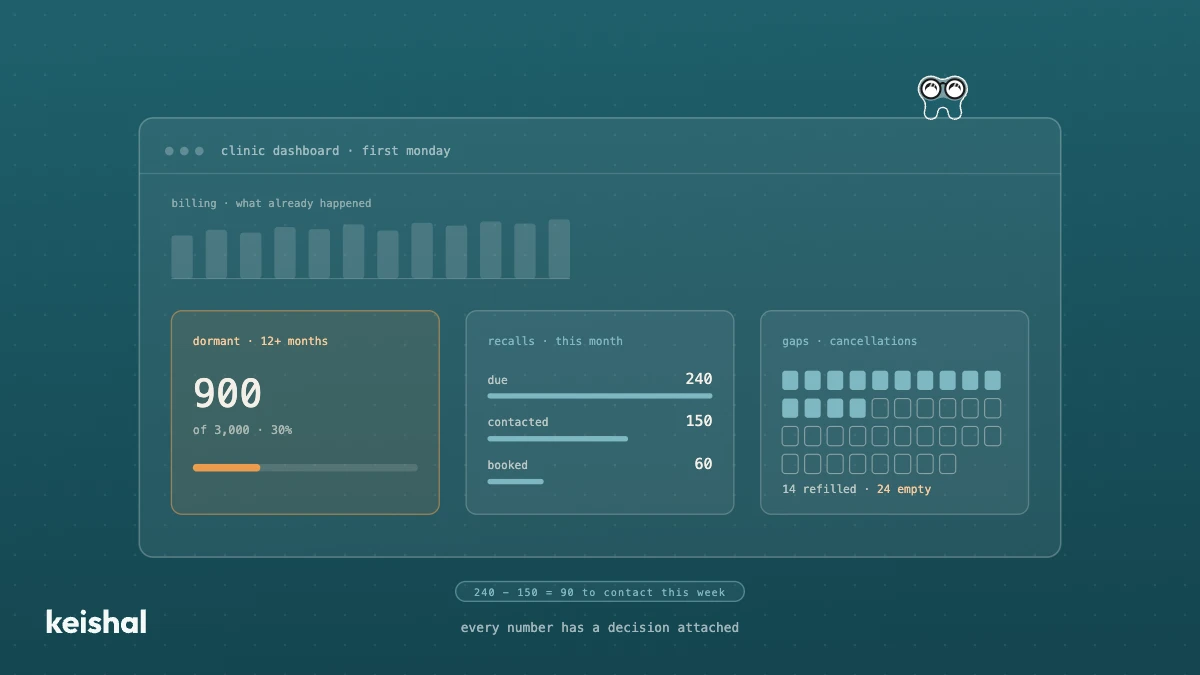
Dental clinic dashboard: what it should actually show you
A dental clinic dashboard is useful if it helps you decide something. The one in your practice management software usually shows billing and the schedule, which is the past. What it usually lacks is the patient base: how many haven't been in for over a year (900 of 3,000 = 30%), which recalls fall due this month, which gaps stayed empty and how much of your base you can actually reach. Six questions, each with its number and its decision.
What is superintelligence and what AI actually does in a dental clinic today
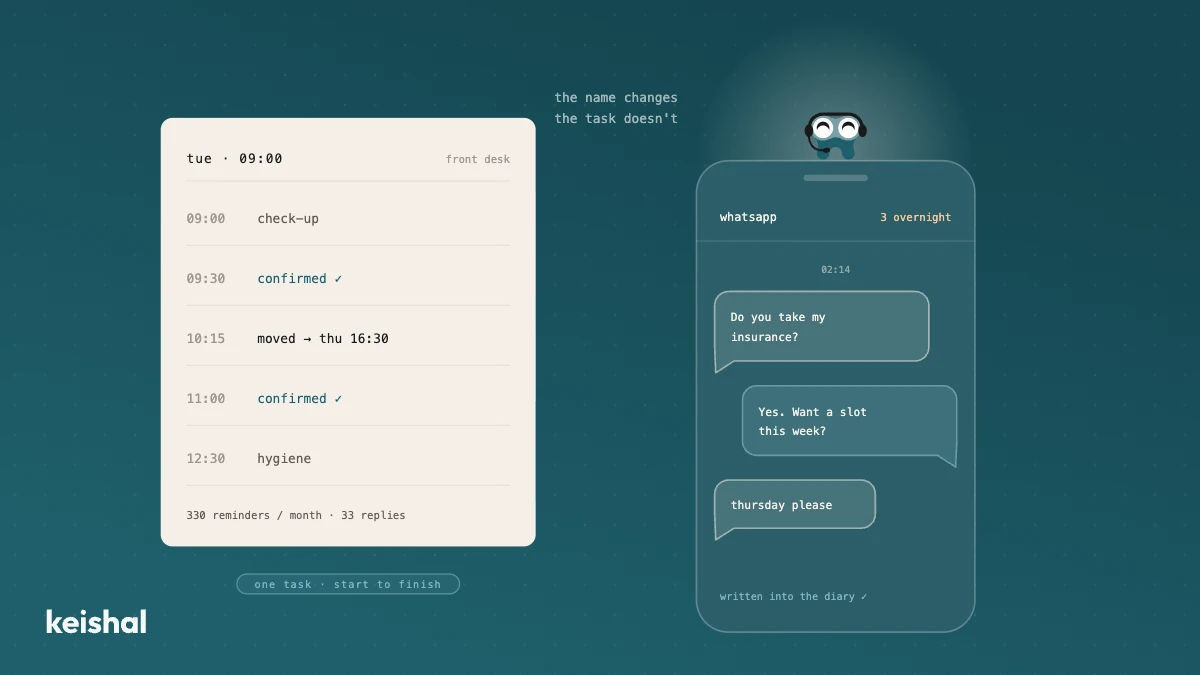
Superintelligence is a hypothetical AI that would outperform people at almost every intellectual task, and it doesn't exist today. The AI dental clinics use is narrow AI: it confirms appointments (15 × 22 = 330 reminders a month), reactivates dormant patients, answers during the 118 hours a week the clinic is closed and flags incomplete records. For a clinic, the name matters less than the specific task the tool gets done in your schedule.