Cookies & privacy
We use essential cookies to run the site and, with your consent, analytics cookies to understand how it's used. You can change your choice anytime.
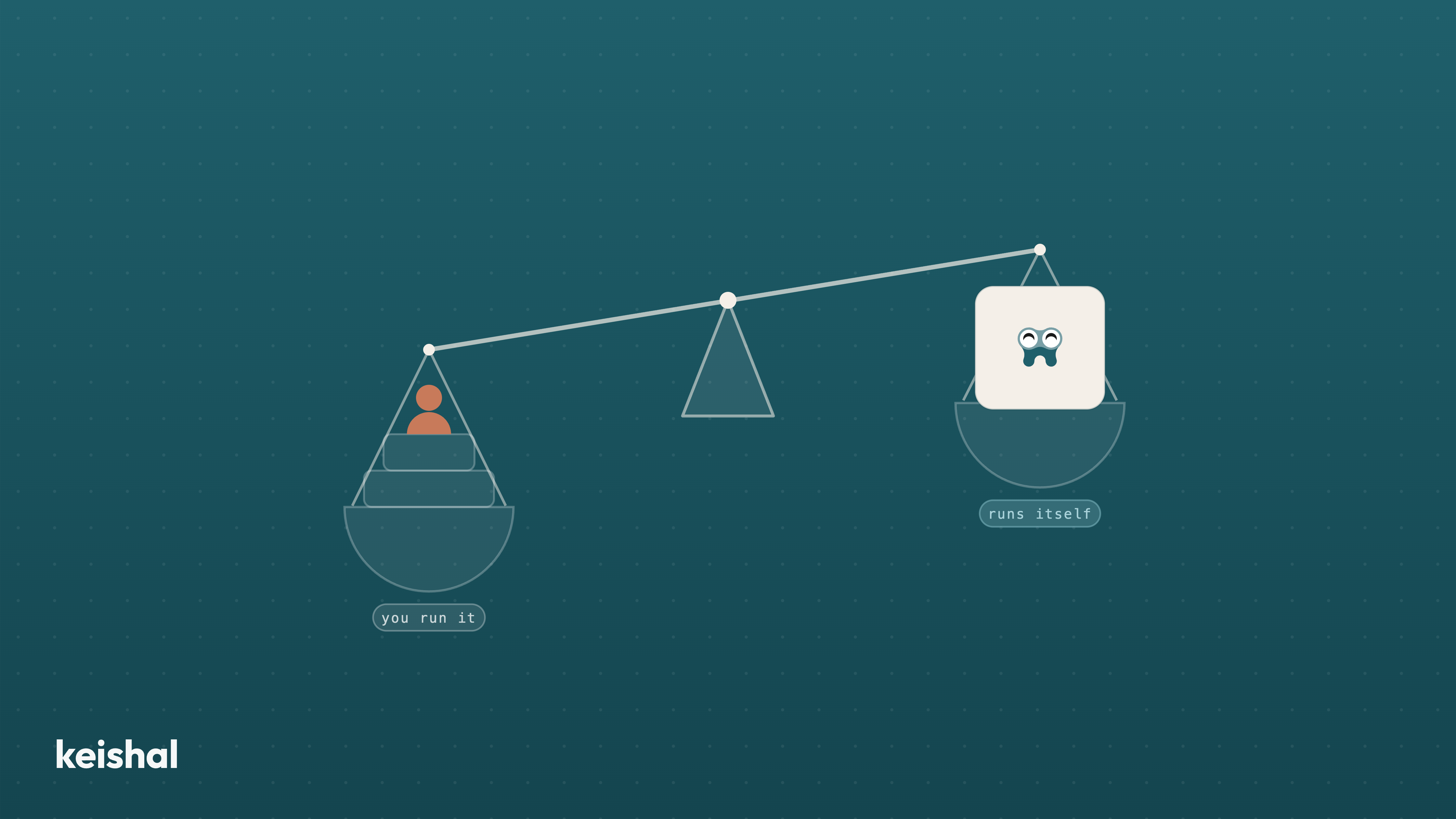
Dental clinics have two options for handling patient communication (reminders, recall, reactivation): buy software (Kokuai, WhatsApp modules from Gesden, Nubimed…) and run it in-house, or outsource to a managed service that operates on the clinic's behalf. Software costs less per month but demands time and attention from your team. A managed service has a higher fee but zero effort. The choice depends on how much time your team has, not on how much each option costs.
Every dental clinic hits a point where patient communication becomes a bottleneck. Inactive patients who never get reactivated. Reminders that slip through the cracks. Recall that goes from being a process to being an intention.
And almost always, the market's answer has been the same: "buy software." Today there's another option, different in philosophy and in outcome. Let's compare them.
There are two fundamentally different approaches:
Software: you buy a tool. Your team learns it, configures it, operates it daily, and makes sure it produces results.
Managed service: you hire an external company that handles patient communication for you. Your team doesn't learn anything new, doesn't operate anything, doesn't configure anything. They just see the results.
Both options can work. The question isn't which one is better in the abstract, but which one fits the reality of your clinic.
You choose a platform, sign up, receive initial training, and your team integrates it into their daily routine. The clinic is responsible for using it well.
The market has two generations of dental software coexisting:
Practice management software (PMS): Gesden, Nubimed, Dentalink, Flowww, Klinikare, ODL. They cover everything: scheduling, clinical records, billing, basic reminders. They're the backbone of most Spanish dental clinics.
AI-powered dental software (new generation): Kokuai is the current reference in Spain. A modern platform with AI, WhatsApp management, automated recall, and a virtual assistant. It integrates with the PMS and adds an intelligent communication layer with the patient.
Both generations share the same underlying model: the clinic buys the tool and operates it in-house.
It works well when someone at the clinic has the time, willingness, and aptitude to operate the system. Typically: a clinic manager with a technical profile, a senior receptionist with less operational load, or the owner themselves if they can delegate clinical work.
The real cost of software isn't the monthly fee. It's the monthly fee plus the time your team spends operating it.
A realistic estimate based on what we see in the sector: between 5 and 15 hours per week of team time for an advanced management software to produce results. If nobody dedicates that time, the software stays contracted but inactive.
This explains a pattern we've seen repeatedly in conversations with clinics:
"I tried (...) but never got around to using it. They set me up, explained everything, and it required many hours of training. At that point I just didn't have the time." — Family-owned clinic, Valencian Country
"We have (...) under contract but we don't do anything with it. We don't even know how to use it." — Family-owned clinic, Catalonia
It's not a problem with the software. It's a problem of human capacity. A dental front desk already carries an enormous workload, and adding a second operational layer isn't realistic without dedicated time.
You hire an external company that integrates with your PMS and your WhatsApp. They identify inactive patients, contact them, manage the conversations, and write confirmed appointments directly into your calendar.
Your team doesn't learn any new tool. Doesn't configure anything. Doesn't operate anything. They just see new appointments appearing on the calendar.
Today, managed services in the dental sector typically cover:
It works well when:
A managed service has a higher monthly fee than software, but the real total cost (fee plus team time) is usually comparable or lower. The clinic doesn't pay for internal hours of operation because there are none.
Pricing for managed services varies by clinic size and results generated — the most common models combine a base fee with a variable component tied to appointments booked.
| Feature | Software | Managed service |
|---|---|---|
| Who operates | The clinic | The external company |
| Team time | 5-15 h/week | 0 h |
| Learning curve | Yes, weeks | No |
| Implementation | 4-12 weeks (technical + adoption) | 1-2 weeks (technical) |
| Base cost | Lower (€80-200/mo typical) | Higher (varies by size and results) |
| Real total cost | Fee + internal hours | Fee only |
| Main risk | Stays contracted but unused | Provider dependency |
| Predictable results | Variable (depends on usage) | More predictable |
| Local customisation | High (clinic decides everything) | Medium (agreed with provider) |
This way of managing dental clinics has a technical name: Service-as-a-Software. It's a category emerging globally across traditional industries, not just dental. The idea is simple: instead of selling a tool the client operates, you sell the outcome and operate the tool yourself.
The Spanish dental publication El Dentista Moderno highlighted this model in June 2026 as a new category that is beginning to transform the Spanish dental sector. The reason is straightforward: clinics are healthcare businesses, not software businesses. Asking them to operate software within their clinical routines has a natural ceiling.
If you want to understand what specific tasks AI can cover at a dental clinic — and how to evaluate the options on the market — we've written a complete guide.
Four concrete questions that can help:
1. Does someone on your team have dedicated time to operate digital tools? If yes (clinic manager, senior receptionist with margin, technical partner), software can work. If no, the software will sit unused.
2. What is your time worth — and your team's? Calculate how many weekly hours you could dedicate to operating software, multiply by the real cost of that hour (not just salary — opportunity cost too). Compare with the price of a managed service.
3. Have you tried implementing software before? What happened? If you have a track record of software subscriptions that went unused, the pattern will repeat. It's not a motivation problem — it's a structural capacity problem.
4. What do you prefer: full control with effort, or results without effort? This is the philosophical question at the core. Some clinics prefer to keep everything under their control even if it costs time. Others prefer to delegate and focus on clinical work. There's no right answer.
If you've read this far and think a managed service fits your clinic, we can show you how it works in 20 minutes. Book a call or calculate your clinic's lost revenue first to have a concrete number before the conversation.
A virtual receptionist should not replace your receptionist: it should absorb the repetitive load that does not fit in their day. A front desk open 50 hours a week leaves 118 of the week's 168 hours unanswered: 70% of the time. An autonomous system covers reminders that get a response, 24/7 booking (WhatsApp chat plus a calendar link), out-of-hours questions with escalation, recall and reactivation. It does not answer the phone: it removes volume from it. The front desk, clinical conversations and complaints stay human.
When you go from one clinic to two or three, the bottleneck stops being the schedule and becomes visibility: the location where you are not is a black box. To manage it without being there, compare locations with four ratios computed the same way everywhere — occupancy (370 out of 528 hours = 70%), no-shows over total appointments, dormant base over total database and contactability — and distrust any comparison made with unequal data quality. Total revenue compares sizes; ratios compare management.