Cookies & privacy
We use essential cookies to run the site and, with your consent, analytics cookies to understand how it's used. You can change your choice anytime.
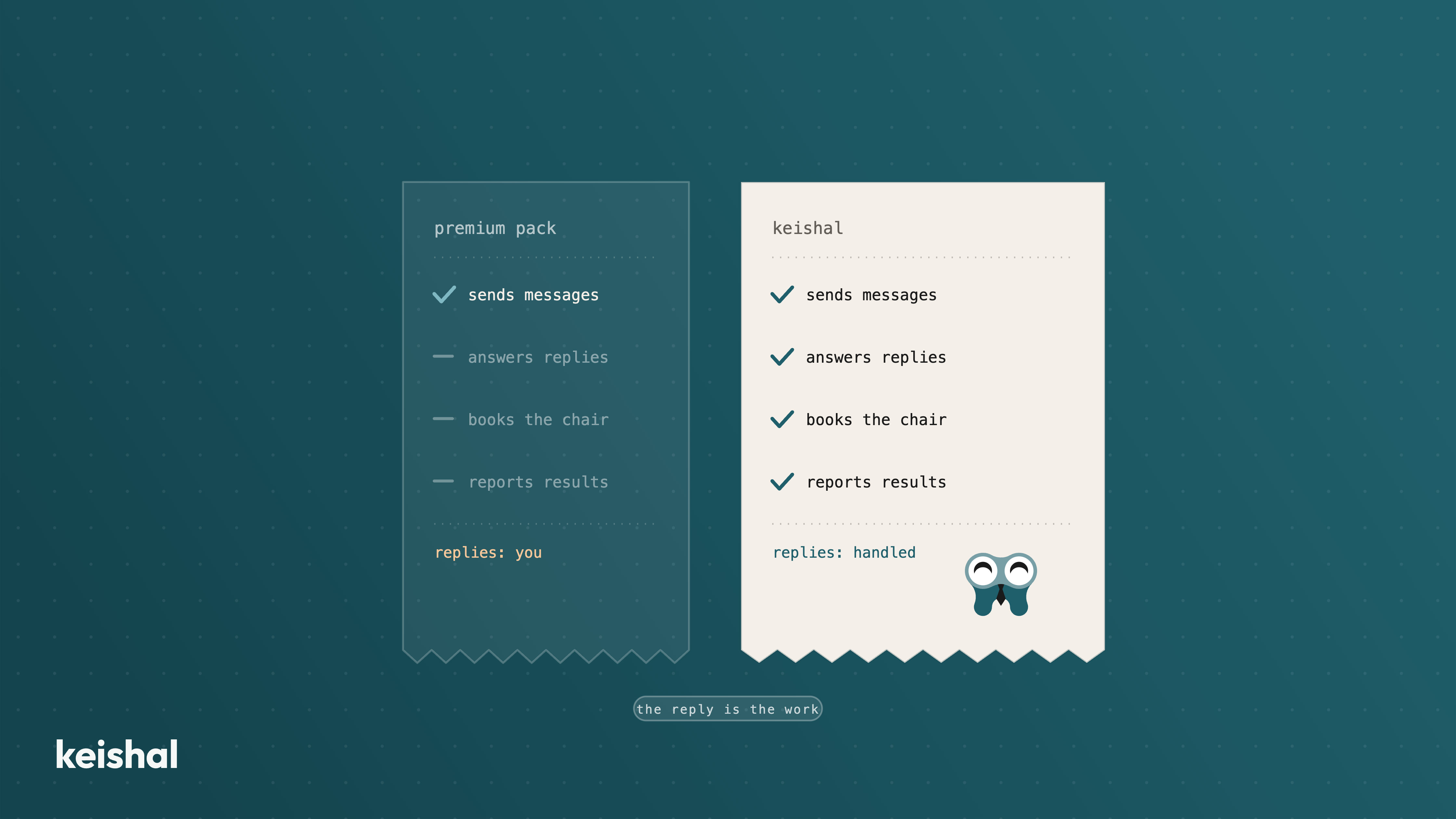
If your clinic runs on Gesden you have two options that don't involve changing software: activating the Premium Pack (a tool your team operates) or adding Keishal (an autonomous system that operates for you on top of your Gesden). The difference isn't technological: it's who does the work every week. Run the numbers: 15 appointments a day × 22 days is 330 reminders a month; if 1 in 10 patients replies with more than 'confirmed', that's 33 conversations someone has to handle. If you have that person, the Premium Pack is a serious option. If not, one more tool won't create the missing hours.
Infomed introduced the Premium Pack at Expodental 2026: a set of modules that extend Gesden — the most widely used dental PMS in Spain — with WhatsApp, SMS and email communication, reminder automation, a KPI dashboard, AI (dentIA), payments (ONE PAY), digital signature and a mobile agenda. If your clinic runs on Gesden, the question asks itself: do I finally solve patient communication by switching these modules on, or is there another way?
This article compares the two real options on your table that don't involve changing software: activating Gesden's Premium Pack, a tool your team operates, or adding Keishal, an autonomous system that integrates with your Gesden and that we operate for you. Either can be the right call. It depends on one variable, and it isn't price or technology: who is going to operate the tool every week.
One important thing before we start: nobody here is questioning Gesden. Whatever you choose, your PMS stays as the central system of your clinic. The comparison covers only the patient communication layer — the same underlying decision we analysed in software versus an autonomous system for patient communication, now applied to the most common case of all: your own PMS.
Facts first, opinion second. According to Infomed's official page, the Premium Pack groups modules for communication (WhatsApp, SMS and emailing), automation (ATMT), a KPI dashboard, artificial intelligence (dentIA), payments (ONE PAY), digital signature and a mobile agenda.
The WhatsApp channel runs on the official WhatsApp Business API integration and covers appointment confirmations, recalls, conversations, satisfaction questionnaires, consents and quote delivery. The automation module, ATMT, sends reminders, confirmations, recalls and birthday greetings over SMS, WhatsApp or email, and comes in two tiers, Lite and Pro.
Plainly said: it is a serious extension, and it does three things especially well.
It is born inside Gesden. The modules read the agenda and the patient record directly, with no third-party connectors or fragile syncs. For a clinic that already lives in Gesden, that continuity is a real advantage: one vendor, one support line, one database.
It uses the right channel the serious way. WhatsApp through the official Business API, not a phone with regular WhatsApp sitting at the front desk. Communicating with patients always means handling sensitive data, whatever the channel, and working through the professional route is the option that offers more guarantees. That point counts clearly in the Premium Pack's favour.
It covers a lot of ground. From appointment confirmation to digital signature to payments, the bundle touches almost the entire administrative layer. If your goal is fewer vendors, that's a weighty argument.
Does that settle the decision? No, and the reason isn't on the feature list. It sits in one sentence of Infomed's own documentation that is worth reading twice: the modules' effectiveness depends on a well-established working protocol and on good data entry in Gesden. The manufacturer says it, and it's right to say it. This whole category of tools works exactly that way: the result depends on who operates it, and with what discipline.
The honest answer: the clinic that has someone to operate it. The profile that gets value out of it usually has three things.
If your clinic matches that profile, the Premium Pack is a serious option, and probably the most direct one: you already work in Gesden and the extension saves you adding a new vendor. If you're at a more open point and want the full map before deciding, our dental software comparison for Spain analyses the market system by system, written from the neutrality of not selling any of them.
When you compare features, almost everything looks alike: the channels are the same and so are the use cases. The difference that can't be dressed up is structural. The Premium Pack is a tool the clinic operates. Keishal is an autonomous system that operates for you.
"Operating" is not an abstraction. Taking the Premium Pack itself as the example, and going by its documentation, operating means:
In sales conversations we often hear a sentence that sums up the pattern. We quote it as what it is — a pattern from our own conversations, not a fact about any product: "we have the modules under contract; what we don't have is someone on top of them every week."
With Keishal, the division of labour is different. The system integrates with your Gesden, talks with your patients over WhatsApp, and we operate the whole layer: the sends, the replies, the follow-up, and the escalation to your team whenever a conversation needs a human. The outcomes — appointments, confirmations, status changes — are written back into your Gesden agenda. Your team learns no new tool: it sees the results. This model has a name as a category, and we explain it in depth in what service-as-a-software means for a dental clinic.
Neither division of labour is better in the abstract. They are two different answers to the same question: who does the work?
We ran a similar calculation when analysing another patient communication tool, and it works the same here because it doesn't depend on the product: it depends on your agenda. Run it with your numbers, not ours.
Confirmations and reminders. 15 appointments a day × 22 working days = 330 reminders a month. The sending happens by itself. The part that doesn't: if 1 in 10 patients replies with something other than "confirmed" — a time change, a question about a quote, a "do you work with my insurance?" — that's 33 conversations a month someone has to read, resolve and carry into the agenda.
Recalls. If your database holds 1,000 patients with no visit in the last 12+ months and you want to contact them properly (segment, personalise the message, reply, rebook), at 5 minutes per patient that's 5,000 minutes: roughly 83 hours of work. At a front desk that's already full, those hours don't exist. That's why so many recall campaigns happen once a year, or stay an intention.
Maintenance. Templates kept current, protocols revised when the team changes, and Monday morning's inbox holding everything patients wrote over the weekend.
Two caveats to keep the arithmetic honest. First: not every dormant patient would come back even if you contacted them; some have moved away, others no longer need it. The calculation sizes the work, it doesn't promise the outcome. Second: the conclusion is not that the tool is bad. It's that a tool doesn't create hours — it needs them. If you have them, it turns them into results. If you don't, the module stays activated and the work still doesn't fit.
The Premium Pack includes pieces that don't compete with anything Keishal does. Digital signature, payments with ONE PAY, the mobile agenda or the KPI dashboard are independent decisions: if they fit you, they're compatible with any scenario.
This article's comparison covers only the communication and automation layer: reminders, confirmations, recalls and patient conversations. That's where a single clear owner matters, because it's the part that demands hours every week. The rest can coexist without conflict.
If your answers point to a specific person with protected hours, activate the Premium Pack: you have the profile that gets value from it. If they point to "reception will get to it when they can", the problem isn't which tool you pick — it's that one more tool doesn't add hours to the day. That's the case the other option exists for.
Whatever you decide, you are not choosing a PMS. That decision is already made, and Keishal doesn't touch it: we integrate with Gesden, read the agenda and write the outcomes back. The only decision on the table is who operates the patient communication layer: your team, with the Premium Pack's modules, or an autonomous system that operates for you while your team looks after the patients in front of them.
If you want to see what that layer looks like running on top of your Gesden, book a demo and we'll show you with your clinic's numbers, not a generic case.
A virtual receptionist should not replace your receptionist: it should absorb the repetitive load that does not fit in their day. A front desk open 50 hours a week leaves 118 of the week's 168 hours unanswered: 70% of the time. An autonomous system covers reminders that get a response, 24/7 booking (WhatsApp chat plus a calendar link), out-of-hours questions with escalation, recall and reactivation. It does not answer the phone: it removes volume from it. The front desk, clinical conversations and complaints stay human.
When you go from one clinic to two or three, the bottleneck stops being the schedule and becomes visibility: the location where you are not is a black box. To manage it without being there, compare locations with four ratios computed the same way everywhere — occupancy (370 out of 528 hours = 70%), no-shows over total appointments, dormant base over total database and contactability — and distrust any comparison made with unequal data quality. Total revenue compares sizes; ratios compare management.