
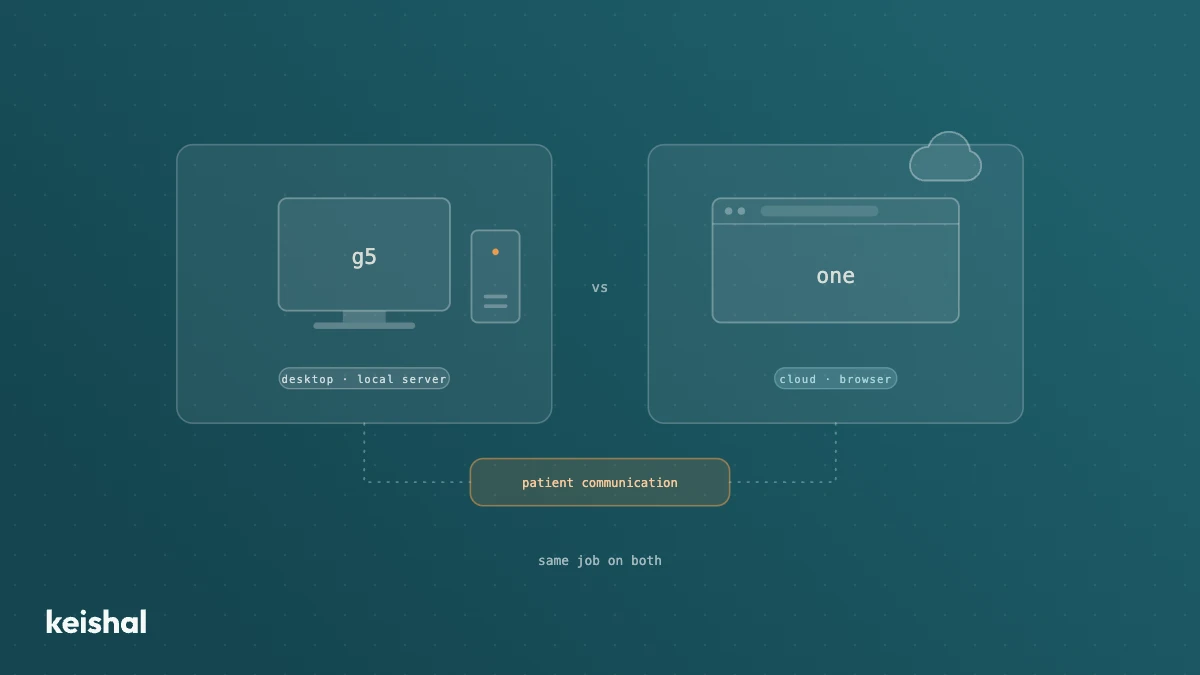
Gesden G5 is the desktop version and Gesden One the cloud version: between them, what changes is where the software lives, access, maintenance and backups. What does not change with either is who operates patient communication: 15 appointments a day across 22 working days means 330 reminders a month, and 1,000 dormant patients at 5 minutes each is about 83 hours of work, on both versions. This guide separates the version decision (locations, server, access) from the operating decision, with the questions to decide using your own numbers.
If your clinic runs on Gesden, the question comes up sooner or later: Gesden G5 or Gesden One? The Gesden G5 vs Gesden One comparison usually gets framed as a technology decision, but it is really an operational one. G5 is the desktop version, installed on the clinic's computers. One is the cloud version, accessed from the browser. That changes several things about the day to day. And one important thing does not change with either: who operates the communication with your patients.
This guide is about separating those two things. What really changes between versions, what does not change with either, and which questions to ask before deciding. No rush and no drama: both versions are Gesden, and both run real clinics every day.
First, the important part: this decision is not about changing your PMS
Gesden, in any of its versions, is one of the most widely used practice management systems in Spanish dental clinics. If your clinic uses it, your clinical records, your schedule and your treatment plans already live there. Our position is the same one we explain in our dental software comparison for Spain: we do not sell any PMS, and we are not going to tell you to change yours.
Choosing between G5 and One is choosing how you want your Gesden to run, not whether Gesden should stay. That part is not up for debate in this article. If what you are weighing is not a new version but a different program, that is another decision, and we cover it in what switching dental software really involves. What is worth being clear about is what the version change solves, and what will be exactly the same the morning after the migration.
What really changes between Gesden G5 and Gesden One
The underlying difference is where the software lives, and the rest follows from it.
Where it runs. G5 is desktop software: it is installed on the clinic's computers and the data sits on a local server. One is cloud software: the program and the data live on the provider's servers, and the clinic works from the browser.
Access. With a local installation, you work from the machines where the program is installed. With the cloud, you can log in from any connected device: another location, home, the manager's laptop. For clinics with several locations or remote management, this is usually the strongest argument.
Maintenance and updates. With local desktop software, updates are installed on your machines, and the local server is the responsibility of the clinic or its IT person. In the cloud, the provider updates and maintains the infrastructure, and the clinic stops carrying that layer.
Backups. With a local server, backups are a discipline the clinic has to keep: someone has to run them and check them. In the cloud, the provider manages them as part of the service.
Dependence on the connection. This is the honest flip side of the cloud: no internet, no access. With a local server, the clinic can keep working even if the connection drops. Each model has its weak point, and it helps to know which one you can live with.
Two more things, in the interest of honesty. First: these are the structural differences between desktop and cloud software, not an inventory of Infomed's modules. The exact detail of what each version and plan includes changes over time, so confirm it with Infomed for your case before deciding. Second: we do not talk about prices here, because we do not publish figures we cannot verify, and because your Infomed sales contact will give you that conversation far better, with your configuration on the table.
What does not change with either: who operates the communication
This is the part that rarely comes up in the Gesden G5 vs Gesden One decision. The PMS, desktop or cloud, is the system where things get recorded: appointments, treatments, plans, clinical history. What the version change does not alter is who does the daily work of communicating with patients.
Run the numbers on your own schedule. A clinic with 15 appointments a day and 22 working days generates 330 reminders a month. If one in ten replies brings a question or a schedule change, that is 33 conversations someone has to handle. And that is just tomorrow's schedule: if 1,000 of your patients have not visited in over a year and contacting each one properly takes about 5 minutes, reactivating them by hand is about 83 hours of work. Two full weeks of one person's time. Those hours exist just the same on G5 and on One.
"We are looking at moving to One, but what eats our mornings is not where the program is installed. It is the phone." That is a composite sentence, not a literal quote, but it sums up a pattern we hear again and again in conversations with clinics that work on Gesden.
For that layer there are two paths, and we cover them in detail in two other articles. One is switching on communication tools inside Gesden itself, which your team configures and operates: we look at that calmly in our comparison of the Gesden Premium Pack versus Keishal. The other is adding an autonomous system that operates that layer for you, the structural difference we explain in software versus autonomous system. The version decision and the operation decision are independent: you can migrate to One and still have a collapsed phone line, and you can stay on G5 with communication running on its own.
Which clinic each version fits
Said with the same frankness in both directions.
G5 makes sense if you work from a single location, your current installation is stable, server maintenance and backups are genuinely handled, and nobody needs to access the program from outside the clinic. Changing for the sake of changing is not a strategy: a well-maintained local installation is a perfectly serious base to work from.
One makes sense if you have or will have more than one location, management works remotely, you do not want to carry your own server or the backup discipline, or you are renewing hardware and do not want to tie yourself to local infrastructure. Also if your trusted IT person is precisely the one recommending you stop owning a server.
If neither list fully describes you, that is fine. The next section is for that.
Migrating from Gesden G5 to Gesden One: what to ask first
Migrating from Gesden G5 to Gesden One is a project, not a click. There is no need to dramatise it, PMS migrations happen every day, but it pays to arrive at the conversation with Infomed with concrete questions:
- Which data travels, and how is it verified? Clinical records, images, treatment plans, future appointments. Ask how you will confirm everything arrived.
- How long does the transition take, and what happens on those days? What the switchover window looks like and how the clinic works in the meantime.
- What changes for the team? What training the change includes, and which day-to-day processes work differently.
- Which integrations and devices keep working? Radiology, scanners, payment terminals, and anything connected to your current Gesden.
- What happens to the tools you already have switched on? Modules, templates and configurations you use today on G5.
None of these questions is a trick. A serious provider, and Infomed is one, answers them as a matter of course. The goal is a decision made with information, not with fear or inertia.
The questions that decide it
Five questions to decide the version with your numbers, nobody else's:
- How many locations do you have, or will you have in two years? More than one leans strongly toward the cloud.
- Who maintains your server and your backups today, and what does it cost you in time and peace of mind? If the answer is "nobody is quite sure", that is already an answer.
- Does anyone need access from outside the clinic? Owners, managers, advisers.
- What happens in your clinic if the internet fails for a morning? And the reverse: what happens if the local server fails?
- What problem do you expect the migration to solve? If the answer is "patients coming back" or "the phone no longer swamping reception", the migration is not the lever. That problem belongs to the operating layer, not the version.
G5 or One, Gesden stays. The other decision is who operates
The Gesden G5 vs Gesden One decision is real and deserves proper thought: access, maintenance, locations, infrastructure. But it is a decision about where your system of record lives. Daily patient communication, reminders, recall, reactivation, out-of-hours questions, is a different layer, and it will still be somebody's work whichever version you choose.
Keishal is an autonomous system that operates that layer on top of the Gesden you already have, and it integrates with both Gesden G5 and Gesden One. Your team does not learn any new tool: the results, confirmed appointments, reactivated patients, show up in your Gesden. If you are rethinking your system, it is a good moment to look at both layers together: book a demo and we will walk you through it with your clinic's own case, whichever version you are on in 2026.

Ready to try Keishal in your dental clinic?
Book a demo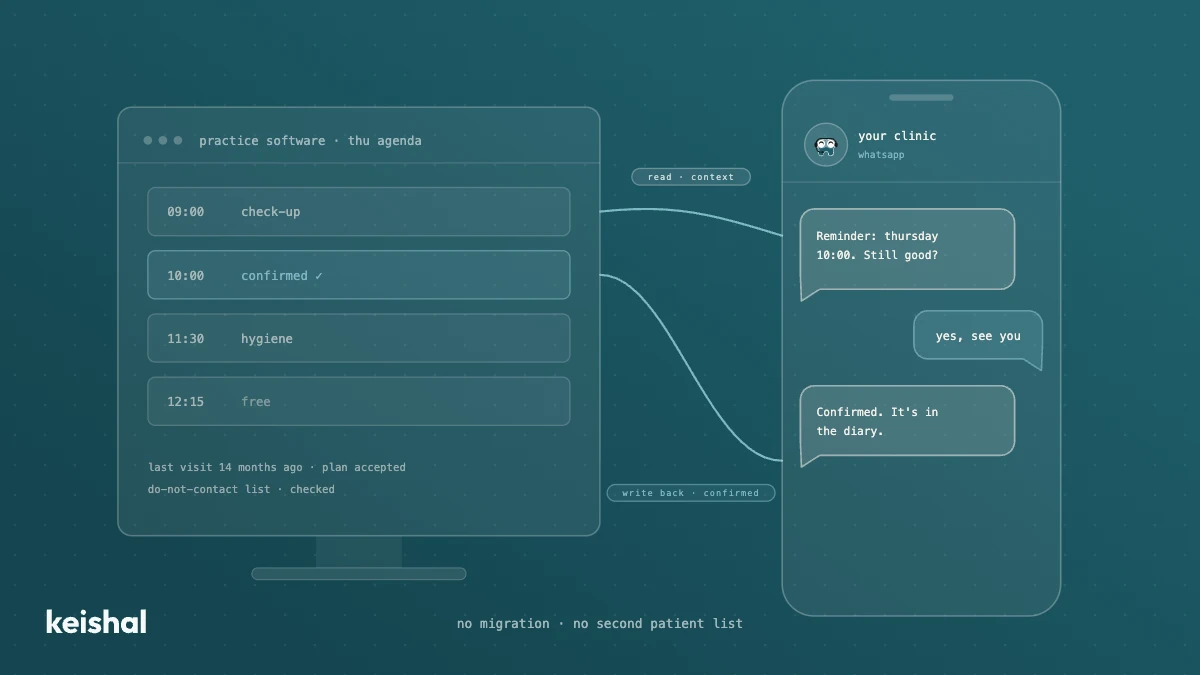
Integrating AI with your dental practice software: what a real connection means
A real integration with your dental clinic's software does two jobs: it reads your patients' data for context and writes appointments, confirmations and status changes back into your program. A monthly CSV, a calendar connector or a read-only tool leaves the rest to your team: with 330 reminders a month, marking each confirmation at 30 seconds adds up to almost 3 hours. Ask for the list of supported programs and versions in writing, and check that there's no migration and no duplicate patient base.
Switching dental software: what migrating really involves and when you don't need to
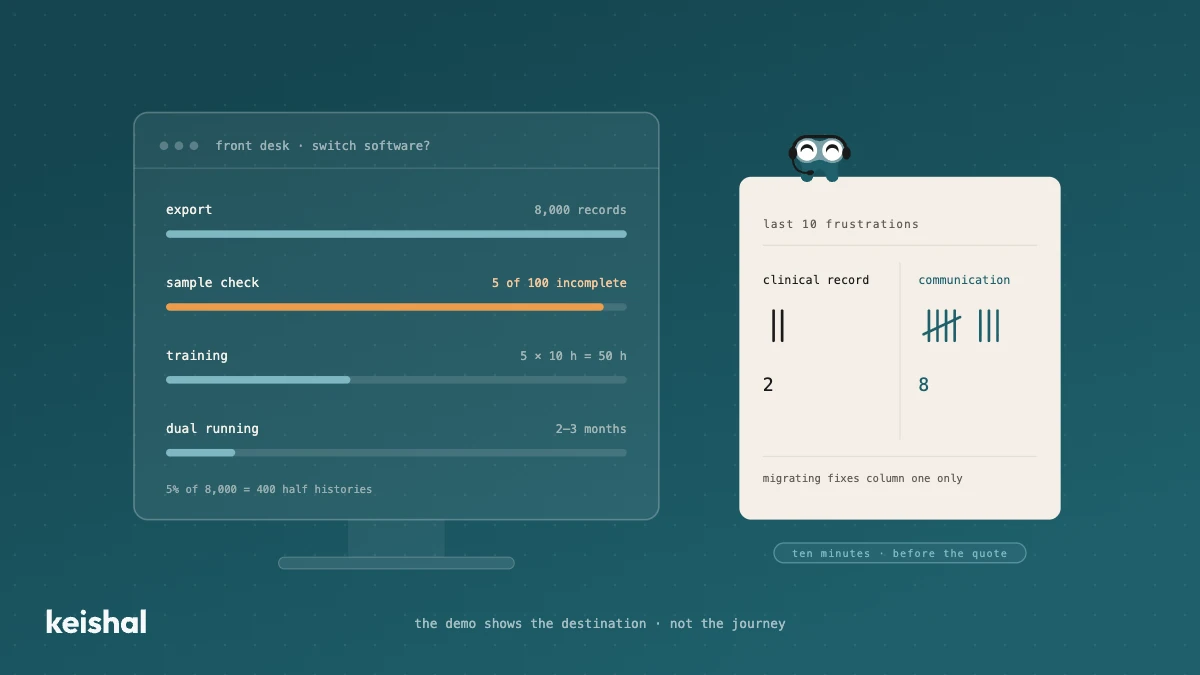
Switching dental software isn't installing a program: it's exporting and verifying thousands of records, training the team (5 people × 10 hours = 50 hours) and running two systems side by side for two or three months. It's worth it when the software has no support, holds your data hostage or the clinic has outgrown it. But if what's pushing you is unmanaged reminders, recall that never happens and out-of-hours messages, that communication layer can be added on top of your current PMS, without migrating anything.